Topics
Reproduction in Organisms
Reproduction
Sexual Reproduction in Flowering Plants
- Flower
- Pre-fertilisation in Flowering Plant: Structures and Events
- Structure and Development of Anther
- Microsporogenesis
- Structure and Development of Male Gametophyte
- Pollen Viability and Storage
- Structure and Development of Ovule
- Megasporogenesis
- Development of Female Gametophyte or Embryo Sac
- Pollination
- Autogamy
- Geitonogamy
- Cross-pollination
- Agents of Pollination
- Anemophily
- Hydrophily
- Animal-Mediated Pollination (Zoophily)
- Outbreeding Devices
- Pollen Pistil Interaction
- Artificial Hybridization or Artificial Fertilization
- Double Fertilization and Triple Fusion
- Events in Sexual Reproduction > Post-Fertilization Structures and Events
- Endosperm
- Dicotyledonous Embryo
- Monocotyledonous Embryo
- The Seed
- Apomixis
- Polyembryony
Human Reproduction
- Human Reproduction
- The Male Reproductive System
- The Female Reproductive System
- Gametogenesis
- Spermatogenesis
- Structure of Sperm
- Spermiogenesis
- Oogenesis
- Menstrual Cycle (Ovarian Cycle)
- Major Events of Menstrual Cycle
- Menstrual Hygiene
- Fertilization in Human
- Implantation in Human
- Pregnancy and Embryonic Development
- Parturition (Birth) in Human
- Lactation in Human
Genetics and Evolution
Biology and Human Welfare
Reproductive Health
- Concept of Reproductive Health
- Population Explosion and Control Measures
- Birth Control
- Natural Contraceptive Methods
- Artificial Contraceptive Methods
- Induced Abortion or Medical Termination of Pregnancy (MTP)
- Sexually Transmitted Diseases (STD) or Sexually Transmitted Infections (STI)
- Infertility
- Assisted Reproductive Technology (ART)
- Amniocentesis
- Genetic Counselling
Environmental Issues
- Controlling Vehicular Air Pollution: a Case Study of Delhi
- Effects of Domestic Sewage and Industrial Effluents on Water
- Solid Wastes
- Radioactive Wastes
- Greenhouse Effect and Climate Change
- Ozone Depletion in the Stratosphere
- Degradation by Improper Resource Utilisation and Maintenance
- Radioactive Waste Management and E-waste
Principles of Inheritance and Variation
- Heredity and Variation
- Gregor Johann Mendel – Father of Genetics
- Mendel's Experiments on Inheritance
- Monohybrid Cross
- Punnett Square
- Back Cross and Test Cross
- Mendel's Laws > The Law of Dominance
- Mendel's Laws > The Law of Segregation (Law of Purity of Gametes)
- Exceptions to Mendel's Principles > Incomplete Dominance
- Exceptions to Mendel's Principles > Co-Dominance
- Dihybrid Cross
- Mendel's Laws > The Law of Independent Assortment
- Chromosomal Theory of Inheritance
- Linkage and Recombination
- Polygenic Inheritance
- Exceptions to Mendel's Principles > Pleiotropy
- Sex Determination
- Sex Determination in Humans
- Sex Determination in Honey Bees
- Mutations
- Pedigree Analysis
- Mendelian Disorders in Humans
- Chromosomal Disorders or Abnormalities
Biotechnology
Molecular Basis of Inheritance
- Deoxyribonucleic Acid (DNA)
- Structure of Polynucleotide Chain
- Packaging of DNA Helix
- Search for Genetic Material
- Griffith’s Experiment
- Avery, McCarty and MacLeod’s Experiment
- The Hershey-Chase Experiment
- Properties of Genetic Material
- The RNA World
- DNA Replication
- Conservative Replication
- Dispersive Replication
- Semi-Conservative Replication
- Meselson and Stahl’s Experiment
- Enzymes used in DNA Replication
- Mechanism of DNA Replication
- Protein Synthesis
- Reverse Transcription (Teminism)
- Transcription
- Transcription Unit and the Gene
- Process of Transcription in Bacteria
- Process of Transcription in Eukaryotes
- Genetic Code
- Characteristics of the Genetic Code
- Mutations and Genetic Code
- Transfer RNA (tRNA)
- Translation
- Regulation of Gene Expression
- The Lac Operon
- Human Genome Project
- DNA Fingerprinting
Ecology
Evolution
- Origin of Life on Earth
- Urey and Miller’s Experiment
- Evolution of Life Forms - a Theory
- Evidences Supporting the Theory of Evolution
- Adaptive Radiation
- Theories and Mechanism of Evolution
- Theories and Mechanism of Evolution
- Hardy Weinberg’s Principle
- Types of Selection
- Brief Account of Evolution
- Human Evolution
Human Health and Diseases
- Concept and Determinants of Health
- Modes of Transmission of Diseases through Pathogens
- Diseases Caused by Bacteria > Typhoid
- Diseases Caused by Bacteria > Pneumonia
- Diseases Caused by Viruses > Common Cold
- Diseases Caused by Protozoa > Malaria
- Diseases Caused by Protozoa > Amoebiasis (Amoeboic dysentery)
- Diseases Caused by Helminths > Ascariasis
- Diseases Caused by Helminths > Filariasis (Elephantiasis)
- Diseases Caused by Fungi > Ringworm
- Prevention and Control of Infectious Diseases
- Immunity
- Types of Immunity > Innate Immunity
- Types of Immunity > Acquired Immunity
- Vaccination and Immunization
- Allergies
- Autoimmunity
- The Immune System
- Acquired Immuno Deficiency Syndrome (AIDS)
- Cancer
- Causes of Cancer
- Symptoms and Diagnosis of Cancer
- Prevention/Treatment of Cancer
- Drugs and Alcohol Abuse
- Addiction and Dependence
- Effects of Drug and Alcohol Abuse
- Prevention and Control of Drugs and Alcohol Abuse
Strategies for Enhancement in Food Production
Microbes in Human Welfare
Biotechnology - Principles and Processes
Biotechnology and Its Application
Organisms and Populations
- Organisms and Their Environment
- Population and Population Attributes
- Population Growth
- Life History Variation
- Population Interactions
- Negative Interactions > Predation
- Negative Interactions > Competition
- Negative Interactions > Parasitism
- Positive Interactions > Commensalism
- Positive Interactions > Mutualism (Symbiosis)
Ecosystem
Biodiversity and Its Conservation
Maharashtra State Board: Class 12
CISCE: Class 12
Introduction
After fertilisation, the zygote undergoes repeated mitotic divisions to form a blastocyst, which then implants into the endometrium of the uterus - a process called implantation. Once implantation is complete, pregnancy begins. The period from fertilisation to delivery in humans lasts approximately nine (9) months, also called the gestation period.
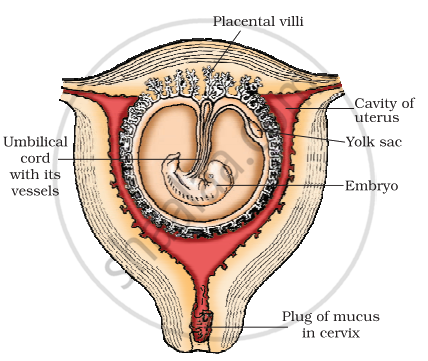
The human foetus within the uterus
Maharashtra State Board: Class 12
CISCE: Class 12
Definition: Gastrulation
Gastrulation is the early developmental process in which the embryo changes from a single-layered blastula into a three-layered structure called the gastrula.
Maharashtra State Board: Class 12
CISCE: Class 12
Definition: Placenta
Placenta is a temporary organ formed during pregnancy that connects the foetus to the uterine wall and allows exchange of nutrients, gases and wastes between the mother and the foetus.
Maharashtra State Board: Class 12
CISCE: Class 12
Formation of Chorionic Villi
After implantation of the blastocyst into the uterine wall, the outer layer of the embryo (trophoblast) develops finger-like projections called chorionic villi.
- These villi penetrate and become surrounded by uterine tissue and maternal blood.
- The chorionic villi and uterine tissue become interdigitated (interlocked) with each other.
- Together, they form a structural and functional unit called the placenta.
Maharashtra State Board: Class 12
CISCE: Class 12
The Placenta
The placenta is a disc-shaped structure connecting the developing embryo (fetus) to the mother's uterine wall.
Connection to Fetus: The placenta is connected to the embryo through the umbilical cord, which contains blood vessels that transport substances between the mother and the embryo.
Functions of the Placenta:
| Function | Description |
|---|---|
| Oxygen supply | Delivers O₂ from maternal blood to the fetus |
| Nutrient supply | Transfers glucose, amino acids, vitamins to fetus |
| CO₂ removal | Removes carbon dioxide produced by fetus |
| Waste removal | Removes excretory/metabolic waste from fetus |
| Endocrine function | Secretes hormones essential for pregnancy |
| Immune transfer | Passes maternal antibodies to the fetus |
Maharashtra State Board: Class 12
CISCE: Class 12
Hormones of Pregnancy
The placenta acts as a temporary endocrine gland and secretes several hormones critical for maintaining pregnancy.
Placental Hormones
| Hormone | Function | Unique to Pregnancy? |
|---|---|---|
| Human Chorionic Gonadotropin (hCG) | Maintains corpus luteum; detected in pregnancy tests | Yes |
| Human Placental Lactogen (hPL) | Promotes fetal growth; prepares mammary glands | Yes |
| Estrogens | Support fetal growth and uterine development | Levels increase significantly |
| Progestogens | Maintain uterine lining; prevent premature contractions | Levels increase significantly |
| Relaxin | Secreted by ovary in later phase; relaxes pelvic ligaments for delivery | Yes |
Other Hormones Elevated During Pregnancy:
In addition to placental hormones, levels of the following hormones also increase several-fold in maternal blood: - Cortisol - regulates metabolism and immune response - Prolactin - prepares mammary glands for lactation - Thyroxine - supports increased metabolic demand
Purpose of Elevated Hormones:
Increased production of these hormones is essential for:
- Supporting fetal growth and development
- Causing metabolic changes in the mother's body
- Maintaining pregnancy throughout its duration
Maharashtra State Board: Class 12
CISCE: Class 12
Germ Layer Formation (Embryonic Differentiation)
Immediately after implantation, the inner cell mass (embryo proper) begins to differentiate into distinct tissue layers.
The Three Primary Germ Layers:
Inner Cell Mass (Embryo)
(Differentiates into)
↓
Ectoderm - Outer germ layer
Endoderm - Inner germ layer
(Later, a third layer develops between them)
↓
Mesoderm - Middle germ layer
These three germ layers give rise to all tissues and organs in the adult human body.
Organs Derived from Each Germ Layer:
| Germ Layer | Position | Organs / Tissues Formed |
|---|---|---|
| Ectoderm | Outermost | Brain, spinal cord, peripheral nerves, skin (epidermis), hair, nails, eye lens, cornea |
| Mesoderm | Middle | Heart, blood vessels, muscles, bones, kidneys, gonads (testes/ovaries), connective tissue, lymph |
| Endoderm | Innermost | Liver, pancreas, stomach, intestines, lungs, urinary bladder, thyroid gland |
Maharashtra State Board: Class 12
CISCE: Class 12
Stem Cells
The inner cell mass contains a special population of cells called stem cells.
- Stem cells have the ability (potency) to differentiate into any tissue or organ of the body.
- They are described as pluripotent - able to give rise to all cell types.
- Stem cells are of great medical importance in regenerative medicine.
Maharashtra State Board: Class 12
CISCE: Class 12
Changes in the Embryo During Pregnancy
Duration of Human Pregnancy:
The human gestation period (duration of pregnancy) is 9 months, divided into three trimesters.
| Trimester | Duration | Primary Events |
|---|---|---|
| First Trimester | Months 1–3 (Weeks 1–12) | Organogenesis - formation of all major organs |
| Second Trimester | Months 4–6 (Weeks 13–24) | Growth, movement, sensory development |
| Third Trimester | Months 7–9 (Weeks 25–birth) | Rapid growth, weight gain, birth preparation |
Month-by-Month Developmental Milestones:
First Trimester
- End of Month 1: The embryo's heart is formed - the first major organ to develop. - The heartbeat can be detected using a stethoscope.
- End of Month 2: The fetus develops limbs and digits (fingers and toes). - At this stage, the embryo is officially referred to as a fetus.
- End of 12 Weeks (End of First Trimester): Most major organ systems are formed. - The limbs are well-developed. - The external genital organs are distinguishable and well-developed.
Second Trimester
- During Month 5 (Around Week 20): The first movements of the fetus are felt by the mother (called quickening). - Hair appears on the head of the fetus.
- End of 24 Weeks (End of Second Trimester): The body is covered with fine hair (lanugo). - Eyelids separate (they were fused earlier in development). - Eyelashes are formed.
Third Trimester
- End of 9 Months (Completion of Pregnancy): The fetus is fully developed with all organs mature and functional. - The fetus is ready for delivery.
Maharashtra State Board: Class 12
CISCE: Class 12
Key Points: Pregnancy and Embryonic Development
- Placenta is formed after implantation and helps in exchange of nutrients, oxygen and wastes between mother and foetus.
- Three germ layers (ectoderm, mesoderm and endoderm) are formed, which develop into all body organs.
- Hormones like hCG, progesterone and estrogen increase to support pregnancy and foetal growth.
- Foetal development occurs gradually, and by nine months the foetus is fully developed and ready for birth.
Test Yourself
Shaalaa.com | Human Reproduction Part 6
Related QuestionsVIEW ALL [25]
Match the columns I and II with reference to weeks of pregnancy and the development of a human embryo. Select the correct option from the choices given below:
| Column I | Column II | ||
| I. | 8 weeks | (P) | Limbs and external genital organs |
| II. | 12 weeks | (Q) | Limbs and digits develop. |
| III. | 20 weeks | (R) | Body hair develops. |
| IV. | 24 weeks | (S) | Eyelids separate. |
