Topics
Sexual Reproduction in Flowering Plants
- Flower
- Pre-fertilisation in Flowering Plant: Structures and Events
- Structure and Development of Anther
- Microsporogenesis
- Structure and Development of Male Gametophyte
- Pollen Viability and Storage
- Structure and Development of Ovule
- Megasporogenesis
- Development of Female Gametophyte or Embryo Sac
- Pollination
- Autogamy
- Geitonogamy
- Cross-pollination
- Agents of Pollination
- Anemophily
- Hydrophily
- Animal-Mediated Pollination (Zoophily)
- Outbreeding Devices
- Pollen Pistil Interaction
- Artificial Hybridization or Artificial Fertilization
- Double Fertilization and Triple Fusion
- Events in Sexual Reproduction > Post-Fertilization Structures and Events
- Endosperm
- Embryo
- The Seed
- Apomixis
- Polyembryony
Reproduction
Reproduction in Organisms
Human Reproduction
- Human Reproduction
- The Male Reproductive System
- The Female Reproductive System
- Gametogenesis
- Spermatogenesis
- Structure of Sperm
- Spermiogenesis
- Oogenesis
- Menstrual Cycle (Ovarian Cycle)
- Major Events of Menstrual Cycle
- Menstrual Hygiene
- Fertilisation in Human
- Implantation in Human
- Pregnancy and Embryonic Development
- Parturition (Birth) in Human
- Lactation in Human
Genetics and Evolution
Reproductive Health
- Concept of Reproductive Health
- Population Explosion and Control Measures
- Birth Control
- Natural Contraceptive Methods
- Artificial Contraceptive Methods
- Induced Abortion or Medical Termination of Pregnancy (MTP)
- Sexually Transmitted Diseases (STD) or Sexually Transmitted Infections (STI)
- Infertility
- Assisted Reproductive Technology (ART)
- Amniocentesis
- Genetic Counselling
Biology and Human Welfare
Principles of Inheritance and Variation
- Heredity and Variation
- Gregor Johann Mendel – Father of Genetics
- Mendel's Experiments on Inheritance
- Monohybrid Cross
- Punnett Square
- Back Cross and Test Cross
- Mendel's Laws > The Law of Dominance
- Mendel's Laws > The Law of Segregation (Law of Purity of Gametes)
- Exceptions to Mendel's Principles > Incomplete Dominance
- Exceptions to Mendel's Principles > Co-Dominance
- Dihybrid Cross
- Mendel's Laws > The Law of Independent Assortment
- Chromosomal Theory of Inheritance
- Linkage and Recombination
- Polygenic Inheritance
- Exceptions to Mendel's Principles > Pleiotropy
- Sex Determination
- Sex Determination in Humans
- Sex Determination in Honey Bees
- Mutations
- Pedigree Analysis
- Mendelian Disorders in Humans
- Chromosomal Disorders or Abnormalities
Environmental Issues
- Controlling Vehicular Air Pollution: a Case Study of Delhi
- Effects of Domestic Sewage and Industrial Effluents on Water
- Solid Wastes
- Radioactive Wastes
- Greenhouse Effect and Climate Change
- Ozone Depletion in the Stratosphere
- Degradation by Improper Resource Utilisation and Maintenance
- Radioactive Waste Management and E-waste
Biotechnology
Ecology
Molecular Basis of Inheritance
- Deoxyribonucleic Acid (DNA)
- Structure of Polynucleotide Chain
- Packaging of DNA Helix
- Search for Genetic Material
- Griffith’s Experiment
- Avery, McCarty and MacLeod’s Experiment
- The Hershey-Chase Experiment
- Properties of Genetic Material
- The RNA World
- DNA Replication
- Conservative Replication
- Dispersive Replication
- Semi-Conservative Replication
- Meselson and Stahl’s Experiment
- Enzymes used in DNA Replication
- Mechanism of DNA Replication
- Protein Synthesis
- Reverse Transcription (Teminism)
- Transcription
- Transcription Unit and the Gene
- Process of Transcription in Bacteria
- Process of Transcription in Eukaryotes
- Genetic Code
- Characteristics of the Genetic Code
- Mutations and Genetic Code
- tRNA – the Adapter Molecule
- Translation
- Regulation of Gene Expression
- The Lac Operon
- Human Genome Project
- DNA Fingerprinting
Evolution
Human Health and Diseases
- Concept and Determinants of Health
- Modes of Transmission of Diseases through Pathogens
- Diseases Caused by Bacteria > Typhoid
- Diseases Caused by Bacteria > Pneumonia
- Diseases Caused by Viruses > Common Cold
- Diseases Caused by Protozoa > Malaria
- Diseases Caused by Protozoa > Amoebiasis (Amoeboic dysentery)
- Diseases Caused by Helminths > Ascariasis
- Diseases Caused by Helminths > Filariasis (Elephantiasis)
- Diseases Caused by Fungi > Ringworm
- Prevention and Control of Infectious Diseases
- Immunity
- Types of Immunity > Innate Immunity
- Types of Immunity > Acquired Immunity
- Vaccination and Immunization
- Allergies
- Autoimmunity
- The Immune System
- Acquired Immuno Deficiency Syndrome (AIDS)
- Cancer
- Causes of Cancer
- Symptoms and Diagnosis of Cancer
- Prevention/Treatment of Cancer
- Drugs and Alcohol Abuse
- Addiction and Dependence
- Effects of Drug and Alcohol Abuse
- Prevention and Control of Drugs and Alcohol Abuse
Strategies for Enhancement in Food Production
Microbes in Human Welfare
Biotechnology - Principles and Processes
Biotechnology and Its Application
Organisms and Populations
- Organisms and Their Environment
- Ecology
- Population Attributes
- Population Growth
- Life History Variation
- Population Interactions
- Negative Interactions > Predation
- Negative Interactions > Competition
- Negative Interactions > Parasitism
- Positive Interactions > Commensalism
- Positive Interactions > Mutualism (Symbiosis)
- Overview of Organisms and Populations
Ecosystem
Biodiversity and Its Conservation
Estimated time: 13 minutes
CBSE: Class 12
Introduction
- Recombinant DNA technology has improved healthcare by enabling the mass production of safe and effective therapeutic drugs.
- Recombinant therapeutics usually do not cause unwanted immune responses like some products obtained from non-human sources.
- Around 30 recombinant therapeutics have been approved worldwide, and 12 are being marketed in India.
CBSE: Class 12
Genetically Engineered Insulin
- Earlier, insulin was obtained from the pancreas of cattle and pigs.
- Animal insulin could cause allergy or immune reactions in some patients.
- Human insulin consists of two polypeptide chains: A chain and B chain, joined by disulfide bonds.
- Insulin is first produced as pro-insulin, which contains an extra C-peptide.
- C-peptide is removed during maturation, forming active insulin.
- In 1983, Eli Lilly produced human insulin using recombinant DNA technology.
- DNA sequences for A and B chains were inserted separately into E. coli, and the chains were later combined to form insulin.
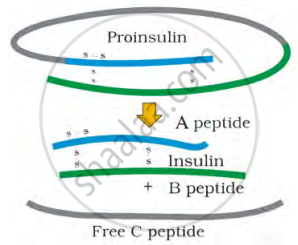
Maturation of pro-insulin into insulin
CBSE: Class 12
Gene Therapy
- Gene therapy is a method used to correct a defective gene by introducing a functional copy of the gene into cells or tissues.
- The first clinical gene therapy was given in 1990 to a 4-year-old girl with ADA deficiency.
- ADA deficiency results from the deletion of the adenosine deaminase gene, which is important for immune function.
- In one method, lymphocytes are taken from the patient, a functional ADA cDNA is introduced, and the corrected cells are returned to the body.
- This is not always permanent because lymphocytes are not immortal, so repeated infusion may be needed.
- A more permanent cure may be possible if the functional gene is introduced at an early embryonic stage.
CBSE: Class 12
Molecular Diagnosis
- Early diagnosis is important for proper treatment, but conventional methods often cannot detect disease at an early stage.
- PCR, ELISA, and recombinant DNA technology help in early diagnosis.
- PCR amplifies very small amounts of nucleic acid, so it can detect pathogens before symptoms appear.
- PCR is used to detect HIV in suspected AIDS patients and mutations in genes of suspected cancer patients.
- A labelled DNA or RNA probe can identify complementary nucleic acid sequences.
- ELISA is based on antigen-antibody interaction.
- Infection can be detected either by the presence of antigens or by antibodies produced against the pathogen.
CBSE: Class 12
Key Points: Biotechnological Application in Medicine
- Recombinant DNA technology mass-produces safe, human-identical therapeutics, preventing the allergic reactions caused by animal extracts.
- Genetically engineered human insulin is produced by separately synthesising the A and B chains in E. coli and then joining them.
- Gene therapy treats genetic disorders, like ADA deficiency, by inserting functional genes into a patient's extracted lymphocytes.
- Because lymphocytes have a limited lifespan, gene therapy requires periodic treatments unless performed at the embryonic stage.
- Molecular diagnostics, such as PCR and ELISA, enable highly sensitive, early detection of disease before physical symptoms even appear.
