The study of the inheritance of a particular trait in humans by collecting information from family history and representing it through a family tree using standard symbols is called pedigree analysis.
Topics
Reproduction in Organisms
Sexual Reproduction in Flowering Plants
- Flower
- Pre-fertilisation in Flowering Plant: Structures and Events
- Structure and Development of Anther
- Microsporogenesis
- Structure and Development of Male Gametophyte
- Pollen Viability and Storage
- Structure and Development of Ovule
- Megasporogenesis
- Development of Female Gametophyte or Embryo Sac
- Pollination
- Autogamy
- Geitonogamy
- Cross-pollination
- Agents of Pollination
- Anemophily
- Hydrophily
- Animal-Mediated Pollination (Zoophily)
- Outbreeding Devices
- Pollen Pistil Interaction
- Artificial Hybridization or Artificial Fertilization
- Double Fertilization and Triple Fusion
- Events in Sexual Reproduction > Post-Fertilization Structures and Events
- Endosperm
- Dicotyledonous Embryo
- Monocotyledonous Embryo
- The Seed
- Apomixis
- Polyembryony
Reproduction
Genetics and Evolution
Human Reproduction
- Human Reproduction
- The Male Reproductive System
- The Female Reproductive System
- Gametogenesis
- Spermatogenesis
- Structure of Sperm
- Spermiogenesis
- Oogenesis
- Menstrual Cycle (Ovarian Cycle)
- Major Events of Menstrual Cycle
- Menstrual Hygiene
- Fertilization in Humans
- Implantation in Human
- Pregnancy and Embryonic Development
- Parturition (Birth) in Human
- Lactation in Human
Reproductive Health
- Concept of Reproductive Health
- Population Explosion and Control Measures
- Birth Control
- Natural Contraceptive Methods
- Artificial Contraceptive Methods
- Induced Abortion or Medical Termination of Pregnancy (MTP)
- Sexually Transmitted Diseases (STD) or Sexually Transmitted Infections (STI)
- Infertility
- Assisted Reproductive Technology (ART)
- Amniocentesis
- Genetic Counselling
Biology and Human Welfare
Biotechnology
Environmental Issues
- Controlling Vehicular Air Pollution: a Case Study of Delhi
- Effects of Domestic Sewage and Industrial Effluents on Water
- Solid Wastes
- Radioactive Wastes
- Greenhouse Effect and Climate Change
- Ozone Depletion in the Stratosphere
- Degradation by Improper Resource Utilisation and Maintenance
- Radioactive Waste Management and E-waste
Principles of Inheritance and Variation
- Heredity and Variation
- Gregor Johann Mendel – Father of Genetics
- Mendel's Experiments on Inheritance
- Monohybrid Cross
- Punnett Square
- Back Cross and Test Cross
- Mendel's Laws > The Law of Dominance
- Mendel's Laws > The Law of Segregation (Law of Purity of Gametes)
- Exceptions to Mendel's Principles > Incomplete Dominance
- Exceptions to Mendel's Principles > Co-Dominance
- Dihybrid Cross
- Mendel's Laws > The Law of Independent Assortment
- Chromosomal Theory of Inheritance
- Linkage and Recombination
- Polygenic Inheritance
- Exceptions to Mendel's Principles > Pleiotropy
- Sex Determination
- Sex Determination in Humans
- Sex Determination in Honey Bees
- Mutations
- Pedigree Analysis
- Mendelian Disorders in Humans
- Chromosomal Disorders or Abnormalities
Molecular Basis of Inheritance
- Deoxyribonucleic Acid (DNA)
- Structure of Polynucleotide Chain
- Packaging of DNA Helix
- Search for Genetic Material
- Griffith’s Experiment
- Avery, McCarty and MacLeod’s Experiment
- The Hershey-Chase Experiment
- Properties of Genetic Material
- The RNA World
- DNA Replication
- Conservative Replication
- Dispersive Replication
- Semi-Conservative Replication
- Meselson and Stahl’s Experiment
- Enzymes used in DNA Replication
- Mechanism of DNA Replication
- Protein Synthesis
- Reverse Transcription (Teminism)
- Transcription
- Transcription Unit and the Gene
- Process of Transcription in Bacteria
- Process of Transcription in Eukaryotes
- Genetic Code
- Characteristics of the Genetic Code
- Mutations and Genetic Code
- Transfer RNA (tRNA)
- Translation
- Regulation of Gene Expression
- The Lac Operon
- Human Genome Project
- DNA Fingerprinting
Ecology
Evolution
- Origin of Life on Earth
- Urey and Miller’s Experiment
- Evolution of Life Forms - a Theory
- Evidences Supporting the Theory of Evolution
- Adaptive Radiation
- Theories and Mechanism of Evolution
- Theories and Mechanism of Evolution
- Hardy Weinberg’s Principle
- Types of Selection
- Brief Account of Evolution
- Human Evolution
Human Health and Diseases
- Concept and Determinants of Health
- Modes of Transmission of Diseases through Pathogens
- Diseases Caused by Bacteria > Typhoid
- Diseases Caused by Bacteria > Pneumonia
- Diseases Caused by Viruses > Common Cold
- Diseases Caused by Protozoa > Malaria
- Diseases Caused by Protozoa > Amoebiasis (Amoeboic dysentery)
- Diseases Caused by Helminths > Ascariasis
- Diseases Caused by Helminths > Filariasis (Elephantiasis)
- Diseases Caused by Fungi > Ringworm
- Prevention and Control of Infectious Diseases
- Immunity
- Types of Immunity > Innate Immunity
- Types of Immunity > Acquired Immunity
- Vaccination and Immunization
- Allergies
- Autoimmunity
- The Immune System
- Acquired Immuno Deficiency Syndrome (AIDS)
- Cancer
- Causes of Cancer
- Symptoms and Diagnosis of Cancer
- Prevention/Treatment of Cancer
- Drugs and Alcohol Abuse
- Addiction and Dependence
- Effects of Drug and Alcohol Abuse
- Prevention and Control of Drugs and Alcohol Abuse
Microbes in Human Welfare
Strategies for Enhancement in Food Production
Biotechnology - Principles and Processes
Biotechnology and Its Application
Organisms and Populations
- Organisms and Their Environment
- Population and Population Attributes
- Population Growth
- Life History Variation
- Population Interactions
- Negative Interactions > Predation
- Negative Interactions > Competition
- Negative Interactions > Parasitism
- Positive Interactions > Commensalism
- Positive Interactions > Mutualism (Symbiosis)
Ecosystem
Biodiversity and Its Conservation
Estimated time: 13 minutes
CBSE: Class 12
CISCE: Class 12
CISCE: Class 12
Definition: Pedigree analysis
CBSE: Class 12
CISCE: Class 12
CISCE: Class 12
Introduction
Pedigree Analysis is the study of the inheritance of a specific trait, abnormality, or disease in a family by constructing and analysing a multi-generational family tree (called a pedigree chart) using a standardised set of symbols to determine the mode of inheritance.
- The constructed family tree is called a Pedigree Chart (or simply a Pedigree).
- The individual from whom the pedigree study begins is called the Propositus (male) or Proposita (female), also known as the Proband.
- Pedigree analysis helps determine whether a trait is dominant or recessive, and whether it is autosomal or sex-linked
Why Pedigree Analysis?
| Reason | Explanation |
|---|---|
| No controlled crosses possible | Ethical and social barriers prevent planned human matings |
| Long generation time | Humans take ~20–25 years per generation; controlled studies are impractical |
| Small family size | Limited offspring make statistical analysis difficult |
| Medical application | Helps predict the risk of genetic disorders in future generations |
CBSE: Class 12
CISCE: Class 12
CISCE: Class 12
Standard Pedigree Symbols
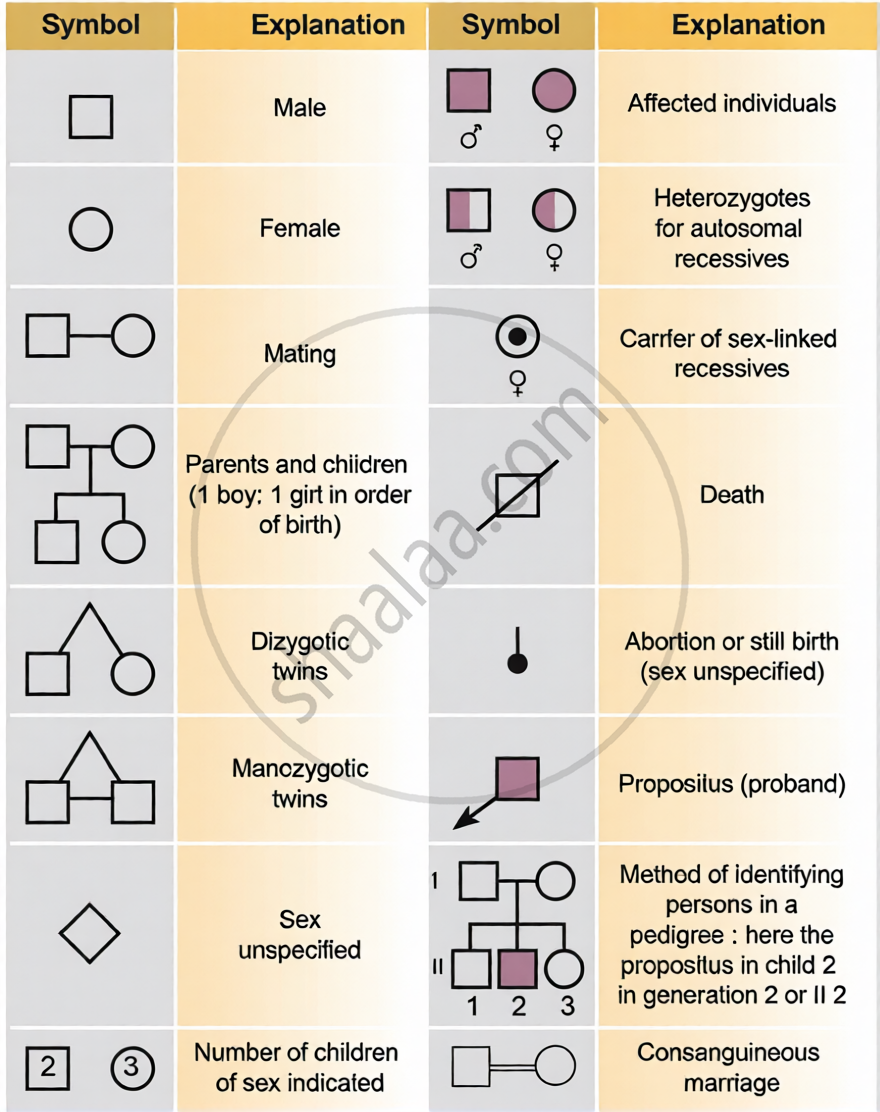
CBSE: Class 12
CISCE: Class 12
CISCE: Class 12
Pedigree Analysis & Construction
1. Drawing a Pedigree Chart
- Step 1 (Data Collection): Identify affected, unaffected, and carrier individuals across generations.
- Step 2 (Layout): Assign each generation a row, labelled with Roman numerals (I, II, III...) from top to bottom.
- Step 3 (Symbols & Connections): Use standard shapes (Squares = Males; Circles = Females). Connect mating pairs with a horizontal line and offspring with a vertical line below.
- Step 4 (Shading): Fully shade affected individuals. Use half-shading for known carriers.
- Step 5 (Analysis): Evaluate the layout to deduce the mode of inheritance.
2. The 3-Step Shortcut Strategy: How to Analyse a Pedigree?
Step 1: The Dominance Test (Generation Skipping)
- Recessive: Two unaffected parents have an affected child, or the trait skips generations.
- Dominant: Every affected child has at least one affected parent; the trait appears in every generation without skipping.
Step 2: The Gender Bias Test (Autosomal vs. Sex-Linked)
- Autosomal: Males and females are affected in roughly equal proportions.
- X-Linked Recessive: Males are predominantly affected. An affected mother will pass the trait to all of her sons.
- X-Linked Dominant: An affected father passes the trait to all of his daughters.
- Y-Linked: Trait passes exclusively from father to all sons.
Step 3: The Genotype Cross-Check
- Assign tentative genotypes (e.g., AA, Aa, aa) to all individuals based on your hypothesis.
- If the genotypes are internally consistent throughout the entire chart, your hypothesis is correct. If a contradiction arises, eliminate that option and test the next one.
CBSE: Class 12
CISCE: Class 12
CISCE: Class 12
Key Points: Pedigree Analysis
- Pedigree Analysis is the study of inheritance patterns of traits across several generations of a family; the chart representing this is called a family tree (pedigree).
- Since controlled crosses (like in pea plants) cannot be done in humans, family history analysis is used as an alternative to study inheritance.
- Pedigree analysis is a powerful tool in human genetics used to trace the inheritance of a specific trait, abnormality or disease.
- Standard symbols used - Square = normal male, Circle = normal female, Diamond = sex unspecified; filled/shaded shapes = affected individuals.
- A horizontal line between two symbols = mating; a double horizontal line = consanguineous mating (mating between relatives); children are shown below parents in order of birth from left to right.
Test Yourself
Shaalaa.com | Genetic disorders, pedigree analysis
to track your progress

