The study of the inheritance of a particular trait in humans by collecting information from family history and representing it through a family tree using standard symbols is called pedigree analysis.
Topics
Reproduction in Organisms
Sexual Reproduction in Flowering Plants
- Flower
- Pre-fertilisation in Flowering Plant: Structures and Events
- Structure and Development of Anther
- Microsporogenesis
- Structure and Development of Male Gametophyte
- Pollen Viability and Storage
- Structure and Development of Ovule
- Megasporogenesis
- Development of Female Gametophyte or Embryo Sac
- Pollination
- Autogamy
- Geitonogamy
- Cross-pollination
- Agents of Pollination
- Anemophily
- Hydrophily
- Animal-Mediated Pollination (Zoophily)
- Outbreeding Devices
- Pollen Pistil Interaction
- Artificial Hybridization or Artificial Fertilization
- Double Fertilization and Triple Fusion
- Events in Sexual Reproduction > Post-Fertilization Structures and Events
- Endosperm
- Dicotyledonous Embryo
- Monocotyledonous Embryo
- The Seed
- Apomixis
- Polyembryony
Reproduction
Genetics and Evolution
Human Reproduction
- Human Reproduction
- The Male Reproductive System
- The Female Reproductive System
- Gametogenesis
- Spermatogenesis
- Structure of Sperm
- Spermiogenesis
- Oogenesis
- Menstrual Cycle (Ovarian Cycle)
- Major Events of Menstrual Cycle
- Menstrual Hygiene
- Fertilization in Humans
- Implantation in Human
- Pregnancy and Embryonic Development
- Parturition (Birth) in Human
- Lactation in Human
Reproductive Health
- Concept of Reproductive Health
- Population Explosion and Control Measures
- Birth Control
- Natural Contraceptive Methods
- Artificial Contraceptive Methods
- Induced Abortion or Medical Termination of Pregnancy (MTP)
- Sexually Transmitted Diseases (STD) or Sexually Transmitted Infections (STI)
- Infertility
- Assisted Reproductive Technology (ART)
- Amniocentesis
- Genetic Counselling
Biology and Human Welfare
Biotechnology
Environmental Issues
- Controlling Vehicular Air Pollution: a Case Study of Delhi
- Effects of Domestic Sewage and Industrial Effluents on Water
- Solid Wastes
- Radioactive Wastes
- Greenhouse Effect and Climate Change
- Ozone Depletion in the Stratosphere
- Degradation by Improper Resource Utilisation and Maintenance
- Radioactive Waste Management and E-waste
Principles of Inheritance and Variation
- Heredity and Variation
- Gregor Johann Mendel – Father of Genetics
- Mendel's Experiments on Inheritance
- Monohybrid Cross
- Punnett Square
- Back Cross and Test Cross
- Mendel's Laws > The Law of Dominance
- Mendel's Laws > The Law of Segregation (Law of Purity of Gametes)
- Exceptions to Mendel's Principles > Incomplete Dominance
- Exceptions to Mendel's Principles > Co-Dominance
- Dihybrid Cross
- Mendel's Laws > The Law of Independent Assortment
- Chromosomal Theory of Inheritance
- Linkage and Recombination
- Polygenic Inheritance
- Exceptions to Mendel's Principles > Pleiotropy
- Sex Determination
- Sex Determination in Humans
- Sex Determination in Honey Bees
- Mutations
- Pedigree Analysis
- Mendelian Disorders in Humans
- Chromosomal Disorders or Abnormalities
Molecular Basis of Inheritance
- Deoxyribonucleic Acid (DNA)
- Structure of Polynucleotide Chain
- Packaging of DNA Helix
- Search for Genetic Material
- Griffith’s Experiment
- Avery, McCarty and MacLeod’s Experiment
- The Hershey-Chase Experiment
- Properties of Genetic Material
- The RNA World
- DNA Replication
- Conservative Replication
- Dispersive Replication
- Semi-Conservative Replication
- Meselson and Stahl’s Experiment
- Enzymes used in DNA Replication
- Mechanism of DNA Replication
- Protein Synthesis
- Reverse Transcription (Teminism)
- Transcription
- Transcription Unit and the Gene
- Process of Transcription in Bacteria
- Process of Transcription in Eukaryotes
- Genetic Code
- Characteristics of the Genetic Code
- Mutations and Genetic Code
- Transfer RNA (tRNA)
- Translation
- Regulation of Gene Expression
- The Lac Operon
- Human Genome Project
- DNA Fingerprinting
Ecology
Evolution
- Origin of Life on Earth
- Urey and Miller’s Experiment
- Evolution of Life Forms - a Theory
- Evidences Supporting the Theory of Evolution
- Adaptive Radiation
- Theories and Mechanism of Evolution
- Theories and Mechanism of Evolution
- Hardy Weinberg’s Principle
- Types of Selection
- Brief Account of Evolution
- Human Evolution
Human Health and Diseases
- Concept and Determinants of Health
- Modes of Transmission of Diseases through Pathogens
- Diseases Caused by Bacteria > Typhoid
- Diseases Caused by Bacteria > Pneumonia
- Diseases Caused by Viruses > Common Cold
- Diseases Caused by Protozoa > Malaria
- Diseases Caused by Protozoa > Amoebiasis (Amoeboic dysentery)
- Diseases Caused by Helminths > Ascariasis
- Diseases Caused by Helminths > Filariasis (Elephantiasis)
- Diseases Caused by Fungi > Ringworm
- Prevention and Control of Infectious Diseases
- Immunity
- Types of Immunity > Innate Immunity
- Types of Immunity > Acquired Immunity
- Vaccination and Immunization
- Allergies
- Autoimmunity
- The Immune System
- Acquired Immuno Deficiency Syndrome (AIDS)
- Cancer
- Causes of Cancer
- Symptoms and Diagnosis of Cancer
- Prevention/Treatment of Cancer
- Drugs and Alcohol Abuse
- Addiction and Dependence
- Effects of Drug and Alcohol Abuse
- Prevention and Control of Drugs and Alcohol Abuse
Microbes in Human Welfare
Strategies for Enhancement in Food Production
Biotechnology - Principles and Processes
Biotechnology and Its Application
Organisms and Populations
- Organisms and Their Environment
- Population and Population Attributes
- Population Growth
- Life History Variation
- Population Interactions
- Negative Interactions > Predation
- Negative Interactions > Competition
- Negative Interactions > Parasitism
- Positive Interactions > Commensalism
- Positive Interactions > Mutualism (Symbiosis)
Ecosystem
Biodiversity and Its Conservation
Estimated time: 13 minutes
CBSE: Class 12
CISCE: Class 12
CISCE: Class 12
Definition: Pedigree analysis
CBSE: Class 12
CISCE: Class 12
CISCE: Class 12
Introduction
Pedigree Analysis is the study of the inheritance of a specific trait, abnormality, or disease in a family by constructing and analysing a multi-generational family tree (called a pedigree chart) using a standardised set of symbols to determine the mode of inheritance.
- The constructed family tree is called a Pedigree Chart (or simply a Pedigree).
- The individual from whom the pedigree study begins is called the Propositus (male) or Proposita (female), also known as the Proband.
- Pedigree analysis helps determine whether a trait is dominant or recessive, and whether it is autosomal or sex-linked
Why Pedigree Analysis?
| Reason | Explanation |
|---|---|
| No controlled crosses possible | Ethical and social barriers prevent planned human matings |
| Long generation time | Humans take ~20–25 years per generation; controlled studies are impractical |
| Small family size | Limited offspring make statistical analysis difficult |
| Medical application | Helps predict the risk of genetic disorders in future generations |
CBSE: Class 12
CISCE: Class 12
CISCE: Class 12
Standard Pedigree Symbols
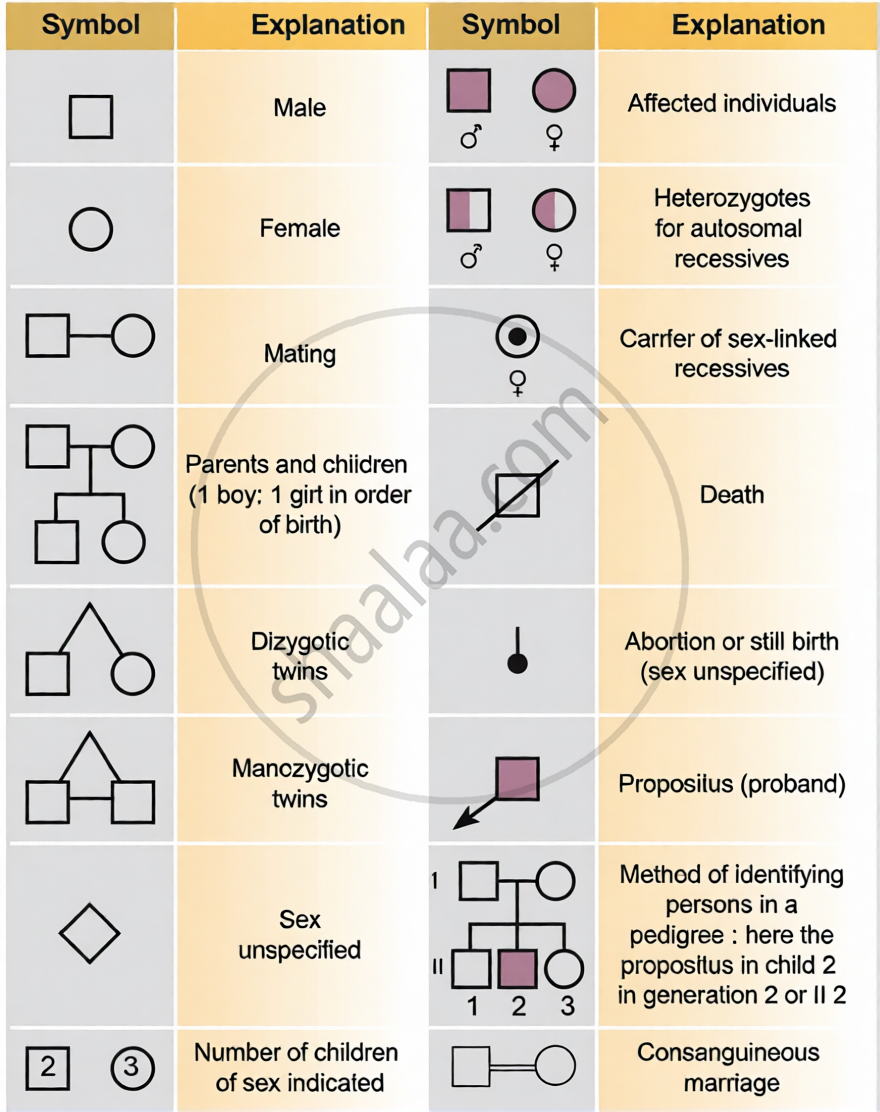
CBSE: Class 12
CISCE: Class 12
CISCE: Class 12
Pedigree Analysis & Construction
1. Drawing a Pedigree Chart
- Step 1 (Data Collection): Identify affected, unaffected, and carrier individuals across generations.
- Step 2 (Layout): Assign each generation a row, labelled with Roman numerals (I, II, III...) from top to bottom.
- Step 3 (Symbols & Connections): Use standard shapes (Squares = Males; Circles = Females). Connect mating pairs with a horizontal line and offspring with a vertical line below.
- Step 4 (Shading): Fully shade affected individuals. Use half-shading for known carriers.
- Step 5 (Analysis): Evaluate the layout to deduce the mode of inheritance.
2. The 3-Step Shortcut Strategy: How to Analyse a Pedigree?
Step 1: The Dominance Test (Generation Skipping)
- Recessive: Two unaffected parents have an affected child, or the trait skips generations.
- Dominant: Every affected child has at least one affected parent; the trait appears in every generation without skipping.
Step 2: The Gender Bias Test (Autosomal vs. Sex-Linked)
- Autosomal: Males and females are affected in roughly equal proportions.
- X-Linked Recessive: Males are predominantly affected. An affected mother will pass the trait to all of her sons.
- X-Linked Dominant: An affected father passes the trait to all of his daughters.
- Y-Linked: Trait passes exclusively from father to all sons.
Step 3: The Genotype Cross-Check
- Assign tentative genotypes (e.g., AA, Aa, aa) to all individuals based on your hypothesis.
- If the genotypes are internally consistent throughout the entire chart, your hypothesis is correct. If a contradiction arises, eliminate that option and test the next one.
CBSE: Class 12
CISCE: Class 12
CISCE: Class 12
Key Points: Pedigree Analysis
- Pedigree Analysis is the study of inheritance patterns of traits across several generations of a family; the chart representing this is called a family tree (pedigree).
- Since controlled crosses (like in pea plants) cannot be done in humans, family history analysis is used as an alternative to study inheritance.
- Pedigree analysis is a powerful tool in human genetics used to trace the inheritance of a specific trait, abnormality or disease.
- Standard symbols used - Square = normal male, Circle = normal female, Diamond = sex unspecified; filled/shaded shapes = affected individuals.
- A horizontal line between two symbols = mating; a double horizontal line = consanguineous mating (mating between relatives); children are shown below parents in order of birth from left to right.
Test Yourself
Shaalaa.com | Genetic disorders, pedigree analysis
to track your progress
Related QuestionsVIEW ALL [9]
Study the Pedigree chart given below and answer the questions that follow:

Symbols used in the given Pedigree Chart are as follows:
 |
Carrier male |
 |
Affected male |
 |
Normal male |
 |
Carrier female |
 |
Affected female |
 |
Normal female |
(a) On the basis of the inheritance pattern exhibited in this pedigree chart, what conclusion can you draw about the pattern of inheritance?
(b) If the female is homozygous for the affected trait in this pedigree chart, then what percentage of her sons will be affected?
(c) Give the genotype of offspring 1, 2, 3 and 4 in III generations.
OR
(c) In this type of inheritance pattern, out of male and female children which one has less probability of receiving the trait from the parents? Give a reason.

