Topics
Reproduction in Organisms
Sexual Reproduction in Flowering Plants
- Flower
- Pre-fertilisation in Flowering Plant: Structures and Events
- Structure and Development of Anther
- Microsporogenesis
- Structure and Development of Male Gametophyte
- Pollen Viability and Storage
- Structure and Development of Ovule
- Megasporogenesis
- Development of Female Gametophyte or Embryo Sac
- Pollination
- Autogamy
- Geitonogamy
- Cross-pollination
- Agents of Pollination
- Anemophily
- Hydrophily
- Animal-Mediated Pollination (Zoophily)
- Outbreeding Devices
- Pollen Pistil Interaction
- Artificial Hybridization or Artificial Fertilization
- Double Fertilization and Triple Fusion
- Events in Sexual Reproduction > Post-Fertilization Structures and Events
- Endosperm
- Dicotyledonous Embryo
- Monocotyledonous Embryo
- The Seed
- Apomixis
- Polyembryony
Reproduction
Genetics and Evolution
Human Reproduction
- Human Reproduction
- The Male Reproductive System
- The Female Reproductive System
- Gametogenesis
- Spermatogenesis
- Structure of Sperm
- Spermiogenesis
- Oogenesis
- Menstrual Cycle (Ovarian Cycle)
- Major Events of Menstrual Cycle
- Menstrual Hygiene
- Fertilization in Humans
- Implantation in Human
- Pregnancy and Embryonic Development
- Parturition (Birth) in Human
- Lactation in Human
Reproductive Health
- Concept of Reproductive Health
- Population Explosion and Control Measures
- Birth Control
- Natural Contraceptive Methods
- Artificial Contraceptive Methods
- Induced Abortion or Medical Termination of Pregnancy (MTP)
- Sexually Transmitted Diseases (STD) or Sexually Transmitted Infections (STI)
- Infertility
- Assisted Reproductive Technology (ART)
- Amniocentesis
- Genetic Counselling
Biology and Human Welfare
Biotechnology
Environmental Issues
- Controlling Vehicular Air Pollution: a Case Study of Delhi
- Effects of Domestic Sewage and Industrial Effluents on Water
- Solid Wastes
- Radioactive Wastes
- Greenhouse Effect and Climate Change
- Ozone Depletion in the Stratosphere
- Degradation by Improper Resource Utilisation and Maintenance
- Radioactive Waste Management and E-waste
Principles of Inheritance and Variation
- Heredity and Variation
- Gregor Johann Mendel – Father of Genetics
- Mendel's Experiments on Inheritance
- Monohybrid Cross
- Punnett Square
- Back Cross and Test Cross
- Mendel's Laws > The Law of Dominance
- Mendel's Laws > The Law of Segregation (Law of Purity of Gametes)
- Exceptions to Mendel's Principles > Incomplete Dominance
- Exceptions to Mendel's Principles > Co-Dominance
- Dihybrid Cross
- Mendel's Laws > The Law of Independent Assortment
- Chromosomal Theory of Inheritance
- Linkage and Recombination
- Polygenic Inheritance
- Exceptions to Mendel's Principles > Pleiotropy
- Sex Determination
- Sex Determination in Humans
- Sex Determination in Honey Bees
- Mutations
- Pedigree Analysis
- Mendelian Disorders in Humans
- Chromosomal Disorders or Abnormalities
Molecular Basis of Inheritance
- Deoxyribonucleic Acid (DNA)
- Structure of Polynucleotide Chain
- Packaging of DNA Helix
- Search for Genetic Material
- Griffith’s Experiment
- Avery, McCarty and MacLeod’s Experiment
- The Hershey-Chase Experiment
- Properties of Genetic Material
- The RNA World
- DNA Replication
- Conservative Replication
- Dispersive Replication
- Semi-Conservative Replication
- Meselson and Stahl’s Experiment
- Enzymes used in DNA Replication
- Mechanism of DNA Replication
- Protein Synthesis
- Reverse Transcription (Teminism)
- Transcription
- Transcription Unit and the Gene
- Process of Transcription in Bacteria
- Process of Transcription in Eukaryotes
- Genetic Code
- Characteristics of the Genetic Code
- Mutations and Genetic Code
- Transfer RNA (tRNA)
- Translation
- Regulation of Gene Expression
- The Lac Operon
- Human Genome Project
- DNA Fingerprinting
Ecology
Evolution
- Origin of Life on Earth
- Urey and Miller’s Experiment
- Evolution of Life Forms - a Theory
- Evidences Supporting the Theory of Evolution
- Adaptive Radiation
- Theories and Mechanism of Evolution
- Theories and Mechanism of Evolution
- Hardy Weinberg’s Principle
- Types of Selection
- Brief Account of Evolution
- Human Evolution
Human Health and Diseases
- Concept and Determinants of Health
- Modes of Transmission of Diseases through Pathogens
- Diseases Caused by Bacteria > Typhoid
- Diseases Caused by Bacteria > Pneumonia
- Diseases Caused by Viruses > Common Cold
- Diseases Caused by Protozoa > Malaria
- Diseases Caused by Protozoa > Amoebiasis (Amoeboic dysentery)
- Diseases Caused by Helminths > Ascariasis
- Diseases Caused by Helminths > Filariasis (Elephantiasis)
- Diseases Caused by Fungi > Ringworm
- Prevention and Control of Infectious Diseases
- Immunity
- Types of Immunity > Innate Immunity
- Types of Immunity > Acquired Immunity
- Vaccination and Immunization
- Allergies
- Autoimmunity
- The Immune System
- Acquired Immuno Deficiency Syndrome (AIDS)
- Cancer
- Causes of Cancer
- Symptoms and Diagnosis of Cancer
- Prevention/Treatment of Cancer
- Drugs and Alcohol Abuse
- Addiction and Dependence
- Effects of Drug and Alcohol Abuse
- Prevention and Control of Drugs and Alcohol Abuse
Microbes in Human Welfare
Strategies for Enhancement in Food Production
Biotechnology - Principles and Processes
Biotechnology and Its Application
Organisms and Populations
- Organisms and Their Environment
- Population and Population Attributes
- Population Growth
- Life History Variation
- Population Interactions
- Negative Interactions > Predation
- Negative Interactions > Competition
- Negative Interactions > Parasitism
- Positive Interactions > Commensalism
- Positive Interactions > Mutualism (Symbiosis)
Ecosystem
Biodiversity and Its Conservation
CISCE: Class 12
Definition: Polygenic inheritance
- The inheritance of a trait that is controlled by two or more genes, where each gene contributes additively to the phenotype and the trait shows continuous variation rather than distinct categories, is called polygenic inheritance.
- When two or more genes control the traits having distinct alternate forms, it is called polygenic inheritance.
CISCE: Class 12
Introduction
"Polygenic inheritance is defined as quantitative inheritance in which multiple independent genes have an additive (cumulative) effect on a single quantitative trait, resulting in continuous variation of the phenotype."
- Also called: Multiple gene inheritance, Multiple factor inheritance, or Quantitative inheritance
- The individual genes involved are called polygenes
CISCE: Class 12
Characteristics
- Multiple genes involved: Three or more independent genes control a single trait
- Additive allele effects: Each dominant allele adds an equal and cumulative increment; the effect of any single gene is too small to detect on its own
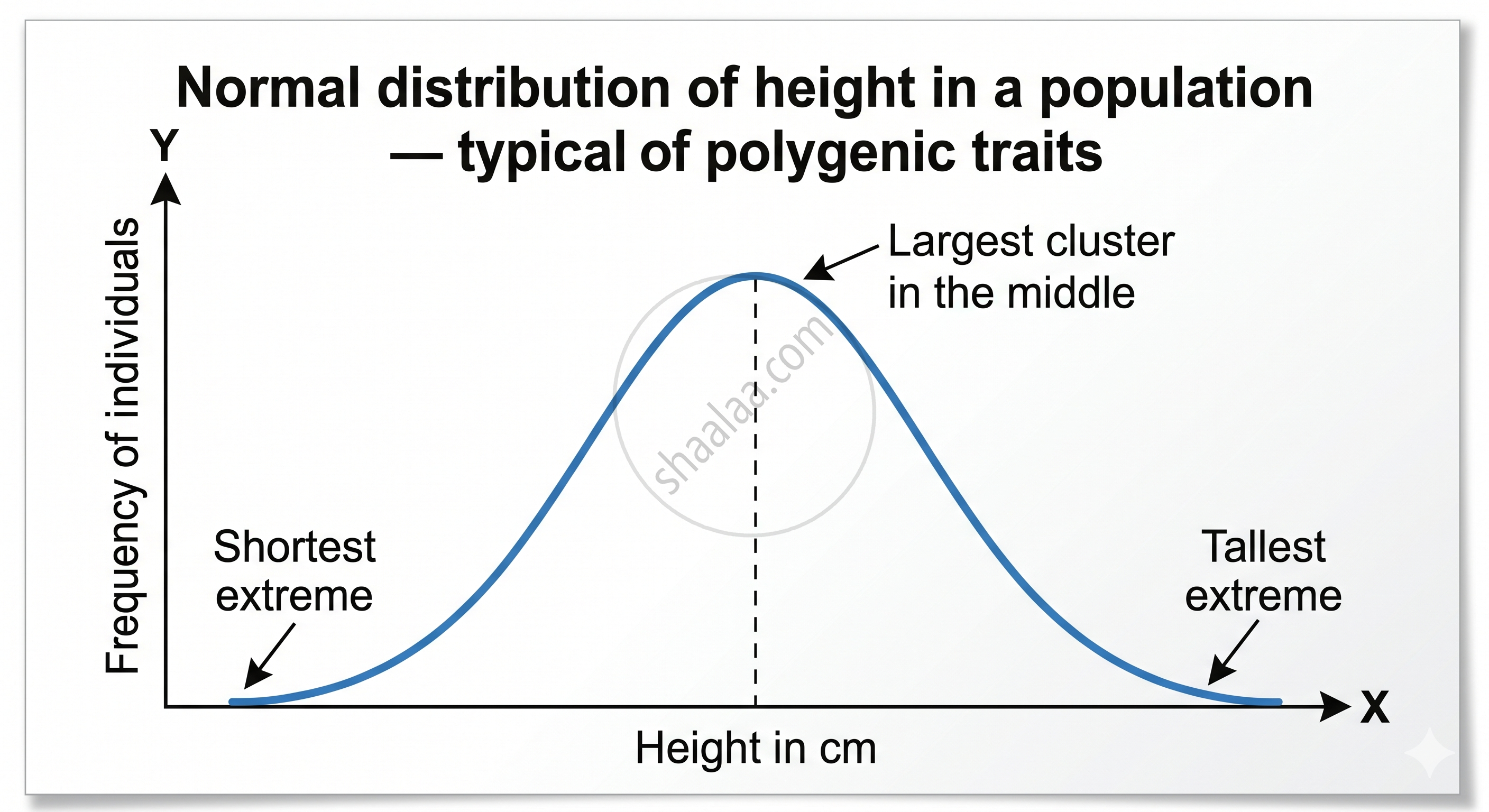
- Continuous variation: Produces a spectrum of phenotypes, not distinct categories; phenotype distribution follows a bell-shaped (normal distribution) curve in the population
- No simple dominance/recessiveness: There are contributing alleles (active) and non-contributing alleles (null), not classic dominant-recessive pairs
- No epistasis: Unlike gene interaction, polygenes do not mask each other; all genes contribute equally
- No linkage: Polygenes assort independently of each other (Law of Independent Assortment applies)
- Environmental influence: Environmental conditions greatly modify phenotypic expression.
- Statistical analysis required: Individual phenotypes cannot be predicted precisely; population statistics (mean, variance, standard deviation) are needed
CISCE: Class 12
Example 1: Human Skin Colour
Genes involved: Three gene pairs - A/a, B/b, C/c (each located on different, unlinked chromosomes)
- Capital letters (A, B, C) = contributing alleles → darker skin
- Lowercase letters (a, b, c) = non-contributing alleles → lighter skin
Cross Analysis:
| Generation | Genotype | Phenotype |
|---|---|---|
| Parent 1 (P₁) | AABBCC | Darkest skin colour |
| Parent 2 (P₂) | aabbcc | Lightest skin colour |
| F₁ | AaBbCc | Intermediate skin colour |
| F₂ (AaBbCc × AaBbCc) | All combinations | Continuous range |
F₂ Genotypic Ratio (number of contributing alleles → phenotype):
| No. of Contributing Alleles | 6 | 5 | 4 | 3 | 2 | 1 | 0 |
|---|---|---|---|---|---|---|---|
| Phenotype | Darkest | Very dark | Dark | Intermediate | Light | Very light | Lightest |
| Ratio | 1 | 6 | 15 | 20 | 15 | 6 | 1 |
Around 60 genetic loci contribute to skin colour in humans - far more than the simplified 3-gene model
CISCE: Class 12
Example 2: Human Height
- Approximately 400 genes are responsible for variation in height
- Environmental factors such as diet, general health, and hormones greatly influence final height
- Population distribution of height follows a bell-shaped normal distribution curve
CISCE: Class 12
Example 3: Human Eye Colour
- Determined by at least 16 genes in humans
- At least 9 different eye colours are recognised
- The two major genes are OCA2 and HERC2, both located on chromosome 15
- Eye colour genes are X-linked in part
CISCE: Class 12
Example 4: Kernel Colour in Wheat
Kernel Colour in Wheat: Nilsson-Ehle's Experiment (Plant Example)
Scientist: Nils Herman Nilsson-Ehle (developed the "multiple factor" theory)
Genes involved: Three independent gene pairs - A/a, B/b, C/c
| Generation | Genotype | Phenotype |
|---|---|---|
| P₁ | AABBCC | Dark red kernels |
| P₂ | aabbcc | White kernels |
| F₁ | AaBbCc | Intermediate red kernels |
| F₂ (AaBbCc × AaBbCc) | All genotypes | 63 red (various shades): 1 white |
F₂ Kernel Colour Spectrum:
| 1 | 6 | 15 | 20 | 15 | 6 | 1 |
|---|---|---|---|---|---|---|
| Dark Red | Moderate Red | Red | Intermediate Red | Light Red | Very Light Red | White |
F₂ Ratio = 63 Red (various shades) : 1 White
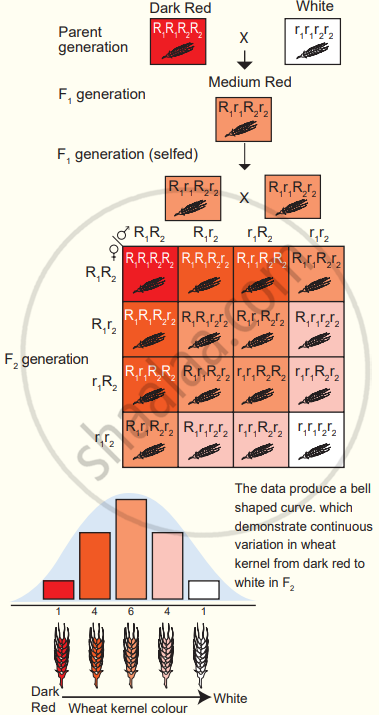
Polygenic inheritance in wheat kernel colour
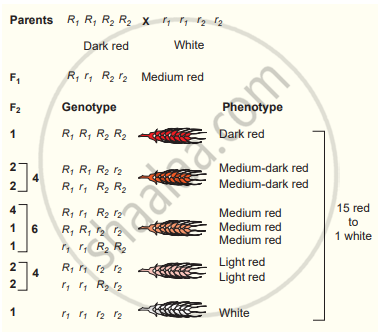
The genetic control of colour in wheat kernels
CISCE: Class 12
Key Points: Polygenic Inheritance
- Polygenic traits are controlled by two or more independent genes, with each contributing allele adding an equal, additive increment to the final phenotype.
- Instead of falling into distinct categories, these traits form a continuous spectrum that typically results in a bell-shaped normal distribution curve within a population.
- This type of inheritance lacks simple dominant-recessive relationships and gene masking (epistasis); alleles are simply contributing or non-contributing, and the genes assort independently.
- The final physical expression of these traits is not strictly dictated by genetics, as it is heavily modified by environmental conditions, such as nutrition, affecting a person's height.
- Prominent examples include human skin colour, human height (involving roughly 400 genes), human eye colour, and wheat kernel colour.
