Topics
Reproduction in Organisms
Sexual Reproduction in Flowering Plants
- Flower
- Pre-fertilisation in Flowering Plant: Structures and Events
- Structure and Development of Anther
- Microsporogenesis
- Structure and Development of Male Gametophyte
- Pollen Viability and Storage
- Structure and Development of Ovule
- Megasporogenesis
- Development of Female Gametophyte or Embryo Sac
- Pollination
- Autogamy
- Geitonogamy
- Cross-pollination
- Agents of Pollination
- Anemophily
- Hydrophily
- Animal-Mediated Pollination (Zoophily)
- Outbreeding Devices
- Pollen Pistil Interaction
- Artificial Hybridization or Artificial Fertilization
- Double Fertilization and Triple Fusion
- Events in Sexual Reproduction > Post-Fertilization Structures and Events
- Endosperm
- Dicotyledonous Embryo
- Monocotyledonous Embryo
- The Seed
- Apomixis
- Polyembryony
Reproduction
Genetics and Evolution
Human Reproduction
- Human Reproduction
- The Male Reproductive System
- The Female Reproductive System
- Gametogenesis
- Spermatogenesis
- Structure of Sperm
- Spermiogenesis
- Oogenesis
- Menstrual Cycle (Ovarian Cycle)
- Major Events of Menstrual Cycle
- Menstrual Hygiene
- Fertilization in Humans
- Implantation in Human
- Pregnancy and Embryonic Development
- Parturition (Birth) in Human
- Lactation in Human
Reproductive Health
- Concept of Reproductive Health
- Population Explosion and Control Measures
- Birth Control
- Natural Contraceptive Methods
- Artificial Contraceptive Methods
- Induced Abortion or Medical Termination of Pregnancy (MTP)
- Sexually Transmitted Diseases (STD) or Sexually Transmitted Infections (STI)
- Infertility
- Assisted Reproductive Technology (ART)
- Amniocentesis
- Genetic Counselling
Biology and Human Welfare
Biotechnology
Environmental Issues
- Controlling Vehicular Air Pollution: a Case Study of Delhi
- Effects of Domestic Sewage and Industrial Effluents on Water
- Solid Wastes
- Radioactive Wastes
- Greenhouse Effect and Climate Change
- Ozone Depletion in the Stratosphere
- Degradation by Improper Resource Utilisation and Maintenance
- Radioactive Waste Management and E-waste
Principles of Inheritance and Variation
- Heredity and Variation
- Gregor Johann Mendel – Father of Genetics
- Mendel's Experiments on Inheritance
- Monohybrid Cross
- Punnett Square
- Back Cross and Test Cross
- Mendel's Laws > The Law of Dominance
- Mendel's Laws > The Law of Segregation (Law of Purity of Gametes)
- Exceptions to Mendel's Principles > Incomplete Dominance
- Exceptions to Mendel's Principles > Co-Dominance
- Dihybrid Cross
- Mendel's Laws > The Law of Independent Assortment
- Chromosomal Theory of Inheritance
- Linkage and Recombination
- Polygenic Inheritance
- Exceptions to Mendel's Principles > Pleiotropy
- Sex Determination
- Sex Determination in Humans
- Sex Determination in Honey Bees
- Mutations
- Pedigree Analysis
- Mendelian Disorders in Humans
- Chromosomal Disorders or Abnormalities
Molecular Basis of Inheritance
- Deoxyribonucleic Acid (DNA)
- Structure of Polynucleotide Chain
- Packaging of DNA Helix
- Search for Genetic Material
- Griffith’s Experiment
- Avery, McCarty and MacLeod’s Experiment
- The Hershey-Chase Experiment
- Properties of Genetic Material
- The RNA World
- DNA Replication
- Conservative Replication
- Dispersive Replication
- Semi-Conservative Replication
- Meselson and Stahl’s Experiment
- Enzymes used in DNA Replication
- Mechanism of DNA Replication
- Protein Synthesis
- Reverse Transcription (Teminism)
- Transcription
- Transcription Unit and the Gene
- Process of Transcription in Bacteria
- Process of Transcription in Eukaryotes
- Genetic Code
- Characteristics of the Genetic Code
- Mutations and Genetic Code
- Transfer RNA (tRNA)
- Translation
- Regulation of Gene Expression
- The Lac Operon
- Human Genome Project
- DNA Fingerprinting
Ecology
Evolution
- Origin of Life on Earth
- Urey and Miller’s Experiment
- Evolution of Life Forms - a Theory
- Evidences Supporting the Theory of Evolution
- Adaptive Radiation
- Theories and Mechanism of Evolution
- Theories and Mechanism of Evolution
- Hardy Weinberg’s Principle
- Types of Selection
- Brief Account of Evolution
- Human Evolution
Human Health and Diseases
- Concept and Determinants of Health
- Modes of Transmission of Diseases through Pathogens
- Diseases Caused by Bacteria > Typhoid
- Diseases Caused by Bacteria > Pneumonia
- Diseases Caused by Viruses > Common Cold
- Diseases Caused by Protozoa > Malaria
- Diseases Caused by Protozoa > Amoebiasis (Amoeboic dysentery)
- Diseases Caused by Helminths > Ascariasis
- Diseases Caused by Helminths > Filariasis (Elephantiasis)
- Diseases Caused by Fungi > Ringworm
- Prevention and Control of Infectious Diseases
- Immunity
- Types of Immunity > Innate Immunity
- Types of Immunity > Acquired Immunity
- Vaccination and Immunization
- Allergies
- Autoimmunity
- The Immune System
- Acquired Immuno Deficiency Syndrome (AIDS)
- Cancer
- Causes of Cancer
- Symptoms and Diagnosis of Cancer
- Prevention/Treatment of Cancer
- Drugs and Alcohol Abuse
- Addiction and Dependence
- Effects of Drug and Alcohol Abuse
- Prevention and Control of Drugs and Alcohol Abuse
Microbes in Human Welfare
Strategies for Enhancement in Food Production
Biotechnology - Principles and Processes
Biotechnology and Its Application
Organisms and Populations
- Organisms and Their Environment
- Population and Population Attributes
- Population Growth
- Life History Variation
- Population Interactions
- Negative Interactions > Predation
- Negative Interactions > Competition
- Negative Interactions > Parasitism
- Positive Interactions > Commensalism
- Positive Interactions > Mutualism (Symbiosis)
Ecosystem
Biodiversity and Its Conservation
Estimated time: 18 minutes
CBSE: Class 12
Maharashtra State Board: Class 7, 8
Maharashtra State Board: Class 7, 8
Introduction
- Microorganisms are organisms that cannot be seen with the naked eye and can be observed only under a microscope.
- The cell has four main parts: cell wall, cell membrane, cytoplasm, and cell organelles.
- Microorganisms are present in air, water, soil, food, sewage, garbage, and in the bodies of plants, animals, and humans.
Occurrence of Microorganisms
- Microorganisms are found all around us in the environment.
- They occur in both living and non-living surroundings such as soil, water, food, and waste materials.
- Some microorganisms live in the bodies of plants and animals, including humans.
CBSE: Class 12
Maharashtra State Board: Class 7, 8
Maharashtra State Board: Class 7, 8
Types of Microorganisms
| Type | Description | Examples | Role |
|---|---|---|---|
| Solitary microorganisms | These live alone and perform all life processes independently. | Amoeba, Paramecium | They survive alone without depending on other organisms. |
| Colony microorganisms | These live in groups or colonies, where cells stay together but function independently. | Volvox, Anabaena | They gain protection and a survival advantage, especially in difficult conditions. |
| Decomposers | These break down dead plants and animals into simpler substances | Fungi, bacteria | They recycle nutrients and prevent waste accumulation. |
Maharashtra State Board: Class 7, 8
Nature of Microorganisms
- Some microorganisms are multicellular, such as the fungus growing on bread and strands of algae in ponds.
- Most microorganisms are unicellular, such as bacteria and viruses.
- Bacteria have a different cellular structure and lack the membrane-bound organelles found in eukaryotic cells.
- Their only components are the plasma membrane, cytoplasm, and nucleoid. Such cells are called prokaryotic cells.
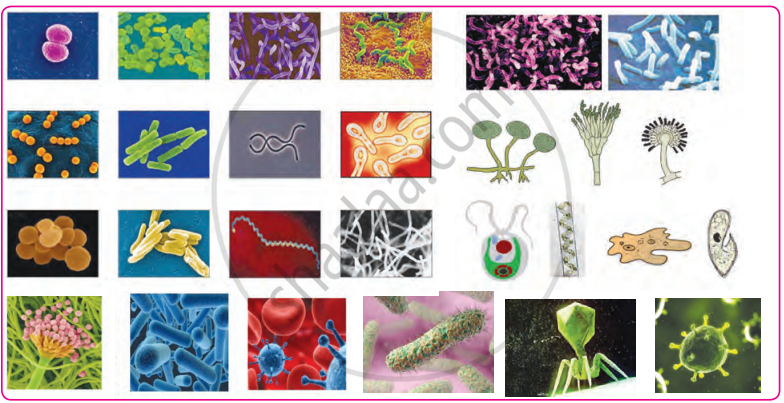
A variety of microbes
Maharashtra State Board: Class 7, 8
Growth of Microorganisms
- Each microorganism needs a specific environment for growth and reproduction.
- Some microorganisms require oxygen for growth, while others can grow without it.
- Some microorganisms survive in extreme and adverse conditions, such as the ocean floor, polar ice, and hot water springs.
- During adverse conditions, microorganisms form a thick covering around themselves and stop their life processes.
- When favourable conditions return, they come out of the covering and continue their life processes.
Maharashtra State Board: Class 7, 8
Conditions Required for Growth
- Medium: soil, water, decaying matter, etc.
- Temperature: 25°C to 37°C.
- Nutrition: specific nutrients; for example, algae need chlorophyll, and oxygen is required by many microbes.
- Atmosphere: moist, humid, and warm.
Maharashtra State Board: Class 7, 8
Experiment
Aim:
To observe microorganisms in different environments using a magnifying lens or a microscope.
Requirements:
Moistened bread or bhakari, a closed box, muddy water or water from a stagnant puddle, yoghurt or buttermilk, glass slides, coverslips, a compound microscope, and a magnifying lens.
Procedure:
- Keep a moistened piece of bread or bhakari in a closed box and observe it after 3–4 days using a magnifying lens.
- Observe a drop of muddy water or stagnant water under a compound microscope.
- Take a drop of yoghurt or buttermilk on a glass slide and observe it under a compound microscope.
- Draw sketches of the microbes observed.
Conclusion
- Bread or bhakari shows mould or fungal growth after a few days.
- Muddy water shows tiny protozoa and bacteria under the microscope.
- Yoghurt or buttermilk shows Lactobacillus bacteria responsible for curd formation.
CBSE: Class 12
Key Points: Microorganisms (Microbes) and Microbiology
- Microbes are found everywhere - in soil, water, air, and inside the bodies of humans, animals, and plants.
- They survive extreme conditions - thermal vents (100°C), deep soil, thick snow layers, and highly acidic environments.
- Types of microbes - protozoa, bacteria, fungi, microscopic plants, viruses, viroids, and prions (proteinaceous infectious agents).
- Bacteria and fungi grow on nutritive media to form visible colonies, essential for studying microorganisms.
- Microbes cause diseases in humans, animals, and plants, but many are also beneficial to human welfare.
Test Yourself
Related QuestionsVIEW ALL [42]
Match the organisms in Column A with their action in Column B.
| A | B | ||
| (i) | Bacteria | (a) | Fixing Nitrogen |
| (ii) | Rhizobium | (b) | Setting of curd |
| (iii) | Lactobacillus | (c) | Baking of bread |
| (iv) | Yeast | (d) | Causing Malaria |
| (v) | A protozoan | (e) | Causing Cholera |
| (vi) | A Virus | (f) | Causing AIDS |
| (g) | Producing antibodies |
