Topics
Reproduction in Organisms
Sexual Reproduction in Flowering Plants
- Flower
- Pre-fertilisation in Flowering Plant: Structures and Events
- Structure and Development of Anther
- Microsporogenesis
- Structure and Development of Male Gametophyte
- Pollen Viability and Storage
- Structure and Development of Ovule
- Megasporogenesis
- Development of Female Gametophyte or Embryo Sac
- Pollination
- Autogamy
- Geitonogamy
- Cross-pollination
- Agents of Pollination
- Anemophily
- Hydrophily
- Animal-Mediated Pollination (Zoophily)
- Outbreeding Devices
- Pollen Pistil Interaction
- Artificial Hybridization or Artificial Fertilization
- Double Fertilization and Triple Fusion
- Events in Sexual Reproduction > Post-Fertilization Structures and Events
- Endosperm
- Dicotyledonous Embryo
- Monocotyledonous Embryo
- The Seed
- Apomixis
- Polyembryony
Reproduction
Genetics and Evolution
Human Reproduction
- Human Reproduction
- The Male Reproductive System
- The Female Reproductive System
- Gametogenesis
- Spermatogenesis
- Structure of Sperm
- Spermiogenesis
- Oogenesis
- Menstrual Cycle (Ovarian Cycle)
- Major Events of Menstrual Cycle
- Menstrual Hygiene
- Fertilization in Humans
- Implantation in Human
- Pregnancy and Embryonic Development
- Parturition (Birth) in Human
- Lactation in Human
Reproductive Health
- Concept of Reproductive Health
- Population Explosion and Control Measures
- Birth Control
- Natural Contraceptive Methods
- Artificial Contraceptive Methods
- Induced Abortion or Medical Termination of Pregnancy (MTP)
- Sexually Transmitted Diseases (STD) or Sexually Transmitted Infections (STI)
- Infertility
- Assisted Reproductive Technology (ART)
- Amniocentesis
- Genetic Counselling
Biology and Human Welfare
Biotechnology
Environmental Issues
- Controlling Vehicular Air Pollution: a Case Study of Delhi
- Effects of Domestic Sewage and Industrial Effluents on Water
- Solid Wastes
- Radioactive Wastes
- Greenhouse Effect and Climate Change
- Ozone Depletion in the Stratosphere
- Degradation by Improper Resource Utilisation and Maintenance
- Radioactive Waste Management and E-waste
Principles of Inheritance and Variation
- Heredity and Variation
- Gregor Johann Mendel – Father of Genetics
- Mendel's Experiments on Inheritance
- Monohybrid Cross
- Punnett Square
- Back Cross and Test Cross
- Mendel's Laws > The Law of Dominance
- Mendel's Laws > The Law of Segregation (Law of Purity of Gametes)
- Exceptions to Mendel's Principles > Incomplete Dominance
- Exceptions to Mendel's Principles > Co-Dominance
- Dihybrid Cross
- Mendel's Laws > The Law of Independent Assortment
- Chromosomal Theory of Inheritance
- Linkage and Recombination
- Polygenic Inheritance
- Exceptions to Mendel's Principles > Pleiotropy
- Sex Determination
- Sex Determination in Humans
- Sex Determination in Honey Bees
- Mutations
- Pedigree Analysis
- Mendelian Disorders in Humans
- Chromosomal Disorders or Abnormalities
Molecular Basis of Inheritance
- Deoxyribonucleic Acid (DNA)
- Structure of Polynucleotide Chain
- Packaging of DNA Helix
- Search for Genetic Material
- Griffith’s Experiment
- Avery, McCarty and MacLeod’s Experiment
- The Hershey-Chase Experiment
- Properties of Genetic Material
- The RNA World
- DNA Replication
- Conservative Replication
- Dispersive Replication
- Semi-Conservative Replication
- Meselson and Stahl’s Experiment
- Enzymes used in DNA Replication
- Mechanism of DNA Replication
- Protein Synthesis
- Reverse Transcription (Teminism)
- Transcription
- Transcription Unit and the Gene
- Process of Transcription in Bacteria
- Process of Transcription in Eukaryotes
- Genetic Code
- Characteristics of the Genetic Code
- Mutations and Genetic Code
- Transfer RNA (tRNA)
- Translation
- Regulation of Gene Expression
- The Lac Operon
- Human Genome Project
- DNA Fingerprinting
Ecology
Evolution
- Origin of Life on Earth
- Urey and Miller’s Experiment
- Evolution of Life Forms - a Theory
- Evidences Supporting the Theory of Evolution
- Adaptive Radiation
- Theories and Mechanism of Evolution
- Theories and Mechanism of Evolution
- Hardy Weinberg’s Principle
- Types of Selection
- Brief Account of Evolution
- Human Evolution
Human Health and Diseases
- Concept and Determinants of Health
- Modes of Transmission of Diseases through Pathogens
- Diseases Caused by Bacteria > Typhoid
- Diseases Caused by Bacteria > Pneumonia
- Diseases Caused by Viruses > Common Cold
- Diseases Caused by Protozoa > Malaria
- Diseases Caused by Protozoa > Amoebiasis (Amoeboic dysentery)
- Diseases Caused by Helminths > Ascariasis
- Diseases Caused by Helminths > Filariasis (Elephantiasis)
- Diseases Caused by Fungi > Ringworm
- Prevention and Control of Infectious Diseases
- Immunity
- Types of Immunity > Innate Immunity
- Types of Immunity > Acquired Immunity
- Vaccination and Immunization
- Allergies
- Autoimmunity
- The Immune System
- Acquired Immuno Deficiency Syndrome (AIDS)
- Cancer
- Causes of Cancer
- Symptoms and Diagnosis of Cancer
- Prevention/Treatment of Cancer
- Drugs and Alcohol Abuse
- Addiction and Dependence
- Effects of Drug and Alcohol Abuse
- Prevention and Control of Drugs and Alcohol Abuse
Microbes in Human Welfare
Strategies for Enhancement in Food Production
Biotechnology - Principles and Processes
Biotechnology and Its Application
Organisms and Populations
- Organisms and Their Environment
- Population and Population Attributes
- Population Growth
- Life History Variation
- Population Interactions
- Negative Interactions > Predation
- Negative Interactions > Competition
- Negative Interactions > Parasitism
- Positive Interactions > Commensalism
- Positive Interactions > Mutualism (Symbiosis)
Ecosystem
Biodiversity and Its Conservation
Introduction
Chromosomal disorders arise from changes in the number or structure of chromosomes, rather than mutations in individual genes. They are classified into Numerical Abnormalities (changes in chromosome count) and Structural Abnormalities (changes in chromosome architecture). Both types are caused either by errors during cell division or by exposure to mutagenic agents.
Classification
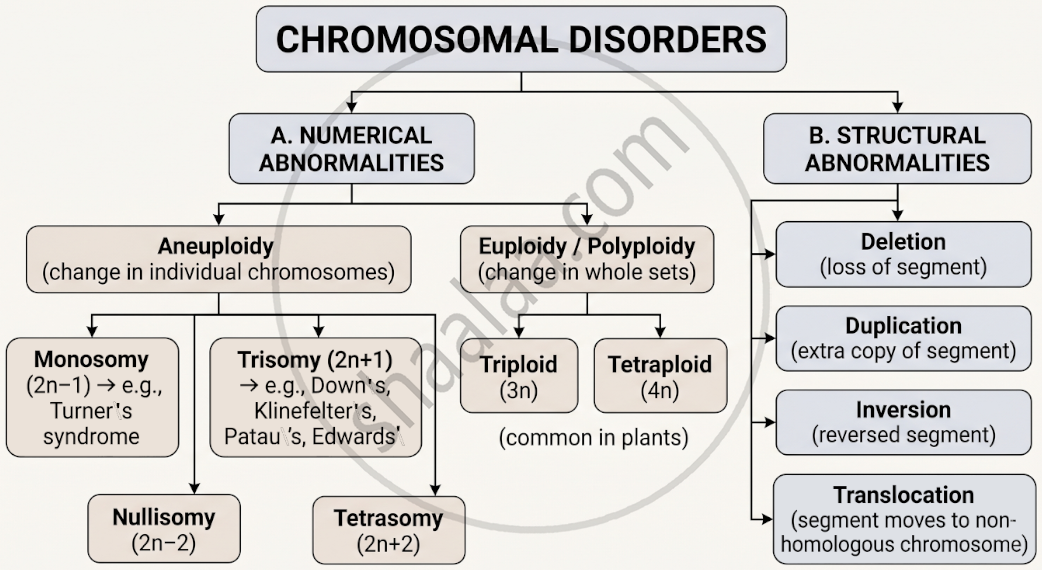
Numerical Abnormalities: Aneuploidy
| Type | Formula | Total Chromosomes (human) | Viability |
|---|---|---|---|
| Nullisomy | 2n − 2 | 44 | Usually lethal |
| Monosomy | 2n − 1 | 45 | Mostly lethal except Turner's (XO) |
| Trisomy | 2n + 1 | 47 | Variable - depends on the chromosome involved |
| Tetrasomy | 2n + 2 | 48 | Rare; some viable sex-chromosome tetrasomies |
Numerical Abnormalities: Autosomal Trisomies
1. Down's Syndrome (Trisomy 21)
- Karyotype: 47, +21 (extra chromosome 21); also written as 44A + 2sex chromosomes + 1 extra chromosome at 21
- Incidence: 1 in 660–700 live births - most common autosomal aneuploidy
- Cause: Nondisjunction during oogenesis (maternal nondisjunction in ~95% cases); risk increases with maternal age
Clinical Features:
- Short stature, broad hands with short fingers
- Flat facial profile with broad skull and flat nasal bridge
- Epicanthal folds (skin fold at inner corner of eye)
- Large, furrowed tongue; open-mouth appearance
- Intellectual disability (mild to moderate)
- Congenital heart defects (present in ~50% of cases)
- Increased risk of acute leukaemia and Alzheimer's disease
2. Patau Syndrome (Trisomy 13):
- Karyotype: 47, +13 (extra chromosome 13)
- Incidence: 1 in 5,000 live births
Clinical Features:
- Severe intellectual disability
- Congenital heart defects
- Extra fingers (polydactyly)
- Cleft palate and lip
- Small eyes (microphthalmia) or absent eyes (anophthalmia)
- Most affected infants die within the first year of life
3. Edwards Syndrome (Trisomy 18):
- Karyotype: 47, +18 (extra chromosome 18)
- Incidence: Second most common trisomy in live births
Clinical Features:
- Severe intellectual disability
- Characteristic "rocker-bottom" feet
- Overlapping fingers with clenched fists
- Congenital heart, kidney, and lung defects
- Very high neonatal mortality; most survive less than 1 year
Numerical Abnormalities: Sex Chromosome Aneuploidies
1. Klinefelter's Syndrome (47, XXY):
- Karyotype: 47, XXY - extra X chromosome in genetic males
- Gender: Affects males only
- Incidence: ~1 in 650 male newborns - most common sex chromosome disorder
- Cause: Nondisjunction in Meiosis I or II during gametogenesis in either parent
Clinical Features:
- Tall stature with long limbs
- Small, underdeveloped testes (hypogonadism/micro-orchidism)
- Gynecomastia (breast tissue development) in late puberty
- Sparse body and facial hair
- Infertility (azoospermia/oligospermia) - most common cause of male hypogonadism
- Mild intellectual or learning difficulties in some patients
- Elevated urinary gonadotropin levels
2. Turner's Syndrome (45, XO):
- Karyotype: 45, XO (monosomy X) - only one functional X chromosome
- Gender: Affects females only
- Incidence: ~1 in 2,000–2,500 live female births
- Cause: Nondisjunction resulting in loss of one sex chromosome; missing chromosome is usually the paternal X in ~2/3 of cases
Clinical Features:
- Short stature (average adult height ~145 cm)
- Webbed neck (pterygium colli)
- Broad chest with widely spaced nipples
- Rudimentary / streak ovaries → absent secondary sexual characteristics
- Primary amenorrhoea (no menstruation)
- Infertility (primary ovarian insufficiency)
- Normal intelligence in most cases
- Risk of cardiac abnormalities (coarctation of the aorta)
3. Triple X Syndrome (47, XXX):
- Karyotype: 47, XXX - extra X chromosome in females
- Incidence: ~1 in 1,000 female newborns
Features: Usually phenotypically normal females; taller than average; mild learning difficulties possible; often fertile
4. XYY Syndrome (47, XYY):
- Karyotype: 47, XYY - extra Y chromosome in males
- Incidence: ~1 in 1,000 male newborns
Features: Phenotypically normal males; tall stature; fertile in most cases; associated with behavioural tendencies in older literature (no longer considered clinically significant)
Numerical Abnormalities: Polyploidy (Euploidy)
- Increase in the number of entire chromosome sets (3n, 4n, 6n…)
- Examples: Triploid (3n), Tetraploid (4n)
- In plants, very common - wheat (Triticum) is hexaploid (6n = 42); banana is triploid (3n); polyploid crops often show increased size and vigour
- In Animals: Generally lethal - very rare in mammals, as dosage compensation mechanisms cannot accommodate multiple X chromosomes
Structural Abnormalities
Structural chromosomal abnormalities arise when a chromosome segment breaks and rejoins abnormally. This may occur spontaneously or be induced by radiation, chemicals, or viruses.
Types of Structural Abnormalities:
| Type | What Happens | Example | Effect |
|---|---|---|---|
| Deletion | A chromosomal segment is lost permanently | Cri-du-chat (deletion on chr. 5p) | Loss of genes; severe developmental effects |
| Duplication | A chromosomal segment is copied and repeated | Fragile X syndrome (X chromosome repeat expansion at Xq27.3) | Gene overdose: variable effects |
| Inversion | A segment detaches and reattaches in reverse orientation | Inversion on chromosome 9 | Often silent; may affect gene expression |
| Translocation | A segment from one chromosome attaches to a non-homologous chromosome | Philadelphia chromosome (chr. 9 → chr. 22) → Chronic Myeloid Leukaemia | Cancer risk; carrier may appear normal |
Maharashtra State Board: Class 12
Key Points: Chromosomal Disorders or Abnormalities
| Chromosomal Disorder | Chromosomal Abnormality | Karyotype | Major Features | Remarks |
|---|---|---|---|---|
| Down’s Syndrome | Extra copy of chromosome 21 (Trisomy 21) | 47, +21 | Short stature, small round head, furrowed tongue, partially open mouth, broad palm with single crease, mental and physical retardation | Most common autosomal aneuploidy |
| Klinefelter’s Syndrome | Extra X chromosome in males | 47, XXY | Masculine body with feminine traits (gynecomastia), underdeveloped testes, sterile | Sex-chromosome aneuploidy |
| Turner’s Syndrome | Absence of one X chromosome | 45, XO | Short stature, rudimentary ovaries, absence of secondary sexual characters, sterile female | Only monosomy compatible with life |
| Aneuploidy | Gain or loss of one or more chromosomes due to non-disjunction | 2n ± 1 | Severe developmental abnormalities | Includes trisomy and monosomy |
| Polyploidy | Increase in whole set of chromosomes due to failure of cytokinesis | 3n, 4n, etc. | Common in plants; increases size and vigor | Rare and usually lethal in animals |
Test Yourself
Related QuestionsVIEW ALL [22]
|
The chromosome number is fixed for all normal organisms leading to species specification whereas any abnormality in the chromosome number of an organism results into abnormal individuals. For example, in humans, 46 is the fixed number of chromosomes both male and female. In males it is '44 + XY' and in females, it is '44 +XX'. Thus the human male is heterogametic, in other words produces two different types of gametes one with '22 + X' chromosomes and the other with '22 + Y' chromosomes respectively. Human female, on the other hand, is homo gametic i.e. produce only one type of gamete with '22 + X' chromosomes only. Sometimes an error may occur during the meiosis of the cell cycle, where the sister chromatids fail to segregate called nondisjunction, leading to the production of abnormal gametes with altered chromosome numbers. On fertilisation, such gametes develop into abnormal individuals. |
(a) State what is aneuploidy. (1)
(b) If during spermatogenesis, the chromatids of sex chromosomes fail to segregate during meiosis, write only the different types of gametes with altered chromosome numbers that could possibly be produced. (1)
(c) A normal human sperm (22 + Y) fertilises an ovum with karyotype '22 +XX'. Name the disorder the offspring thus produced would suffer from and write any two symptoms of the disorder. (2)
OR
(c) Name the best-known and most common autosomal aneuploid abnormality in humans and write any two symptoms. (2)
