Topics
Reproduction in Organisms
Sexual Reproduction in Flowering Plants
- Flower
- Pre-fertilisation in Flowering Plant: Structures and Events
- Structure and Development of Anther
- Microsporogenesis
- Structure and Development of Male Gametophyte
- Pollen Viability and Storage
- Structure and Development of Ovule
- Megasporogenesis
- Development of Female Gametophyte or Embryo Sac
- Pollination
- Autogamy
- Geitonogamy
- Cross-pollination
- Agents of Pollination
- Anemophily
- Hydrophily
- Animal-Mediated Pollination (Zoophily)
- Outbreeding Devices
- Pollen Pistil Interaction
- Artificial Hybridization or Artificial Fertilization
- Double Fertilization and Triple Fusion
- Events in Sexual Reproduction > Post-Fertilization Structures and Events
- Endosperm
- Dicotyledonous Embryo
- Monocotyledonous Embryo
- The Seed
- Apomixis
- Polyembryony
Reproduction
Genetics and Evolution
Human Reproduction
- Human Reproduction
- The Male Reproductive System
- The Female Reproductive System
- Gametogenesis
- Spermatogenesis
- Structure of Sperm
- Spermiogenesis
- Oogenesis
- Menstrual Cycle (Ovarian Cycle)
- Major Events of Menstrual Cycle
- Menstrual Hygiene
- Fertilization in Human
- Implantation in Human
- Pregnancy and Embryonic Development
- Parturition (Birth) in Human
- Lactation in Human
Reproductive Health
- Concept of Reproductive Health
- Population Explosion and Control Measures
- Birth Control
- Natural Contraceptive Methods
- Artificial Contraceptive Methods
- Induced Abortion or Medical Termination of Pregnancy (MTP)
- Sexually Transmitted Diseases (STD) or Sexually Transmitted Infections (STI)
- Infertility
- Assisted Reproductive Technology (ART)
- Amniocentesis
- Genetic Counselling
Biology and Human Welfare
Environmental Issues
- Controlling Vehicular Air Pollution: a Case Study of Delhi
- Effects of Domestic Sewage and Industrial Effluents on Water
- Solid Wastes
- Radioactive Wastes
- Greenhouse Effect and Climate Change
- Ozone Depletion in the Stratosphere
- Degradation by Improper Resource Utilisation and Maintenance
- Radioactive Waste Management and E-waste
Biotechnology
Principles of Inheritance and Variation
- Heredity and Variation
- Gregor Johann Mendel – Father of Genetics
- Mendel's Experiments on Inheritance
- Monohybrid Cross
- Punnett Square
- Back Cross and Test Cross
- Mendel's Laws > The Law of Dominance
- Mendel's Laws > The Law of Segregation (Law of Purity of Gametes)
- Exceptions to Mendel's Principles > Incomplete Dominance
- Exceptions to Mendel's Principles > Co-Dominance
- Dihybrid Cross
- Mendel's Laws > The Law of Independent Assortment
- Chromosomal Theory of Inheritance
- Linkage and Recombination
- Polygenic Inheritance
- Exceptions to Mendel's Principles > Pleiotropy
- Sex Determination
- Sex Determination in Humans
- Sex Determination in Honey Bees
- Mutations
- Pedigree Analysis
- Mendelian Disorders in Humans
- Chromosomal Disorders or Abnormalities
Molecular Basis of Inheritance
- Deoxyribonucleic Acid (DNA)
- Structure of Polynucleotide Chain
- Packaging of DNA Helix
- Search for Genetic Material
- Griffith’s Experiment
- Avery, McCarty and MacLeod’s Experiment
- The Hershey-Chase Experiment
- Properties of Genetic Material
- The RNA World
- DNA Replication
- Conservative Replication
- Dispersive Replication
- Semi-Conservative Replication
- Meselson and Stahl’s Experiment
- Enzymes used in DNA Replication
- Mechanism of DNA Replication
- Protein Synthesis
- Reverse Transcription (Teminism)
- Transcription
- Transcription Unit and the Gene
- Process of Transcription in Bacteria
- Process of Transcription in Eukaryotes
- Genetic Code
- Characteristics of the Genetic Code
- Mutations and Genetic Code
- Transfer RNA (tRNA)
- Translation
- Regulation of Gene Expression
- The Lac Operon
- Human Genome Project
- DNA Fingerprinting
Ecology
Evolution
- Origin of Life on Earth
- Urey and Miller’s Experiment
- Evolution of Life Forms - a Theory
- Evidences Supporting the Theory of Evolution
- Adaptive Radiation
- Theories and Mechanism of Evolution
- Theories and Mechanism of Evolution
- Hardy Weinberg’s Principle
- Types of Selection
- Brief Account of Evolution
- Human Evolution
Human Health and Diseases
- Concept and Determinants of Health
- Modes of Transmission of Diseases through Pathogens
- Diseases Caused by Bacteria > Typhoid
- Diseases Caused by Bacteria > Pneumonia
- Diseases Caused by Viruses > Common Cold
- Diseases Caused by Protozoa > Malaria
- Diseases Caused by Protozoa > Amoebiasis (Amoeboic dysentery)
- Diseases Caused by Helminths > Ascariasis
- Diseases Caused by Helminths > Filariasis (Elephantiasis)
- Diseases Caused by Fungi > Ringworm
- Prevention and Control of Infectious Diseases
- Immunity
- Types of Immunity > Innate Immunity
- Types of Immunity > Acquired Immunity
- Vaccination and Immunization
- Allergies
- Autoimmunity
- The Immune System
- Acquired Immuno Deficiency Syndrome (AIDS)
- Cancer
- Causes of Cancer
- Symptoms and Diagnosis of Cancer
- Prevention/Treatment of Cancer
- Drugs and Alcohol Abuse
- Addiction and Dependence
- Effects of Drug and Alcohol Abuse
- Prevention and Control of Drugs and Alcohol Abuse
Strategies for Enhancement in Food Production
Microbes in Human Welfare
Biotechnology - Principles and Processes
Biotechnology and Its Application
Organisms and Populations
- Organisms and Their Environment
- Population and Population Attributes
- Population Growth
- Life History Variation
- Population Interactions
- Negative Interactions > Predation
- Negative Interactions > Competition
- Negative Interactions > Parasitism
- Positive Interactions > Commensalism
- Positive Interactions > Mutualism (Symbiosis)
Ecosystem
Biodiversity and Its Conservation
Estimated time: 12 minutes
CBSE: Class 12
Chronological Account of Evolution
1. First Life Forms
- The first cellular forms of life appeared about 2000 mya.
- Some of these early cells released oxygen into the atmosphere.
- Over time, single-celled organisms gave rise to multicellular forms.
2. Early Aquatic Life
- Invertebrates were present around 500 mya.
- Jawless fishes appeared later, and fishes became an important stage in vertebrate evolution.
- Strong-finned or lobefin fishes were important because they represent the transition toward movement onto land.
3. Shift from Water to Land
- Around 350 mya, some fish lineages developed the ability to move onto land.
- These forms gave rise to amphibians, which could survive in both aquatic and terrestrial conditions.
- This stage marks one of the most important turning points in vertebrate evolution.
4. Rise of Reptiles
- Reptiles evolved after amphibians and became better adapted to life on land.
- Their thick-shelled eggs allowed reproduction away from water, giving them a major survival advantage.
- The source notes that reptiles dominated the Earth for nearly 200 million years.
5. Plant Life and Coal Formation
- During the age when giant ferns were abundant, large forest vegetation contributed to the formation of coal deposits.
- This point helps connect biological evolution with Earth’s geological history.
6. Mesozoic Reptiles and Dinosaurs
- About 200 mya, some reptiles returned to the water; Ichthyosaurs are often cited as examples.
- Dinosaurs became dominant on land during the Mesozoic era.
- The source specifically mentions Tyrannosaurus rex as a major land reptile, approximately 20 feet tall.
7. Extinction of Dinosaurs
- Around 65 mya, dinosaurs disappeared suddenly.
- The source attributes this to possible climatic changes and also mentions evolutionary links with birds.
- This event opened ecological space for the expansion of mammals.
8. Rise of Mammals
- Mammals were small, shrew-like forms in the early stages.
- They were viviparous and comparatively more intelligent, which helped them adapt successfully.
- After the decline of reptiles, mammals became the dominant life forms on Earth.
9. Continental Drift and Mammalian Distribution
- The source notes that South American mammals were later replaced or overridden by North American fauna.
- In contrast, Australian marsupials survived because they faced less competition from placental mammals.
- This shows how geography can influence the survival and spread of species.
CBSE: Class 12
Geological Periods
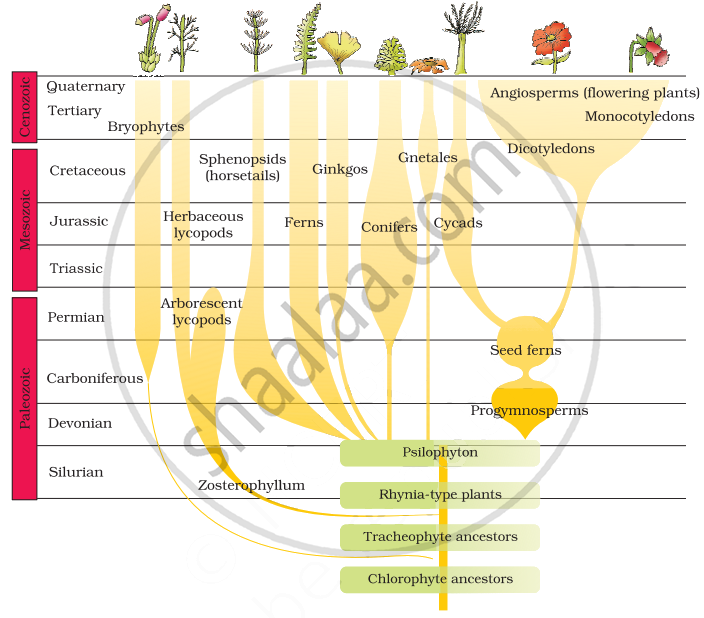
A sketch of the evolution of plant forms through geological periods
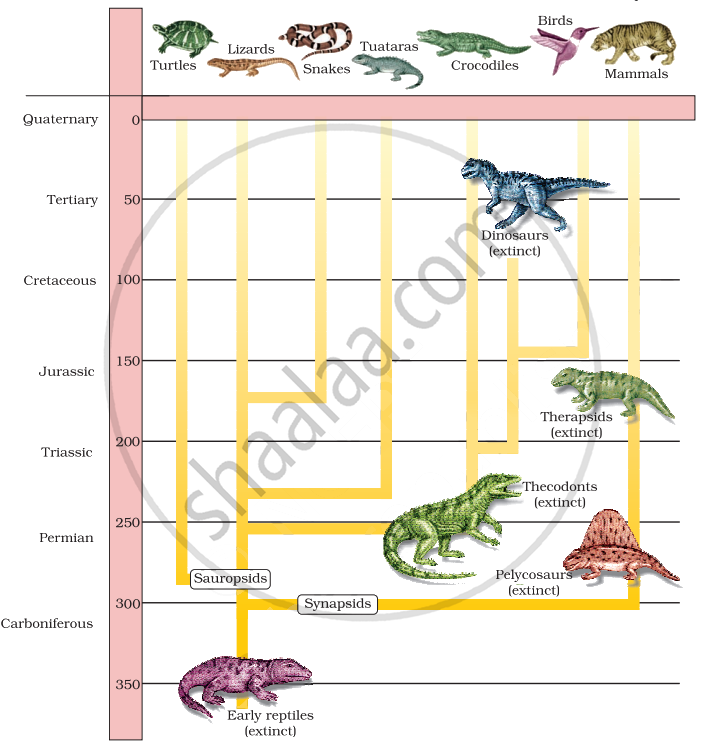
Representative evolutionary history of vertebrates through geological periods
CBSE: Class 12
Timeline
| Time | Major Evolutionary Event |
|---|---|
| 2000 mya | First cells appeared. |
| 500 mya | Invertebrates existed. |
| 350 mya | Fish-to-land transition began. |
| 320–350 mya | Amphibian stage developed from fish ancestors. |
| Later | Reptiles evolved and laid thick-shelled eggs. |
| 200 mya | Aquatic reptiles and dinosaurs flourished. |
| 65 mya | Dinosaurs disappeared. |
| After 65 mya | Mammals became dominant. |
CBSE: Class 12
Key Points: Brief Account of Evolution
- First Life Forms - 2000 mya; first cells appeared, some released O₂; single-celled → multicellular.
- Aquatic to Land - 500 mya invertebrates; 350 mya jawless fish; strong-finned fish moved onto land.
- Amphibians → Reptiles - Reptiles laid thick-shelled eggs; dominated Earth for 200 million years; giant ferns formed coal.
- Mesozoic Era - 200 mya, some reptiles returned to water (e.g., Ichthyosaurs); T. rex dominated land (20 feet tall).
- Dinosaur Extinction - 65 mya, dinosaurs suddenly disappeared due to climatic changes or evolved into birds.
- Rise of Mammals - Shrew-like, viviparous, intelligent; replaced reptiles as dominant life forms.
- Continental Drift - South American mammals were replaced by North American fauna; Australian marsupials survived due to a lack of competition.
