Topics
Reproduction in Organisms
Sexual Reproduction in Flowering Plants
- Flower
- Pre-fertilisation in Flowering Plant: Structures and Events
- Structure and Development of Anther
- Microsporogenesis
- Structure and Development of Male Gametophyte
- Pollen Viability and Storage
- Structure and Development of Ovule
- Megasporogenesis
- Development of Female Gametophyte or Embryo Sac
- Pollination
- Autogamy
- Geitonogamy
- Cross-pollination
- Agents of Pollination
- Anemophily
- Hydrophily
- Animal-Mediated Pollination (Zoophily)
- Outbreeding Devices
- Pollen Pistil Interaction
- Artificial Hybridization or Artificial Fertilization
- Double Fertilization and Triple Fusion
- Events in Sexual Reproduction > Post-Fertilization Structures and Events
- Endosperm
- Dicotyledonous Embryo
- Monocotyledonous Embryo
- The Seed
- Apomixis
- Polyembryony
Reproduction
Genetics and Evolution
Human Reproduction
- Human Reproduction
- The Male Reproductive System
- The Female Reproductive System
- Gametogenesis
- Spermatogenesis
- Structure of Sperm
- Spermiogenesis
- Oogenesis
- Menstrual Cycle (Ovarian Cycle)
- Major Events of Menstrual Cycle
- Menstrual Hygiene
- Fertilization in Humans
- Implantation in Human
- Pregnancy and Embryonic Development
- Parturition (Birth) in Human
- Lactation in Human
Reproductive Health
- Concept of Reproductive Health
- Population Explosion and Control Measures
- Birth Control
- Natural Contraceptive Methods
- Artificial Contraceptive Methods
- Induced Abortion or Medical Termination of Pregnancy (MTP)
- Sexually Transmitted Diseases (STD) or Sexually Transmitted Infections (STI)
- Infertility
- Assisted Reproductive Technology (ART)
- Amniocentesis
- Genetic Counselling
Biology and Human Welfare
Biotechnology
Environmental Issues
- Controlling Vehicular Air Pollution: a Case Study of Delhi
- Effects of Domestic Sewage and Industrial Effluents on Water
- Solid Wastes
- Radioactive Wastes
- Greenhouse Effect and Climate Change
- Ozone Depletion in the Stratosphere
- Degradation by Improper Resource Utilisation and Maintenance
- Radioactive Waste Management and E-waste
Principles of Inheritance and Variation
- Heredity and Variation
- Gregor Johann Mendel – Father of Genetics
- Mendel's Experiments on Inheritance
- Monohybrid Cross
- Punnett Square
- Back Cross and Test Cross
- Mendel's Laws > The Law of Dominance
- Mendel's Laws > The Law of Segregation (Law of Purity of Gametes)
- Exceptions to Mendel's Principles > Incomplete Dominance
- Exceptions to Mendel's Principles > Co-Dominance
- Dihybrid Cross
- Mendel's Laws > The Law of Independent Assortment
- Chromosomal Theory of Inheritance
- Linkage and Recombination
- Polygenic Inheritance
- Exceptions to Mendel's Principles > Pleiotropy
- Sex Determination
- Sex Determination in Humans
- Sex Determination in Honey Bees
- Mutations
- Pedigree Analysis
- Mendelian Disorders in Humans
- Chromosomal Disorders or Abnormalities
Molecular Basis of Inheritance
- Deoxyribonucleic Acid (DNA)
- Structure of Polynucleotide Chain
- Packaging of DNA Helix
- Search for Genetic Material
- Griffith’s Experiment
- Avery, McCarty and MacLeod’s Experiment
- The Hershey-Chase Experiment
- Properties of Genetic Material
- The RNA World
- DNA Replication
- Conservative Replication
- Dispersive Replication
- Semi-Conservative Replication
- Meselson and Stahl’s Experiment
- Enzymes used in DNA Replication
- Mechanism of DNA Replication
- Protein Synthesis
- Reverse Transcription (Teminism)
- Transcription
- Transcription Unit and the Gene
- Process of Transcription in Bacteria
- Process of Transcription in Eukaryotes
- Genetic Code
- Characteristics of the Genetic Code
- Mutations and Genetic Code
- Transfer RNA (tRNA)
- Translation
- Regulation of Gene Expression
- The Lac Operon
- Human Genome Project
- DNA Fingerprinting
Ecology
Evolution
- Origin of Life on Earth
- Urey and Miller’s Experiment
- Evolution of Life Forms - a Theory
- Evidences Supporting the Theory of Evolution
- Adaptive Radiation
- Theories and Mechanism of Evolution
- Theories and Mechanism of Evolution
- Hardy Weinberg’s Principle
- Types of Selection
- Brief Account of Evolution
- Human Evolution
Human Health and Diseases
- Concept and Determinants of Health
- Modes of Transmission of Diseases through Pathogens
- Diseases Caused by Bacteria > Typhoid
- Diseases Caused by Bacteria > Pneumonia
- Diseases Caused by Viruses > Common Cold
- Diseases Caused by Protozoa > Malaria
- Diseases Caused by Protozoa > Amoebiasis (Amoeboic dysentery)
- Diseases Caused by Helminths > Ascariasis
- Diseases Caused by Helminths > Filariasis (Elephantiasis)
- Diseases Caused by Fungi > Ringworm
- Prevention and Control of Infectious Diseases
- Immunity
- Types of Immunity > Innate Immunity
- Types of Immunity > Acquired Immunity
- Vaccination and Immunization
- Allergies
- Autoimmunity
- The Immune System
- Acquired Immuno Deficiency Syndrome (AIDS)
- Cancer
- Causes of Cancer
- Symptoms and Diagnosis of Cancer
- Prevention/Treatment of Cancer
- Drugs and Alcohol Abuse
- Addiction and Dependence
- Effects of Drug and Alcohol Abuse
- Prevention and Control of Drugs and Alcohol Abuse
Microbes in Human Welfare
Strategies for Enhancement in Food Production
Biotechnology - Principles and Processes
Biotechnology and Its Application
Organisms and Populations
- Organisms and Their Environment
- Population and Population Attributes
- Population Growth
- Life History Variation
- Population Interactions
- Negative Interactions > Predation
- Negative Interactions > Competition
- Negative Interactions > Parasitism
- Positive Interactions > Commensalism
- Positive Interactions > Mutualism (Symbiosis)
Ecosystem
Biodiversity and Its Conservation
Estimated time: 14 minutes
CBSE: Class 12
CISCE: Class 12
CISCE: Class 12
Initiation in the Host Plant
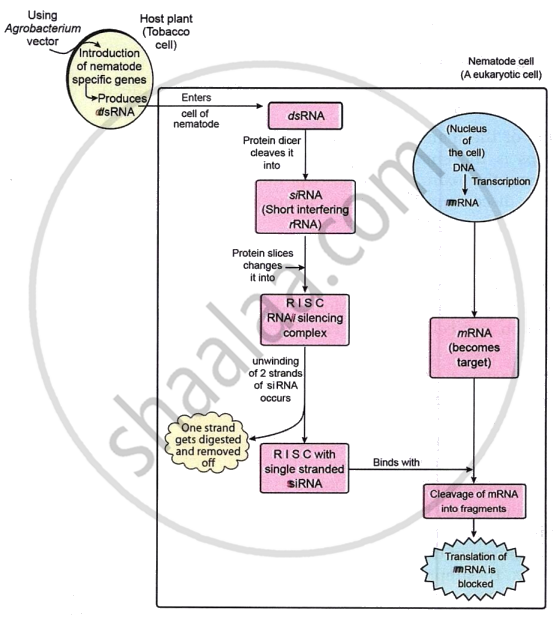
- Nematode-specific genes are introduced into the host plant (tobacco cell) using an Agrobacterium vector.
- The introduced DNA produces both sense and anti-sense RNA within the host cells.
- Because these two RNAs are complementary to each other, they pair up to form double-stranded RNA (dsRNA).
- The formation of this dsRNA is what initiates the RNA interference (RNAi) process.
CBSE: Class 12
CISCE: Class 12
CISCE: Class 12
Processing in the Nematode Cell
- The dsRNA produced by the plant enters the cell of the nematode.
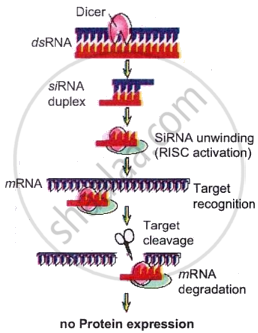
- An enzyme known as dicer (or protein dicer) cuts the long dsRNA into small fragments.
- These small RNA fragments are known as small/short interfering RNAs (siRNA).
- The siRNA molecules pass through the RNA-induced silencing complex (RISC), where the duplex unwinds and the RNA is activated.
- The siRNA binds with the Argonaute protein (also called slicer) to form the functional RISC.
- During this unwinding, one strand of the siRNA is removed, digested, and discarded, leaving RISC with single-stranded siRNA.
CBSE: Class 12
CISCE: Class 12
CISCE: Class 12
Target Cleavage and Gene Silencing
- Inside the nematode's nucleus, DNA naturally transcribes into mRNA.
- The remaining single-stranded siRNA within the RISC binds to this specific target mRNA produced by the pathogen.
- RISC then cleaves the target mRNA into fragments, promoting RNA degradation.
- This cleavage completely blocks the translation of the mRNA, silencing the specific mRNA of the nematode.
- As a consequence, the parasite cannot survive in the transgenic host, and the transgenic plant successfully protects itself.
CBSE: Class 12
CISCE: Class 12
CISCE: Class 12
RNA Interference
CBSE: Class 12
CISCE: Class 12
CISCE: Class 12
Mechanism of RNAi
CBSE: Class 12
CISCE: Class 12
CISCE: Class 12
Applications of RNAi
- It is frequently used to study the functions of genes in cell cultures and model organisms.
- It serves as a tool for gene mapping and annotation in plants.
- It can silence specific gene sequences, which can be utilised to silence genes that cause cancer.
- It is used in treatments for bacterial, viral, and parasitic diseases.
- It can also be applied to relieve pain and modulate sleep.
CBSE: Class 12
CISCE: Class 12
CISCE: Class 12
Key Points: Mechanism of RNA Interference
- Nematode-specific genes are introduced into the host plant using an Agrobacterium vector to synthesise complementary sense and antisense RNA.
- These complementary RNA strands pair together within the host cells to form a double-stranded RNA (dsRNA) molecule.
- Once the nematode ingests the dsRNA, an enzyme called dicer cleaves it into smaller fragments known as small interfering RNAs (siRNA).
- The siRNA binds with the Argonaute protein to form the RNA-induced silencing complex (RISC), where it unwinds into a single active strand.
- This single-stranded siRNA guides the RISC to bind specifically to the complementary target mRNA produced by the nematode.
- The complex cleaves the target mRNA, effectively blocking its translation into protein and neutralising the parasite to protect the plant.
