Advertisements
Advertisements
प्रश्न
Suggest how pedigree analysis can be useful?
Advertisements
उत्तर
- It is beneficial for genetic counsellors to advise prospective couples of the likelihood of having children with genetic disorders such as haemophilia, colour blindness, alkaptonuria, phenylketonuria, thalassemia, sickle cell anaemia (recessive traits), brachydactyly, and syndactyly (dominant traits).
- Pedigree analysis shows that Mendel’s ideas are relevant to human genetics, with later discoveries such as quantitative inheritance, sex-linked traits, and other connections.
- It can suggest the genesis of a characteristic in forebears; for example, haemophilia appeared in Queen Victoria and spread throughout Europe’s royal dynasties through marriage.
- It is helpful to understand the probability that a recessive allele will cause a condition in the progeny, such as thalassemia, muscular dystrophy, or haemophilia.
- It can suggest the potential harm that a marriage between close relatives could cause.
- It can help determine whether a recessive or dominant gene is responsible for a genetic condition.
- In certain situations, it may be useful to identify the genotypes of unborn children.
APPEARS IN
संबंधित प्रश्न
The pedigree chart given below shows a particular trait which is absent in parents but present in the next generatoin irrespective of sexes. Draw your conclusion on the basis of the pedigree.
A normal visioned woman, whose father is colour blind, marries a normal visioned man. What would be probability of her sons and daughters to be colour blind? Explain with the help of a pedigree chart.
What should be the genotype of the indicated member?

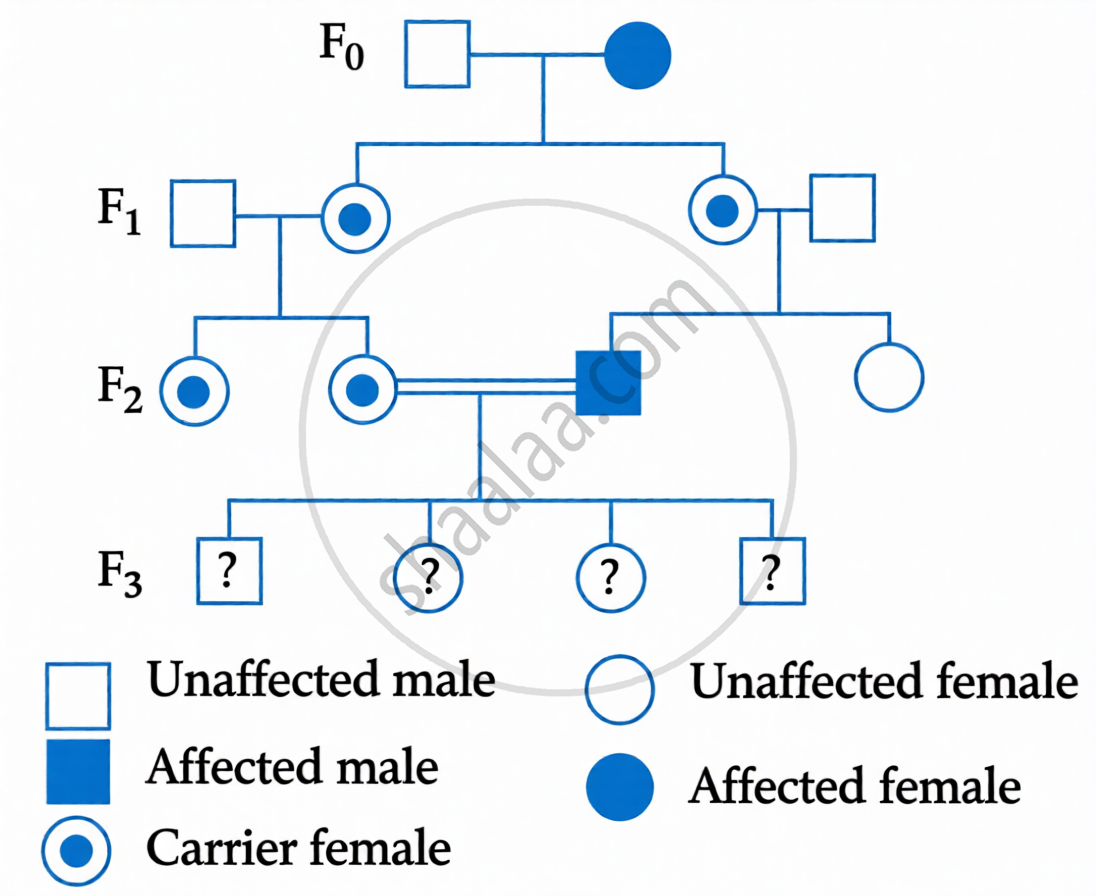
With the help of given pedigree, find out the probability for the birth of a child having no disease and being a carrier (has the disease mutation in one allele of the gene) in F3 generation.
Which one of the following symbols represents mating between relatives in human pedigree analysis?
What is the term used to describe the individual from whom a pedigree study begins?
What is the primary chart constructed during pedigree analysis called?
Why is controlled crossing not possible in human pedigree studies?
What is the typical duration of one human generation?
What symbol is used to represent a male in a pedigree chart?
What symbol is used to represent a female in a pedigree chart?
What symbol is used to represent an individual of unspecified sex in a pedigree chart?
How are affected individuals typically represented in a pedigree chart?
How are known carriers of a trait represented in a pedigree chart?
What does a horizontal line connecting two symbols in a pedigree chart represent?
What does a double horizontal line between two symbols in a pedigree chart represent?
What is the purpose of pedigree analysis in medical applications?
Why is the small family size of humans considered a limitation for pedigree analysis?
What symbol represents the death of an individual in a pedigree chart?
What symbol represents dizygotic twins in a pedigree chart?
