Advertisements
Advertisements
प्रश्न
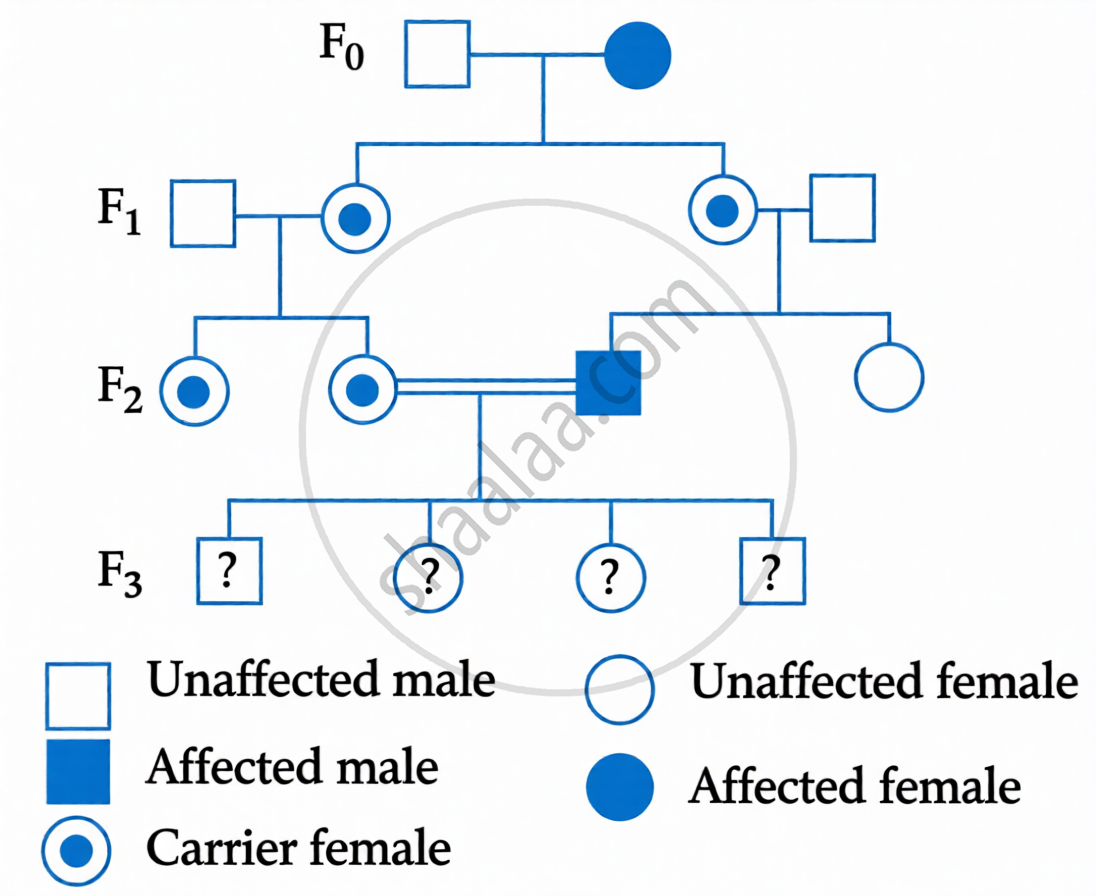
With the help of given pedigree, find out the probability for the birth of a child having no disease and being a carrier (has the disease mutation in one allele of the gene) in F3 generation.
विकल्प
1/4
1/2
1/8
Zero
Advertisements
उत्तर
1/2
Explanation:
From the pedigree:
Step 1: Determine Mode of Inheritance From the pedigree:
- Affected individuals are present in both sexes.
- Disease skips generations.
- Affected offspring (black squares and circles) appear from carrier parents.
This suggests it is an X-linked recessive disorder.
Genotype key:
- XX or XY: Normal (non-carrier, non-affected)
- XaX: Carrier female (one mutant allele, no disease)
- XaXa and XaY affected female and male
Step 2: Look at F2 Generation Couple
We are examining the F2 couple who produce the F2 children.
From the pedigree:
- Mother (F2): A carrier female → Genotype = XaX
- Father (F2): An affected male → Genotype = XaY
Their cross is:
XaX (carrier) × XaY (affected)
Step 3: Use a Punnett Square
Cross: XaX × XaY
| Xa | Y | |
| Xa | XaXa | XaY |
| X | XaX | XY |
Results:
- XaX: 25% (carrier female, not affected).
- XaXa: 25% (affected female).
- XY: 25% (unaffected male).
- XaY: 25% (affected male).
Step 4: What the Question Asks
We want the probability of a child who is Unaffected and Carrier.
25% males are unaffected, and 25% females are carriers but not diseased. So, the probability for the birth of a child having no disease and being a carrier is 50% or 1/2.
