Topics
Reproduction in Organisms
Reproduction
Sexual Reproduction in Flowering Plants
- Flower
- Pre-fertilisation in Flowering Plant: Structures and Events
- Structure and Development of Anther
- Microsporogenesis
- Structure and Development of Male Gametophyte
- Pollen Viability and Storage
- Structure and Development of Ovule
- Megasporogenesis
- Development of Female Gametophyte or Embryo Sac
- Pollination
- Autogamy
- Geitonogamy
- Cross-pollination
- Agents of Pollination
- Anemophily
- Hydrophily
- Animal-Mediated Pollination (Zoophily)
- Outbreeding Devices
- Pollen Pistil Interaction
- Artificial Hybridization or Artificial Fertilization
- Double Fertilization and Triple Fusion
- Events in Sexual Reproduction > Post-Fertilization Structures and Events
- Endosperm
- Dicotyledonous Embryo
- Monocotyledonous Embryo
- The Seed
- Apomixis
- Polyembryony
Human Reproduction
- Human Reproduction
- The Male Reproductive System
- The Female Reproductive System
- Gametogenesis
- Spermatogenesis
- Structure of Sperm
- Spermiogenesis
- Oogenesis
- Menstrual Cycle (Ovarian Cycle)
- Major Events of Menstrual Cycle
- Menstrual Hygiene
- Fertilization in Human
- Implantation in Human
- Pregnancy and Embryonic Development
- Parturition (Birth) in Human
- Lactation in Human
Genetics and Evolution
Biology and Human Welfare
Reproductive Health
- Concept of Reproductive Health
- Population Explosion and Control Measures
- Birth Control
- Natural Contraceptive Methods
- Artificial Contraceptive Methods
- Induced Abortion or Medical Termination of Pregnancy (MTP)
- Sexually Transmitted Diseases (STD) or Sexually Transmitted Infections (STI)
- Infertility
- Assisted Reproductive Technology (ART)
- Amniocentesis
- Genetic Counselling
Environmental Issues
- Controlling Vehicular Air Pollution: a Case Study of Delhi
- Effects of Domestic Sewage and Industrial Effluents on Water
- Solid Wastes
- Radioactive Wastes
- Greenhouse Effect and Climate Change
- Ozone Depletion in the Stratosphere
- Degradation by Improper Resource Utilisation and Maintenance
- Radioactive Waste Management and E-waste
Principles of Inheritance and Variation
- Heredity and Variation
- Gregor Johann Mendel – Father of Genetics
- Mendel's Experiments on Inheritance
- Monohybrid Cross
- Punnett Square
- Back Cross and Test Cross
- Mendel's Laws > The Law of Dominance
- Mendel's Laws > The Law of Segregation (Law of Purity of Gametes)
- Exceptions to Mendel's Principles > Incomplete Dominance
- Exceptions to Mendel's Principles > Co-Dominance
- Dihybrid Cross
- Mendel's Laws > The Law of Independent Assortment
- Chromosomal Theory of Inheritance
- Linkage and Recombination
- Polygenic Inheritance
- Exceptions to Mendel's Principles > Pleiotropy
- Sex Determination
- Sex Determination in Humans
- Sex Determination in Honey Bees
- Mutations
- Pedigree Analysis
- Mendelian Disorders in Humans
- Chromosomal Disorders or Abnormalities
Biotechnology
Molecular Basis of Inheritance
- Deoxyribonucleic Acid (DNA)
- Structure of Polynucleotide Chain
- Packaging of DNA Helix
- Search for Genetic Material
- Griffith’s Experiment
- Avery, McCarty and MacLeod’s Experiment
- The Hershey-Chase Experiment
- Properties of Genetic Material
- The RNA World
- DNA Replication
- Conservative Replication
- Dispersive Replication
- Semi-Conservative Replication
- Meselson and Stahl’s Experiment
- Enzymes used in DNA Replication
- Mechanism of DNA Replication
- Protein Synthesis
- Reverse Transcription (Teminism)
- Transcription
- Transcription Unit and the Gene
- Process of Transcription in Bacteria
- Process of Transcription in Eukaryotes
- Genetic Code
- Characteristics of the Genetic Code
- Mutations and Genetic Code
- Transfer RNA (tRNA)
- Translation
- Regulation of Gene Expression
- The Lac Operon
- Human Genome Project
- DNA Fingerprinting
Ecology
Evolution
- Origin of Life on Earth
- Urey and Miller’s Experiment
- Evolution of Life Forms - a Theory
- Evidences Supporting the Theory of Evolution
- Adaptive Radiation
- Theories and Mechanism of Evolution
- Theories and Mechanism of Evolution
- Hardy Weinberg’s Principle
- Types of Selection
- Brief Account of Evolution
- Human Evolution
Human Health and Diseases
- Concept and Determinants of Health
- Modes of Transmission of Diseases through Pathogens
- Diseases Caused by Bacteria > Typhoid
- Diseases Caused by Bacteria > Pneumonia
- Diseases Caused by Viruses > Common Cold
- Diseases Caused by Protozoa > Malaria
- Diseases Caused by Protozoa > Amoebiasis (Amoeboic dysentery)
- Diseases Caused by Helminths > Ascariasis
- Diseases Caused by Helminths > Filariasis (Elephantiasis)
- Diseases Caused by Fungi > Ringworm
- Prevention and Control of Infectious Diseases
- Immunity
- Types of Immunity > Innate Immunity
- Types of Immunity > Acquired Immunity
- Vaccination and Immunization
- Allergies
- Autoimmunity
- The Immune System
- Acquired Immuno Deficiency Syndrome (AIDS)
- Cancer
- Causes of Cancer
- Symptoms and Diagnosis of Cancer
- Prevention/Treatment of Cancer
- Drugs and Alcohol Abuse
- Addiction and Dependence
- Effects of Drug and Alcohol Abuse
- Prevention and Control of Drugs and Alcohol Abuse
Strategies for Enhancement in Food Production
Microbes in Human Welfare
Biotechnology - Principles and Processes
Biotechnology and Its Application
Organisms and Populations
- Organisms and Their Environment
- Population and Population Attributes
- Population Growth
- Life History Variation
- Population Interactions
- Negative Interactions > Predation
- Negative Interactions > Competition
- Negative Interactions > Parasitism
- Positive Interactions > Commensalism
- Positive Interactions > Mutualism (Symbiosis)
Ecosystem
Biodiversity and Its Conservation
Estimated time: 10 minutes
CBSE: Class 12
Steps of Transcription
1. Initiation
- RNA polymerase binds to the promoter region of the template strand.
- The DNA double helix unwinds locally at the transcription start site.
- In prokaryotes, the sigma (σ) factor assists in initiation; in eukaryotes, transcription factors (TFs) help RNA polymerase recognise and bind the promoter.
- RNA synthesis begins in the 5′ → 3′ direction.
2. Elongation
- RNA polymerase moves along the template strand in 3′ → 5′ direction.
- Nucleoside triphosphates (NTPs) serve as substrates, and complementary ribonucleotides are added.
- The RNA chain grows in the 5′ → 3′ direction.
- Only a short stretch of the RNA remains associated with the polymerase–DNA complex at any time.
3. Termination
- When RNA polymerase reaches the terminator sequence, the nascent RNA is released.
- The RNA polymerase dissociates from the DNA template.
- In prokaryotes, the rho (ρ) factor assists termination; in eukaryotes, specific termination signals exist.
- The primary transcript released in eukaryotes is hnRNA (not ready for translation yet).
CBSE: Class 12
Post-Transcriptional Processing in Eukaryotes
In eukaryotes, the primary transcript (hnRNA) is non-functional and must be processed before it can serve as mRNA for translation.
Splicing:
- Introns (non-coding intervening sequences) are removed.
- Exons (coding sequences) are joined together in a defined order.
- Performed by a molecular machine called the spliceosome (composed of snRNAs and proteins).
- Result: A continuous coding sequence without interruptions.
5′ Capping (Capping):
An unusual nucleotide - methyl guanosine triphosphate (7-methylguanosine, m⁷G) - is added to the 5′ end of hnRNA.
Functions of 5′ cap:
- Protects mRNA from degradation by 5′ exonucleases
- Aids in ribosome recognition and attachment during translation initiation
- Facilitates the export of mRNA from the nucleus
3′ Poly-A Tailing (Tailing)
- 200–300 adenylate (AMP) residues are added to the 3′ end of hnRNA.
- This occurs in a template-independent manner (by poly-A polymerase).
Functions of the poly-A tail:
- Protects mRNA from 3′ degradation
- Enhances mRNA stability and half-life
- Assists in the nuclear export of mRNA
After all three processing steps, the fully processed hnRNA is now called mature mRNA and is transported out of the nucleus to the cytoplasm for translation.
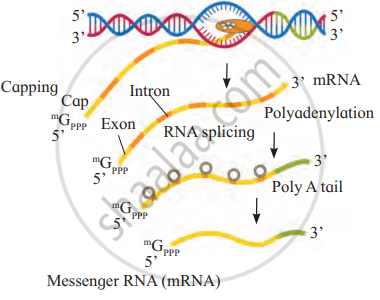
Transcription and Processing of hnRNA to mRNA in Eukaryotes
CBSE: Class 12
Key Points: Process of Transcription in Eukaryotes
- Transcription copies DNA → RNA using RNA polymerase, following complementarity rules (A pairs with U).
- In eukaryotes, 3 RNA polymerases: Pol I (rRNA), Pol II (hnRNA → mRNA), and Pol III (tRNA, 5S rRNA, snRNA).
- The template strand has 3′→5′ polarity; RNA is synthesised 5′→3′.
- Transcription unit = Promoter + Structural Gene + Terminator.
- In eukaryotes, the primary transcript = hnRNA, which contains both exons and introns.
- 3 processing steps: Splicing (remove introns) → 5′ Capping (m⁷G) → 3′ Poly-A tailing (200–300 A residues).
- Mature mRNA is transported to the cytoplasm for translation.
