Advertisements
Advertisements
Question
Who amongst the following scientists had no contribution in the development of the double helix model for the structure of DNA?
Options
Meselson and Stahl
Erwin Chargaff
Maurice Wilkins
Rosalind Franklin
Advertisements
Solution
Meselson and Stahl
APPEARS IN
RELATED QUESTIONS
Group the following as nitrogenous bases and nucleosides:
Adenine, Cytidine, Thymine, Guanosine, Uracil and Cytosine.
If a double stranded DNA has 20 per cent of cytosine, calculate the per cent of adenine in the DNA.
Which property of DNA double helix led Watson and Crick to hypothesise semi-conservative mode of DNA replication? Explain.
One turn of DNA possesses ______.
Both deoxyribose and ribose belong to a class of sugars called ______.
If 30 percent of an organism’s DNA is thymine, then ______.
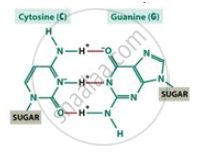
H-bonds between Cytosine and Guanine are ______.
Retroviruses do not follow central Dogma. Comment.
During in vitro synthesis of DNA, a researcher used 2’, 3’ – dideoxy cytidine triphosphate as raw nucleotide in place of 2’-deoxy cytidine. What would be the consequence?
A short piece of DNA, having 20 base pairs, was analyzed to find the number of nucleotide bases in each of the polynucleotide strands. Some of the results are shown in the table.
| Number of nucleotide bases | ||||
| Adenine | Cytosine | Guanine | Thymine | |
| Strand 1 | 4 | 4 | ||
| Strand 2 | 5 | |||
How many nucleotides containing Adenine were present in strand 2?
What structural difference exists between the pentose sugar found in DNA and the pentose sugar found in RNA?
What type of bond connects a nitrogenous base to the pentose sugar in a nucleotide?
Which end of a polynucleotide chain contains a free phosphate group?
In a DNA double helix, what is the spatial relationship between the two polynucleotide strands?
What is the significance of the 2′-OH group in ribose compared to deoxyribose?
Why is the name 'deoxyribonucleic acid' appropriate for DNA?
What type of bond connects a nitrogenous base to the pentose sugar in a nucleotide?
In a polynucleotide chain, nucleotides are linked together by which type of bond?
