Advertisements
Chapters
1: Reproduction in Organisms
2: Sexual Reproduction in Flowering Plants
3: Human Reproduction
4: Reproductive Health
UNIT 2 : GENETICS AND EVOLUTION
5: Principles of Inheritance and Variation
6: Molecular Basis of Inheritance
7: Origin of Life
8: Evidences and Theories of Biological Evolution
▶ 9: Human Evolution
UNIT 3 : BIOLOGY AND HUMAN WELFARE
10: Human Health and Diseases
11: Strategies for Enhancement in Food Production
12: Microbes in Human Welfare
UNIT 4 : BIOTECHNOLOGY AND ITS APPLICATIONS
13: Principles and Processes of Biotechnology
14: Biotechnology and Its Applications
UNIT 5 : ECOLOGY AND ENVIRONMENT
15: Organisms and Populations
16: Ecosystem
17: Biodiversity and Its Conservation
18: Environmental Issues
![Nootan solutions for Biology [English] Class 12 ISC chapter 9 - Human Evolution - Shaalaa.com](/images/biology-english-class-12-isc_6:5d0f76efd5b64b75a3ef882e75824c08.png "Nootan solutions for Biology [English] Class 12 ISC chapter 9 - Human Evolution")
Advertisements
Solutions for Chapter 9: Human Evolution
Below listed, you can find solutions for Chapter 9 of CISCE Nootan for Biology [English] Class 12 ISC.
Nootan solutions for Biology [English] Class 12 ISC 9 Human Evolution TEST YOUR PROGRESS [Pages 363 - 365]
OBJECTIVE TYPE QUESTIONS Choose the correct answer from the alternatives given.
Which of the following is not characteristic of apes?
Movement on the trees by brachiation
Wrists that bend backward
Movement on the ground by knuckle-walking
Highly mobile shoulder joints
Which of the following was not an anatomic change in the evolution of the Homo line from australopithecine ancestors to Homo erectus?
Decrease in the ratio of humerus to femur length
Modifications of the limbs for upright walking
Increase in brain size from roughly 450 cm3 to roughly 1000 cm3
Increase in sexual dimorphism
The first true hominids in the fossil record have been placed in the genus ______.
Aegyptopithecus
Australopithecus
Dryopithecus
Homo
Which one of the following has the largest cranial capacity ranging from 1300-1750 cm3?
Homo erectus
Homo habilis
Homo sapiens neanderthalensis
Homo sapiens
Which of the following is incorrectly matched?
Homo erectus - made tools
Homo habilis - controlled fire
Cro-magnon - good artist
Neanderthal - good hunter
The possibility that the Neanderthals did not interbreed extensively with modern humans is supported by evidence that shows ______.
the two groups did not coexist at the same time - Neanderthals died out before modern humans first appeared
the two groups have been shown to have very different gene pools
the uniformity of human mitochondrial DNA may point to the origin of all modern humans from a very small splinter population
fossil evidence shows that modern humans evolved in Africa, whereas Neanderthals lived in Eurasia
Homo erectus could have been the first to ______.
make tools
migrate out of Africa
use and control fire
all of these
Which of the following characteristics is not consistent with the others?
Projecting face
High forehead
Large zygomatic arch
Large brow ridge
The last common ancestor for apes and hominids ______.
is not expected to be found because there was no such common ancestor
has been found and it has been dated at 30 MYA
has not been found but it is expected to be from the Pliocene epoch
has been found and it resembles a gibbon
Which of the following is incorrectly matched?
Homo erectus - Homo
Gibbon - hominoid
Australopithecus africanus - hominid
Tarsier - anthropoid
Lucy is a member of which of the following species?
Australopithecus afarensis
Homo erectus
Australopithecus robustus
Homo habilis
The son of Lucy lived ______.
about 3.5 mya
in the same epoch as Lucy
about 3 mya
both (b) and (c)
Which one of the following is the correct sequence?
Early Homo sapiens → Cro-magnon → Neanderthal → Modern man
Cro-magnon → Early Homo sapiens → Neanderthal → Modern man
Early Homo sapiens → Neanderthal → Cro-magnon → Modern man
Cro-magnon → Neanderthal → Early Homo sapiens → Modern man
Which one of the following is a true man?
Neanderthal man
Homo erectus
Homo habilis
Shivapithecus
The most accepted line of descent in human evolution is ______.
Ramapithecus → Homo habilis → Homo erectus → Homo sapiens
Australopithecus → Homo erectus → Homo habilis → Homo sapiens
Australopithecus → Ramapithecus → Homo sapiens → Homo erectus
Neanderthal man → Ramapithecus → Peking man → Homo sapiens
Fill in the blanks with appropriate words.
The two extinct species in the genus Homo are ______ and ______ One of these species, ______ now includes the fossils known as Java man and Peking man, which were originally placed in the genus Pithecanthropus.
The Cro-magnon people were ______.
State whether the following statements are true or false.
State whether the following statement is true or false.
The evolutionary history of primates dates back to early Palaeozoic era, about 300 million years ago.
State whether the following statement is true or false.
The ancestors of modern anthropoids had reduced nose, stereoscopic vision, grasping hands and feet with nails on fingers and toes.
State whether the following statement is true or false.
The study of the interrelations of biological, cultural, geographical, and historical aspects of humankind is known as anthropology.
VERY SHORT ANSWER TYPE QUESTIONS
Name the most recent direct prehistoric ancestor of the present man (Homo sapiens sapiens).
What is the name given to the fossil hominid of Shivalik Hills in India?
Name the continent from where most of the fossils of the primitive man have been excavated.
Name that ancestor of modern man which possessed a cranial capacity nearly equal to that of today's man.
Name the prehistoric ancestor of the present man who is believed to have first made use of the fire for hunting, cooking and protection.
Which living ape is the closest primate relative of humans?
Which chromosomes in humans and chimpanzee show an identical banding pattern?
Starting with the oldest form rearrange the following genera/species in the sequence of their appearance on the earth:
Homo erectus, Homo sapiens, Ramapithecus, Homo habilis, Australopithecus.
In which era of geological time scale, mammals dominated the scene?
Write the order in which Neanderthals, Homo habilis and Homo erectus appeared on earth. State the brain capacity of each one of them.
When did modern Homo sapiens appear on this planet?
Name the common ancestor of the great apes and man.
Write the names of different races of modern man.
Give any two distinctive features of Dryopithecus.
Name the ancestors of man based on the features given below:
More human with brain size 1400 cc, lived in central Asia, used hides and buried their dead.
Name the primates that lived about 15 million years ago. List their characteristic features.
Mention any three characteristics of Neanderthal man that lived in near east and central Asia.
Mention the brain capacity of Homo habilis.
Mention the brain capacity of Neanderthal man.
Where was the first man-like animals found?
By what latin name the first human-like being, the homonid was known?
Write the probable differences in eating habits of Homo habilis and Homo erectus.
Name the scientist who discovered the fossil of Cro-magnon man.
Write the name of the following:
A 15 mya primate that was ape-like.
Write the name of the following:
A 2 mya primate that lived in East African grasslands.
Rearrange the human activities mentioned below as per the order in which they developed after the modern Homo sapiens came into existence during ice age:
- Human settlement
- Prehistoric cave art
- Agriculture
In which period and by which nearest ancestors did the evolution of modern man take place?
Enumerate two morphological characteristics of human limb associated with bipedalism.
Write down the scientific name of first primitive man.
Write the biological name of present man.
Name the common ancestor of apes and man.
SHORT/LONG ANSWER TYPE QUESTIONS
Give four features in which human beings are considered more advanced than apes.
When and where did the oldest known fossil species of Homo appear? What is its scientific name? Mention any one feature in which this species showed improvement over Australopithecus.
Differentiate between cultural evolution and biological evolution.
Give one example of cultural evolution in humans.
Give one example of biological evolution in humans.
Why are the apes of the past regarded remote ancestors of man?
Comment upon two fossil apes which might have been representatives of the direct line of human evolution.
Give the characteristic features that suggest a close phylogenetic relationship between man and apes.
Trace the various components of human evolution in the light of the following characteristic:
Brain size and function
Trace the various components of human evolution in the light of the following characteristic:
skeletal structure
Trace the various components of human evolution in the light of the following characteristic:
dietary preference
Enumerate in tabular form some important features of Handy man, Java ape man, Neanderthal man and Cromagnon man.
Nootan solutions for Biology [English] Class 12 ISC 9 Human Evolution BOARD EXAMINATION QUESTIONS [Page 366]
Give reasons to show that Cro-magnon man is the direct ancestor of man of today.
Give two characteristic features of Cro-Magnon man.
What are the chromosomal similarities found in apes and man? What do such similarities indicate?
What are the characteristics that have developed in human beings during evolution?
Give any three characters that have developed during human evolution.
Write the characteristic features of a typical or Neanderthal man.
Give the characteristic features that suggest a close phylogenetic relationship between man and apes.
State three structural features by which Neanderthal man differed from Homo sapiens.
Differentiate between Apes and Man with respect to the following characteristics:
- Posture
- Cranium
- Brow ridges
- Locomotion
What is the difference between the teeth of apes and the teeth of man?
Give two characteristic features of the following:
Ramapithecus
Give two characteristic features of the following:
Cro-magnon man
Nootan solutions for Biology [English] Class 12 ISC 9 Human Evolution HIGHER ORDER THINKING SKILLS QUESTIONS (HOTS) [Page 366]
Name the ancestors of man based on the features given below:
Human like, meat-eater with 900 cc brain, lived in Java.
Name the ancestors of man based on the features given below:
More human with brain size 1400 cc, lived in central Asia, used hides and buried their dead.
Name the ancestors of man based on the features given below:
Human like, vegetarian, with brain capacity between 650 cc and 800 cc
Name the ancestors of man based on the features given below:
Man like primate, that existed about 15 mya, fossils found in Tanzania.
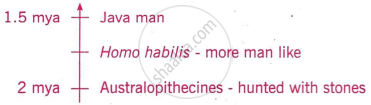
Study the ladder of human evolution as given above and answer the following questions.
- Where did Australopithecines evolve?
- Write the scientific name of Java man.
State the main morphological changes that occurred in the ancestors of modern man.
Rearrange Ramapithecus, Australopithecus and Homo habilis is in the order of their evolution on the earth. Comment on their evolutionary characteristics.
Nootan solutions for Biology [English] Class 12 ISC 9 Human Evolution NCERT EXERCISES [Page 367]
Find out from newspapers and popular science articles any new fossil discoveries or controversies about evolution.
Try to trace the various components of human evolution (hint: brain size and function, skeletal structure, dietary preference, etc.).
Find out through internet and popular science articles whether animals other than man have self-consciousness.
Can we call human evolution as adaptive radiation?
Nootan solutions for Biology [English] Class 12 ISC 9 Human Evolution VALUE BASED QUESTION [Page 367]
In your opinion what advantages man got over other primates by having erect posture and large brain?
Solutions for 9: Human Evolution
Nootan solutions for Biology [English] Class 12 ISC chapter 9 - Human Evolution
Shaalaa.com has the CISCE Mathematics Biology [English] Class 12 ISC CISCE solutions in a manner that help students grasp basic concepts better and faster. The detailed, step-by-step solutions will help you understand the concepts better and clarify any confusion. Nootan solutions for Mathematics Biology [English] Class 12 ISC CISCE 9 (Human Evolution) include all questions with answers and detailed explanations. This will clear students' doubts about questions and improve their application skills while preparing for board exams.
Further, we at Shaalaa.com provide such solutions so students can prepare for written exams. Nootan textbook solutions can be a core help for self-study and provide excellent self-help guidance for students.
Concepts covered in Biology [English] Class 12 ISC chapter 9 Human Evolution are Scientific Perspectives on Human Origins, Place of Man in the Animal Kingdom, Early Human Ancestors > Prior to Ape Man, Early Human Ancestors > The Ape Man, Early Human Ancestors > The Early Man, Man Vs Ape, Average Cranial Capacities of Apes and Men, Social Behaviour in Human Evolution, The Man of Future, Stages of Human Evolution.
Using Nootan Biology [English] Class 12 ISC solutions Human Evolution exercise by students is an easy way to prepare for the exams, as they involve solutions arranged chapter-wise and also page-wise. The questions involved in Nootan Solutions are essential questions that can be asked in the final exam. Maximum CISCE Biology [English] Class 12 ISC students prefer Nootan Textbook Solutions to score more in exams.
Get the free view of Chapter 9, Human Evolution Biology [English] Class 12 ISC additional questions for Mathematics Biology [English] Class 12 ISC CISCE, and you can use Shaalaa.com to keep it handy for your exam preparation.
