Topics
Sexual Reproduction in Flowering Plants
- Sexual Reproduction
- Life Cycle of Angiosperms
- Flower
- Types of Flowers
- Events in Sexual Reproduction > Pre-fertilization Events
- Structure and Development of Anther
- Microsporogenesis
- Structure and Development of Male Gametophyte
- Structure and Development of Ovule
- Types of Ovules (Based on Orientation)
- Types of Ovules (Based on Integuments)
- Megasporogenesis
- Development of Female Gametophyte or Embryo Sac
- Male Vs Female Gametophytes in Angiosperms
- Pollination
- Self-pollination
- Autogamy
- Cross-pollination
- Geitonogamy
- Outbreeding Devices
- Agents and Types of Cross-pollination
- Anemophily
- Hydrophily
- Entomophily
- Ornithophily
- Cheiropteriphily
- Malacophily
- Wind Vs Insect-pollinated flowers
- Self-pollination Vs Cross-pollination
- Events in Sexual Reproduction > Fertilization (Syngamy)
- Artificial Hybridization or Artificial Fertilization
- Pollen Pistil Interaction
- Double Fertilization and Triple Fusion
- Events in Sexual Reproduction > Post-Fertilization Structures and Events
- Endosperm
- Dicotyledonous Embryo
- Monocotyledonous Embryo
- Parthenocarpy
- Polyembryony
- Apomixis
- Formation of Seed and Fruit
- The Fruit
- The Seed
Reproduction
Reproduction in Organisms
- Reproduction
- Modes of Reproduction
- Asexual Reproduction
- Asexual Reproduction in Unicellular Organisms > Binary Fission
- Binary Fission > Simple Binary Fission
- Binary Fission > Transverse Binary Fission
- Binary Fission > Longitudinal Binary Fission
- Asexual Reproduction in Unicellular Organisms > Multiple Fission
- Asexual Reproduction in Unicellular Organisms > Budding
- Asexual Reproduction in Multicellular Organisms > Budding
- Asexual Reproduction in Animals > Gemmule Formation
- Asexual Reproduction in Multicellular Organisms > Regeneration
- Asexual Reproduction in Multicellular Organisms > Fragmentation
- Asexual Reproduction in Multicellular Organisms > Spore Formation
- Binary Vs Multiple Fission
- Vegetative Reproduction or Vegetative Propagation
- Natural Vegetative Propagation
- Artificial Vegetative Propagation
- Sexual Reproduction
- Monocarpic Vs Polycarpic Plants
- Events in Sexual Reproduction > Pre-fertilization Events
- Events in Sexual Reproduction > Fertilization (Syngamy)
- Events in Sexual Reproduction > Post-Fertilization Structures and Events
- Sexual Vs Asexual Reproduction
- Sexuality in Plants
- Sexuality in Animals
- Oviparous Vs Viviparous Animals
- Parthenogenesis (Virgin Birth)
- Oestrus vs Menstrual Cycles
Genetics and Evolution
Human Reproduction
- Human Reproduction
- Secondary Sexual Characteristics in Humans
- Human Reproductive Organs
- The Male Reproductive System
- Testes
- Location and Temperature Regulation of Testes
- Structure of Testis
- Duct system of Male Reproductive Tract
- Accessory Glands of Male Reproductive System
- External Genitalia: Penis
- Semen (Seminal fluid)
- Disorders of Male Reproductive System
- The Female Reproductive System
- External Genitalia: Vulva
- Female Internal Reproductive Organ > Ovary
- Ovarian Follicle Development and Function
- Female Reproductive Duct System
- Mammary Glands
- Disorders of Female Reproductive System
- Male Urethra Vs Female Urethra
- Graafian Follicle Vs Corpus Luteum
- Sperm Vs Ovum
- Gametogenesis
- Spermatogenesis
- Spermiogenesis
- Factors affecting Spermatogenesis
- Structure of Sperm
- Oogenesis
- Spermatogenesis Vs Oogenesis
- Puberty
- Hormonal Control of Puberty
- Menstrual Cycle (Ovarian Cycle)
- Major Events of Menstrual Cycle
- Hormonal Control of Menstrual Cycle
- Menarche and Menopause
- Embryonic Development in Human
- Fertilization in Humans
- Fate of Germ Layers in Embryonic Development
- Major Features of Embryonic Development
- Placenta (Growth) in Human
- Parturition (Birth) in Human
- Lactation in Human
Reproductive Health
- Concept of Reproductive Health
- Population Explosion and Control Measures
- Birth Control
- Natural Contraceptive Methods
- Artificial Contraceptive Methods
- Induced Abortion or Medical Termination of Pregnancy (MTP)
- Inequality of Sexes
- Infertility
- Assisted Reproductive Technology (ART)
- In Vitro Fertilization (IVF)
- Amniocentesis
- Genetic Counselling
- Sexually Transmitted Diseases (STD) or Sexually Transmitted Infections (STI)
- Gonorrhoea
- Syphilis
- Genital Herps
- Chlamydiasis
- Genital Warts
- Trichomoniasis
- Hepatitis B
- Acquired Immuno Deficiency Syndrome (AIDS)
Biology and Human Welfare
Biotechnology and Its Applications
Principles of Inheritance and Variation
- Heredity and Variation
- Gregor Johann Mendel – Father of Genetics
- Mendel's Experiments on Inheritance
- Crossing Technique
- Monohybrid Cross
- Dihybrid Cross
- Mendel's Laws > The Law of Dominance
- Mendel's Laws > The Law of Segregation (Law of Purity of Gametes)
- Mendel's Laws > The Law of Independent Assortment
- Genetic Terminology
- Reasons for Mendel's Success
- Applications and Beyond Mendel's Laws
- Exceptions to Mendel's Principles > Incomplete Dominance
- Exceptions to Mendel's Principles > Co-Dominance
- Exceptions to Mendel's Principles > Pleiotropy
- Exceptions to Mendel's Principles > Multiple alleles
- Exceptions to Mendel's Principles > Polygenic traits - Quantitative inheritance
- Pedigree Analysis
- Chromosomal Theory of Inheritance
- Linkage
- Types of Linkage > Complete Linkage
- Types of Linkage > Incomplete Linkage
- Influencing Factors and Significance of Linkage
- Influencing Factors and Significance of Linkage
- Linked and Unlinked Genes
- Mechanism of Crossing Over
- Types of Crossing Over
- Influencing Factors and Significance of Crossing Over
- Autosomes and Sex Chromosomes
- Sex Determination
- Sex Linked Traits
- Basis of Sex Determination
- Sex Determination in Honey Bees
- Morgan and Drosophila
- Sex Linked Inheritance
- Sex-linked Inheritance in Drosophila
- Sex-Linked Inheritance in Human Beings
- Colour blindness
- Haemophilia
- Human Genetic Disorders
- Mendelian Disorders in Humans
- Autosomal Abnormilities
- Sex Chromosome Abnormalities
- Disorders of Sex Development due to Sex-Chromosome Abnormality
- Variation
- Recombinations
- Mutations
- Gene Mutations
- Frame Shift Mutations
- Substitution (Replacement) Mutations
- Chromosomal Mutations or Aberrations: Deficiency or deletion
- Chromosomal Mutations or Aberrations: Duplication
- Chromosomal Mutations or Aberrations: Translocation
- Chromosomal Mutations or Aberrations: Inversion
- Genomic Mutations or Heteroploidy or Numerical Aberrations: Aneuploidy
- Genomic Mutations or Heteroploidy or Numerical Aberrations: Euploidy
- Induction of Gene Mutation
- Polyploidy: Instant Speciation
Molecular Basis of Inheritance
- Concept of Genes
- Nature of Genes
- Griffith’s Experiment
- Avery, McCarty and MacLeod’s Experiment
- The Hershey-Chase Experiment
- Properties of Genetic Material
- Indirect Evidences for DNA as the Genetic Material
- DNA Vs RNA
- Tobacco Mosaic Virus (TMV)
- The RNA World
- Biomolecules in the Cell > Nucleic Acids
- Deoxyribonucleic Acid (DNA)
- Purines Vs Pyrimidines
- Chargaff's Rules for Base Pairing in DNA
- Structure of Polynucleotide Chain
- Variants of Double Helix DNA
- Prokaryotic DNA Vs Eukaryotic DNA
- ssDNA vs dsDNA
- Ribonucleic acid (RNA)
- Ribosomal RNA (rRNA)
- Messenger RNA (mRNA)
- Transfer RNA (tRNA)
- Prokaryotic mRNA Vs Eukaryotic mRNA
- Various Other Types of RNA
- DNA Replication
- Conservative Replication
- Dispersive Replication
- Semi-Conservative Replication
- Meselson and Stahl’s Experiment
- Enzymes used in DNA Replication
- Mechanism of DNA Replication
- Leading Strand Vs Lagging Strand
- Errors in DNA Replication and Its Repair
- Protein Synthesis
- Reverse Transcription (Teminism)
- Transcription
- Transcription Unit and the Gene
- Post-transcriptional Processing of RNAs
- Translation
- Protein Synthesis in Prokaryotes and Eukaryotes
- Genetic Code
- Characteristics of the Genetic Code
- Chain Initiation and Chain Termination Codons
- Mutations and Protein Structure
- Mechanism of Translation
- Packaging of DNA Helix
- Regulation of Gene Expression
- Induction and Repression
- Operon Concept
- The Lac Operon
- Human Genome Project
- DNA Fingerprinting
- Rice Genome Project
Ecology and Environment
Origin of Life
- The Universe
- Origin of Solar System
- Origin of Life on Earth
- Biochemical Origin of Life
- First step: Origin of Earth and its Primitive Atmosphere
- Second step: Origin of Molecules and Simple Inorganic Compounds
- Third step: Origin of Organic Compounds
- Fourth step: Origin of Colloids, Coacervates and Individuality
- Fifth step: Origin of Autocatalytic Systems, Genes, Viruses and Primordial Life
- Sixth step: Origin of Primordial Cellular forms of Life (Prokaryotes)
- Seventh step: Origin of Autotrophism
- Eighth step: Origin of Eukaryotic Cells
- Basic Terms related to Origin of Life
- Effects of Oxygen on Evolution
- Development of Life through Evolution
Evidences and Theories of Biological Evolution
- Evidences of Organic Evolution
- Evidences of organic evolution > Palaeontology
- Computation of the Age of a Fossil
- Mass Extinctions
- Geological Time Scale
- Evolutionary Evidence from Fossil Records
- Homology and Homologous Organs
- Analogy and Analogous Organs
- Evidences of Evolution > Vestigial Organs
- Evidences of Evolution > Connecting Links
- Evidences of Evolution > Embryological Evidences
- Atavism
- Recapitulation Theory
- Evidences from Cell Biology and Biochemistry
- Molecular (Genetic) Evidences
- Evidences from Geographical Distribution
- Adaptive Radiation
- Theories and Mechanism of Evolution
- Lamarck’s Theory of Evolution (Lamarckism)
- Neo-Lamarckism
- Darwin’s Theory of Natural Selection (Darwinism)
- Basic Postulates of Darwinism
- Drawbacks and Criticism of Darwinism
- Neo-Darwinism
- Mutation Theory of De Vries
- Modern Theory of Evolution
- Causes of Variations
- Common Misconceptions about the Theory of Evolution
- Mutations
- Implications of Mutations
- Recombinations
- Migration
- Genetic Drift
- Gene Flow
- Selection
- Types of Selection
- Hardy Weinberg’s Principle
- Modern Synthetic Theory of Evolution > Natural Selection
- Natural Vs Artificial Selection
- Adaptations
- Process of Adaptation
- Genetic basis of Adaptation
- Convergent vs Divergent Evolution
- Speciation
Human Evolution
Human Health and Diseases
- Health
- Human Diseases > Communicable / Infectious Diseases
- Modes of Transmission of Diseases through Pathogens
- Diseases Caused by Bacteria > Typhoid
- Diseases Caused by Bacteria > Pneumonia
- Diseases Caused by Bacteria > Diphtheria
- Diseases Caused by Bacteria > Plague
- Diseases Caused by Viruses > Common Cold
- Diseases Caused by Viruses > Dengue Fever
- Diseases Caused by Viruses > Chikungunya
- Diseases Caused by Protozoa > Malaria
- Diseases Caused by Protozoa > Amoebiasis (Amoeboic dysentery)
- Diseases Caused by Helminths > Ascariasis
- Diseases Caused by Helminths > Filariasis (Elephantiasis)
- Diseases Caused by Fungi > Ringworm
- Human Diseases > Non-communicable or Non-infectious Diseases
- Cancer
- Types of Cancer
- Causes of Cancer
- Organs Commonly Affected by Cancer
- Chemical Carcinogens and their Target Tissues
- Symptoms and Diagnosis of Cancer
- Prevention/Treatment of Cancer
- Microbial Pathogenesis and Portals of Entry
- Barriers to Invasion by Pathogens
- The Body's Defence Mechanisms
- The Immune System
- Lymphoid Organs
- Production of Lymphocytes
- Cellular Immune Response (Response of T-Cells to Antigens)
- Humoral Immune Response (Response of B-Cells to Antigens)
- Antigens
- Antibodies
- Mechanism of Action (Effector Mechanisms)
- Allergies
- Immunity
- Types of Immunity > Innate Immunity
- Types of Immunity > Acquired Immunity
- Vaccines
- Monoclonal Antibodies
- Interferons
- Autoimmunity
- Immunodeficiency Disorders
- Acquired Immuno Deficiency Syndrome (AIDS)
- Organ Transplants and Immunosuppression
- Kidney Transplantation
- Role of Stem Cells in Medical Treatment
- Concept of Adolescence
- Addiction
- Tobacco
- Tobacco Smoking: Health Impacts and Statistics
- Addiction > Alcohol
- Common Misconceptions about Alcoholism
- Impact of Alcohol Use and Abuse on Health
- Symptoms of Alcohol Intoxication
- Cannabis/Cannabinoids
- Categories of Drugs
- Hallucinogens
- Drug Abuse
Microbes in Human Welfare
Strategies for Enhancement in Food Production
- Rise of Agriculture and Settled Life
- Origin of Cultivated Plants
- Green Revolution
- Crop Improvement
- Steps in Plant Breeding
- Selection in Plant Breeding
- Types of Selection in Plant Breeding
- Hybridization
- Hybridization Procedure
- Plant Breeding for Disease Resistance
- Plant Breeding for Developing Resistance to Insect Pests
- Hybrid Vigour (Heterosis)
- Induced Mutations
- Plant Introduction and Acclimatization
- Tissue Culture
- Technique of Tissue Culture
- Components of Culture Media for Cell/Tissue Culture
- Types of Cell/Tissue Culture
- Applications of Tissue Cultures in Crop Improvement
- Single Cell Protein (SCP)
- Biofortification
- Animal Husbandry (Livestock) > Apiculture (Bee Farming)
- Animal Husbandry (Livestock) > Dairy (Livestock) Farm Management
- Cattle Management
- Controlled Breeding Experiments (Artificial Insemination)
- MOET Programme
- Animal Husbandry (Livestock) > Animal Breeding
- Common Livestock Diseases
- Nutritive Value of Milk
- Utility of Cattle
- Livestock Development in India
- Animal Husbandry (Livestock) > Poultry Farm Management
- Poultry Farming Vs Livestock Rearing
- Raising of Poultry
- Nutritive Value of Eggs
- Poultry Development in India
- Honey Bee
- Bee Keeping and Extraction of Honey
- Products of Bee Keeping/ Advantage of Apiculture
- Development of Apiculture in India
- Animal Husbandry (Livestock) > Pisciculture (Fish Farming)
- Fisheries in India
Principles and Processes of Biotechnology
- Concept of Biotechnology
- Principles of Processes of Biotechnology
- Genetic Engineering
- Recombinant DNA technology
- Tools of Recombinant DNA Technology
- Restriction Enzymes
- Features of an Ideal Vector
- Plasmids
- pBR 322 Vectors
- pUC Vectors
- Agrobacterium tumefaciens
- Phages
- Artificial Chromosomes as Vectors
- Cloning Vectors and Gene Libraries
- Cloning
- Processes of Recombinant DNA Technology
- Applications and Risks of Genetic Engineering
- Moral and Ethical Issues of Genetic Engineering
- Genetic Transformation in Plants
- Genetic Transformation in Animals
Biotechnology and Its Applications
- Applications of Biotechnology in Agriculture
- Bt Cotton
- Pest-Resistant Plant
- Mechanism of RNA Interference
- Applications of Biotechnology in Health and Medicine
- Stem Cell Technology
- Stem Cell Therapy
- Gene Therapy
- Molecular Diagnosis
- ELISA
- Transgenic Animals
- Biopatent
- Role of GEAC in Regulating Genetically Modified Organisms in India
- Bioethics
- Biopiracy
- Biosafety Issues
Organisms and Populations
- Ecology and Biomes
- Levels of Ecological Organisation
- Population Interactions
- Interaction between Organisms
- Intraspecific Relationships
- Interspecific Relationships
- Positive Interactions > Commensalism
- Positive Interactions > Proto-cooperation
- Positive Interactions > Mutualism (Symbiosis)
- Negative Interactions > Predation
- Negative Interactions > Parasitism
- Negative Interactions > Competition
- Negative Interactions > Amensalism
- Concepts and Measures of Population Ecology
- Environmental Resistance
- Population Growth
- Carrying Capacity
- Environmental Stochasticity
- Population Growth Curve
- Population Age Distribution
- Sex Ratio
- Population Dispersal and Energy Flow (Bioenergetics)
- Life History Variation
Ecosystem
- Concept of Ecosystem
- Biotic Component > Producers
- Biotic Component > Consumers
- Biotic Component > Decomposers
- Ecological Terms
- Food Chain
- Types of Food Chain
- Trophic Levels
- Food Web
- Ecological Pyramids
- Abiotic Component
- Functions of an Ecosystem
- Structure of Pond Ecosystem
- Flow of Energy
- Productivity
- Efficiencies in Ecosystem
- Decomposition
- Ecosystem Services
Biodiversity and Its Conservation
- Biodiversity
- Global Biodiversity
- Patterns of Biodiversity
- Biodiversity In India
- Importance of Biodiversity
- Rivet-Popper Hypothesis
- Loss of Biodiversity
- Need for Biodiversity Conservation
- Threatened Species
- Endangered Flora and Fauna
- Hotspots of Biodiversity
- Red Data Book
- Genetic Conservation
- Gene Pool
- Genetic Erosion
- Conservation Strategies
- Wildlife Conservation Strategy in India
- Wildlife Acts/Projects of India for Wildlife Conservation
- Protected Areas in India
- Biosphere Reserve
- National Parks
- Wildlife Sanctuary
- Sacred Groves
- Botanical Gardens
- Wildlife Safari
- Seed Bank
- Cryopreservation
- Gene (Germplasm) Banks
- Ramsar Sites
- Conventions on Biological Diversity
- Earth Summit
- World Summit on Sustainable Development (WSSD)
Environmental Issues
- Environmental Pollution
- Kinds of Pollutants
- Air Pollution
- Sources of Air Pollution
- Major Air Pollutants
- Effects of Air Pollution
- Greenhouse Effect
- Global Warming
- El Nino Effect
- Prevention and Control of Air Pollution
- Ozone
- Ozone Layer Depletion
- Acid Rain
- Nuclear Winter
- Climate Change
- Kyoto Protocol
- Water Pollution
- Sources of Water Pollution
- Ganga and Yamuna River Pollution Control Initiatives
- Effects of Water Pollution
- Effect of Agrochemicals
- Environmental Acts
- Prevention and Control of Water Pollution
- Eutrophication
- Biochemical Oxygen Demand (BOD)
- Biological Concentration and Biomagnification
- A Case Study of Integrated Waste Water Treatment
- Ecosan Toilets
- Noise Pollution
- Sources of Noise Pollution
- Effects of Noise Pollution
- Decibel
- Prevention and Control of Noise Pollution
- Radioactive Pollution
- Sources of Radioactive Pollution
- Effect of Radioactive Pollution
- Prevention and Control of Radioactive Pollution
- Soil Pollution
- Sources of Soil Pollution
- Effects of Soil Pollution
- Prevention and Control of Soil Pollution
- Land Degradation
- Soil Erosion
- Prevention and Control of Land Degradation
- Land and Water Management in India
- Wasteland Development
- Solid Waste Management
- E-waste Management
- Deforestation and Its Causes
- Consequences of Deforestation
- Conservation of Forests
- Case Study of People's Participation in Conservation of Forests
- Case Study of Organic Farming
- Case Study of Remedy for Plastic Waste
- Pollution-related Diseases
- Occupational Respiratory Disorders
Australopithecus africanus (African ape man)
Discovery and age:
Australopithecus africanus was discovered by Raymond Dart in 1924 at Taung in Africa. It belonged to the Pliocene to Pleistocene period and existed about 2 million years ago.
Physical features:
- Height was about 150 cm.
- Cranial capacity was about 600 cm³.
- It had human-like teeth but lacked a chin.
- The face and jaw still showed some primitive features.
- The posture was almost erect, indicating a transition toward upright walking.
Food and habits:
- It was omnivorous.
- It is believed to have used simple natural objects such as pebbles and bones.
Evolutionary importance:
Australopithecus africanus is considered an early hominid that showed a mixture of ape-like and human-like features. It is important because it marks a transitional stage in the path toward more advanced humans.
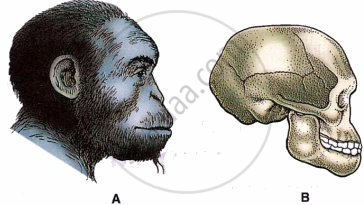
A-B: Australopithecus atricanus (African ape man): restoration and skull
Homo habilis (“Handy man”, the tool‑maker)
Discovery and age:
Homo habilis was discovered by Louis Leakey in 1960 at Olduvai Gorge in Africa. It belonged to the Pleistocene and lived about 1.6 to 1.8 million years ago.
Physical features:
- Height ranged from 120 to 150 cm.
- Cranial capacity was about 680 cm³.
- It had a lighter jaw and more modern dentition than earlier forms.
- It stood fully erect.
Food and habits
- It was omnivorous.
- It is regarded as the first stone tool-maker.
Evolutionary importance:
Homo habilis is often called the handy man because of its association with early stone tools. Its improved hand use and larger brain indicate an important advance in intelligence and adaptation.
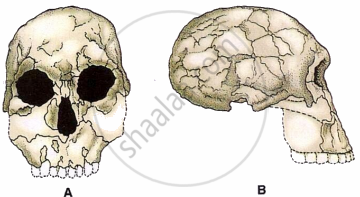
A-B: Homo habilis: skull (reconstructed) in front (A), and side (B) views
Homo erectus (Java ape man)
Discovery and age:
Homo erectus was discovered by Eugène Dubois in 1891 in Java. Fossils were also found in China and Africa, and the form lived about 1.7 million years ago during the Pleistocene.
Physical features:
- Height was about 150 cm.
- Cranial capacity was about 900 cm³.
- It had a heavy jaw, large teeth, and no chin.
- It stood fully erect.
Food and habits:
- It was omnivorous.
- It used advanced tools.
- It also used fire, which marks a major step in human cultural development.
Evolutionary importance:
Homo erectus is considered a direct ancestor of modern humans in many school-level evolutionary summaries. It shows a clear advance in body organisation, intelligence, mobility, and survival techniques.
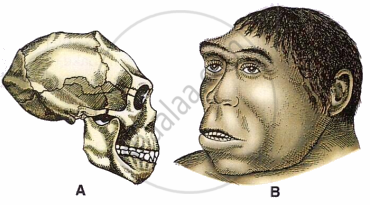
A-B: Homo erectus erectus (Java ape man): A. skull; B. restoration
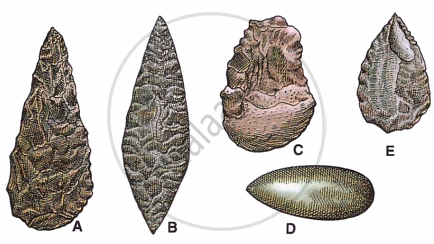
A-E: Some tools of prehistoric ape man: A. axe; B. spear head; C. scraper; D. polished axe; E. cutter
Key Points: The Ape Man
| Feature | Australopithecus africanus | Homo habilis | Homo erectus |
|---|---|---|---|
| Discoverer | Raymond Dart (1924) | Louis Leakey (1960) | Eugène Dubois (1891) |
| Geological age | Pliocene–Pleistocene (~2 mya) | Pleistocene (1.6–1.8 mya) | Pleistocene (~1.7 mya) |
| Place | Taung, Africa | Olduvai Gorge, Africa | Java; also China & Africa |
| Height | ~150 cm | 120–150 cm | ~150 cm |
| Cranial capacity | ~600 cm³ | ~680 cm³ | ~900 cm³ |
| Posture | Almost erect | Fully erect | Fully erect |
| Jaw & teeth | Human-like teeth, no chin | Lighter jaw, modern dentition | Heavy jaw, large teeth, no chin |
| Diet | Omnivorous | Omnivorous | Omnivorous |
| Tools | Used pebbles/bones | First stone tool-maker | Advanced tools, used fire |
| Significance | Early hominid | “Handy man” | Direct ancestor of modern man |
