A palindrome in DNA is a sequence of base pairs that reads the same on both strands when read in the same direction (5′ → 3′).
Topics
Reproduction in Organisms
Sexual Reproduction in Flowering Plants
- Flower
- Pre-fertilisation in Flowering Plant: Structures and Events
- Structure and Development of Anther
- Microsporogenesis
- Structure and Development of Male Gametophyte
- Pollen Viability and Storage
- Structure and Development of Ovule
- Megasporogenesis
- Development of Female Gametophyte or Embryo Sac
- Pollination
- Autogamy
- Geitonogamy
- Cross-pollination
- Agents of Pollination
- Anemophily
- Hydrophily
- Animal-Mediated Pollination (Zoophily)
- Outbreeding Devices
- Pollen Pistil Interaction
- Artificial Hybridization or Artificial Fertilization
- Double Fertilization and Triple Fusion
- Events in Sexual Reproduction > Post-Fertilization Structures and Events
- Endosperm
- Dicotyledonous Embryo
- Monocotyledonous Embryo
- The Seed
- Apomixis
- Polyembryony
Reproduction
Genetics and Evolution
Human Reproduction
- Human Reproduction
- The Male Reproductive System
- The Female Reproductive System
- Gametogenesis
- Spermatogenesis
- Structure of Sperm
- Spermiogenesis
- Oogenesis
- Menstrual Cycle (Ovarian Cycle)
- Major Events of Menstrual Cycle
- Menstrual Hygiene
- Fertilization in Human
- Implantation in Human
- Pregnancy and Embryonic Development
- Parturition (Birth) in Human
- Lactation in Human
Reproductive Health
- Concept of Reproductive Health
- Population Explosion and Control Measures
- Birth Control
- Natural Contraceptive Methods
- Artificial Contraceptive Methods
- Induced Abortion or Medical Termination of Pregnancy (MTP)
- Sexually Transmitted Diseases (STD) or Sexually Transmitted Infections (STI)
- Infertility
- Assisted Reproductive Technology (ART)
- Amniocentesis
- Genetic Counselling
Biology and Human Welfare
Environmental Issues
- Controlling Vehicular Air Pollution: a Case Study of Delhi
- Effects of Domestic Sewage and Industrial Effluents on Water
- Solid Wastes
- Radioactive Wastes
- Greenhouse Effect and Climate Change
- Ozone Depletion in the Stratosphere
- Degradation by Improper Resource Utilisation and Maintenance
- Radioactive Waste Management and E-waste
Biotechnology
Principles of Inheritance and Variation
- Heredity and Variation
- Gregor Johann Mendel – Father of Genetics
- Mendel's Experiments on Inheritance
- Monohybrid Cross
- Punnett Square
- Back Cross and Test Cross
- Mendel's Laws > The Law of Dominance
- Mendel's Laws > The Law of Segregation (Law of Purity of Gametes)
- Exceptions to Mendel's Principles > Incomplete Dominance
- Exceptions to Mendel's Principles > Co-Dominance
- Dihybrid Cross
- Mendel's Laws > The Law of Independent Assortment
- Chromosomal Theory of Inheritance
- Linkage and Recombination
- Polygenic Inheritance
- Exceptions to Mendel's Principles > Pleiotropy
- Sex Determination
- Sex Determination in Humans
- Sex Determination in Honey Bees
- Mutations
- Pedigree Analysis
- Mendelian Disorders in Humans
- Chromosomal Disorders or Abnormalities
Molecular Basis of Inheritance
- Deoxyribonucleic Acid (DNA)
- Structure of Polynucleotide Chain
- Packaging of DNA Helix
- Search for Genetic Material
- Griffith’s Experiment
- Avery, McCarty and MacLeod’s Experiment
- The Hershey-Chase Experiment
- Properties of Genetic Material
- The RNA World
- DNA Replication
- Conservative Replication
- Dispersive Replication
- Semi-Conservative Replication
- Meselson and Stahl’s Experiment
- Enzymes used in DNA Replication
- Mechanism of DNA Replication
- Protein Synthesis
- Reverse Transcription (Teminism)
- Transcription
- Transcription Unit and the Gene
- Process of Transcription in Bacteria
- Process of Transcription in Eukaryotes
- Genetic Code
- Characteristics of the Genetic Code
- Mutations and Genetic Code
- Transfer RNA (tRNA)
- Translation
- Regulation of Gene Expression
- The Lac Operon
- Human Genome Project
- DNA Fingerprinting
Ecology
Evolution
- Origin of Life on Earth
- Urey and Miller’s Experiment
- Evolution of Life Forms - a Theory
- Evidences Supporting the Theory of Evolution
- Adaptive Radiation
- Theories and Mechanism of Evolution
- Theories and Mechanism of Evolution
- Hardy Weinberg’s Principle
- Types of Selection
- Brief Account of Evolution
- Human Evolution
Human Health and Diseases
- Concept and Determinants of Health
- Modes of Transmission of Diseases through Pathogens
- Diseases Caused by Bacteria > Typhoid
- Diseases Caused by Bacteria > Pneumonia
- Diseases Caused by Viruses > Common Cold
- Diseases Caused by Protozoa > Malaria
- Diseases Caused by Protozoa > Amoebiasis (Amoeboic dysentery)
- Diseases Caused by Helminths > Ascariasis
- Diseases Caused by Helminths > Filariasis (Elephantiasis)
- Diseases Caused by Fungi > Ringworm
- Prevention and Control of Infectious Diseases
- Immunity
- Types of Immunity > Innate Immunity
- Types of Immunity > Acquired Immunity
- Vaccination and Immunization
- Allergies
- Autoimmunity
- The Immune System
- Acquired Immuno Deficiency Syndrome (AIDS)
- Cancer
- Causes of Cancer
- Symptoms and Diagnosis of Cancer
- Prevention/Treatment of Cancer
- Drugs and Alcohol Abuse
- Addiction and Dependence
- Effects of Drug and Alcohol Abuse
- Prevention and Control of Drugs and Alcohol Abuse
Strategies for Enhancement in Food Production
Microbes in Human Welfare
Biotechnology - Principles and Processes
Biotechnology and Its Application
Organisms and Populations
- Organisms and Their Environment
- Population and Population Attributes
- Population Growth
- Life History Variation
- Population Interactions
- Negative Interactions > Predation
- Negative Interactions > Competition
- Negative Interactions > Parasitism
- Positive Interactions > Commensalism
- Positive Interactions > Mutualism (Symbiosis)
Ecosystem
Biodiversity and Its Conservation
Estimated time: 22 minutes
CISCE: Class 12
Definition: Palindrome
CBSE: Class 12
CISCE: Class 12
CISCE: Class 12
Discovery and Background
The Breakthrough (1963): Scientists isolated two specific enzymes in Escherichia coli (E. coli) that restricted the growth of bacteriophages (viruses that infect bacteria).
- One enzyme functioned by adding methyl groups to the DNA.
- The other enzyme functioned by cutting the DNA. This DNA-cutting enzyme was called a restriction endonuclease.
The First Restriction Endonuclease: Hind II was the very first restriction endonuclease to be isolated and characterised (discovered 5 years later). It was isolated from the d-strain of Haemophilus influenzae.
Current Statistics: Today, scientists have isolated more than 900 different restriction enzymes from over 230 strains of bacteria.
CBSE: Class 12
CISCE: Class 12
CISCE: Class 12
Types of Nucleases
Nucleases are enzymes that break nucleic acids.
| Type | Site of action | Main feature |
|---|---|---|
| Exonuclease | Cuts nucleotides from the ends of DNA | Removes bases one by one from the free ends |
| Endonuclease | Cuts within the DNA strand | Cleaves DNA at internal positions |
CBSE: Class 12
CISCE: Class 12
CISCE: Class 12
Nomenclature (Naming Convention)
Restriction enzymes follow a strict, standardised naming convention based on the bacterium they are isolated from:
- 1st Letter: Derived from the genus of the bacterium (capitalised).
- 2nd & 3rd Letters: Derived from the species of the bacterium (lowercase).
- 4th Letter (optional): Indicates the specific strain of the bacterium.
- Roman Numeral: Indicates the order of discovery or identification of the enzyme from that specific strain.
Example: EcoRI
- E = Escherichia (Genus)
- co = coli (Species)
- R = RY13 (Strain)
- I = First enzyme identified from this strain.
CBSE: Class 12
CISCE: Class 12
CISCE: Class 12
Mechanism of Action and Palindromic Sequences
Inspection: Each restriction endonuclease functions by 'inspecting' the length of a DNA sequence.
Recognition: It searches for its specific recognition sequence. This sequence is always a palindromic nucleotide sequence.
- What is a palindrome? In DNA, it is a sequence of base pairs that reads exactly the same on both strands when the reading orientation is kept the same (e.g., reading 5' → 3' on both strands).
- Example (EcoRI recognition site):
5' — GAATTC — 3'
3' — CTTAAG — 5' - (Note: Hind II specifically recognises a sequence of six base pairs).
Cleavage: Once it finds the palindrome, the enzyme binds to the DNA and cuts the sugar-phosphate backbones of both strands of the double helix at specific points.
CBSE: Class 12
CISCE: Class 12
CISCE: Class 12
Sticky vs. Blunt Ends
1. Sticky Ends: The enzyme cuts the DNA slightly away from the centre of the palindromic site but between the same two bases on the opposite strands. This leaves single-stranded, overhanging stretches.
- These are called "sticky" because they easily form hydrogen bonds with their complementary cut counterparts. This stickiness greatly facilitates the joining action of the enzyme DNA ligase.
2. Blunt Ends: The enzyme cuts straight through, leaving no unpaired bases or overhangs. These DNA pieces cannot easily anneal (join) to each other, making them very difficult to clone.
CBSE: Class 12
CISCE: Class 12
CISCE: Class 12
Action of Restriction Enzyme EcoRI
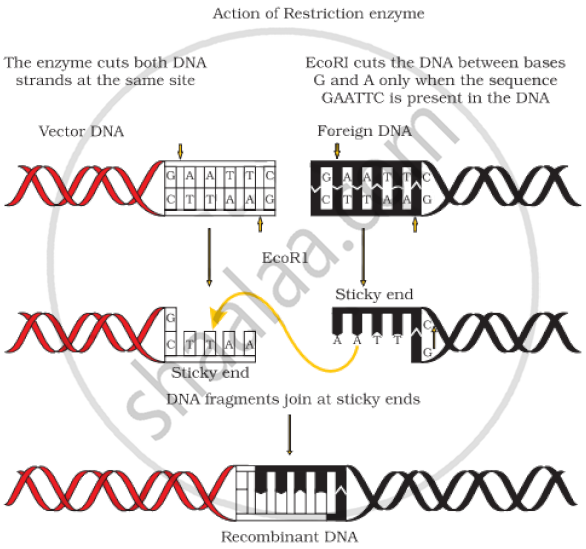
Steps in the formation of recombinant DNA by action of restriction endonuclease enzyme - EcoRI
CBSE: Class 12
CISCE: Class 12
CISCE: Class 12
Crucial Rule for Recombinant DNA
To successfully create a recombinant vector molecule, both the vector DNA and the source (foreign) DNA must be cut with the exact same restriction enzyme. This ensures that both DNA fragments have complementary sticky ends that can be joined end-to-end by DNA ligases.
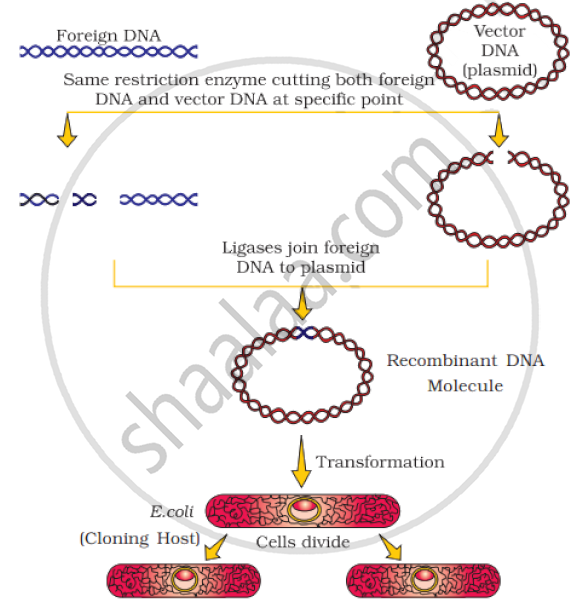
Diagrammatic representation of recombinant DNA technology
CBSE: Class 12
CISCE: Class 12
CISCE: Class 12
Step-by-Step: Separation and Isolation of DNA Fragments
Once the restriction enzymes have cut the DNA into fragments, these fragments must be separated and isolated for use. This is done via gel electrophoresis.
- Step 1: The Principle: DNA fragments are negatively charged molecules. Therefore, they can be separated by applying an electric field that forces them to move towards the positive electrode (anode).
- Step 2: The Matrix: This movement takes place through a medium or matrix. The most commonly used matrix today is agarose, which is a natural polymer extracted from seaweeds.
- Step 3: The Sieving Effect: The agarose gel acts like a sieve. The DNA fragments separate based on their size. The smaller the fragment size, the farther and faster it moves down the gel.
- Step 4: Visualisation (Staining): Pure DNA fragments cannot be seen under visible light. To see them, the gel is stained with a compound called ethidium bromide.
- Step 5: UV Exposure: The stained gel is then exposed to ultraviolet (UV) radiation. The DNA bands immediately become visible as bright orange-coloured bands.
- Step 6: Elution: The desired, separated bands of DNA are physically cut out from the agarose gel and extracted from the gel piece. This extraction process is known as elution.
- Final Step: These purified DNA fragments are now ready to be joined with cloning vectors to construct recombinant DNA.
CBSE: Class 12
CISCE: Class 12
CISCE: Class 12
A typical agarose gel electrophoresis
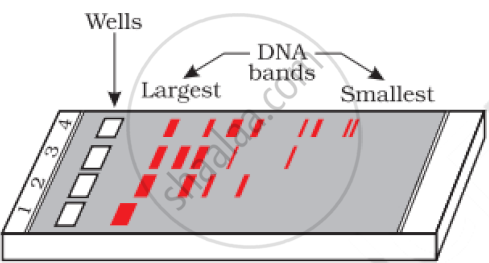
A typical agarose gel electrophoresis showing migration of undigested (lane 1) and digested set of DNA fragments (lane 2 to 4)
CBSE: Class 12
CISCE: Class 12
CISCE: Class 12
Key Points: Restriction Enzymes
- Restriction enzymes, often called "molecular scissors", are specialised endonucleases that cut DNA at specific internal positions to facilitate genetic engineering.
- Over 900 restriction enzymes, including the first discovered Hind II, have been successfully isolated from more than 230 strains of bacteria.
- These enzymes are named using a standard convention based on the genus, species, strain, and discovery order of the source bacterium, such as EcoRI.
- They function by inspecting DNA to find specific palindromic nucleotide sequences, which are base pair sequences that read the same on both strands in the same orientation.
- Type II restriction enzymes are the primary ones used in genetic manipulation because they reliably recognise and cut at very specific target sequences.
- Cutting the DNA slightly away from the centre of a palindrome creates "sticky ends", which are single-stranded overhangs that easily bond with complementary DNA using the enzyme DNA ligase.
- The resulting DNA fragments are separated by size using gel electrophoresis, where smaller negatively charged fragments move faster through an agarose matrix toward an anode.
- The separated DNA is visualised as bright orange bands under UV light after ethidium bromide staining and is carefully extracted from the gel through a process called elution.
