Advertisements
Advertisements
प्रश्न
How are 'sticky ends' formed on a DNA strand? Why are they so called?
Advertisements
उत्तर
Sticky ends are produced by restriction enzymes. These enzymes cut the strand of DNA a little away from the centre of the palindrome sites but between the same two bases on the opposite strands. This leaves single stranded portions at the ends. There are overhanging stretches called 'sticky ends' on each strand.
These are called sticky ends because they form hydrogen bonds with their complementary cut counterparts. This stickiness of the ends facilitates the action of the enzyme DNA ligase.
संबंधित प्रश्न
Mention the difference in the mode of action of exonuclease and endonuclease.
Distinguish between exonuclease and endonuclease.
'Restriction' in restriction enzyme refers to
DNA fragments separate according to size through?
A plasmid DNA and a linear DNA (both are of the same size) have one site for a restriction endonuclease. When cut and separated on agarose gel electrophoresis, plasmid shows one DNA band while linear DNA shows two fragments. Explain.
A mixture of fragmented DNA was electrophoresed in an agarose gel. After staining the gel with ethidium bromide, no DNA bands were observed. What could be the reason?
Given below is the stepwise schematic representation of the process of electrophoresis. Identify the 'alphabets' representing
- Anode end
- smallest/lightest DNA strand in the matrix
- Agarose gel
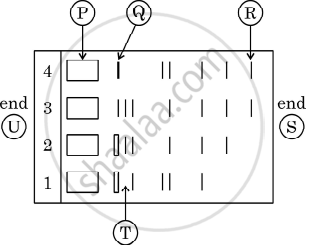
State the principle involved in separation of DNA fragments using gel electrophoresis.
During agarose gel electrophoresis, why do DNA fragments migrate toward the anode (positive electrode)?
What is the origin of agarose, the matrix most commonly used in gel electrophoresis?
