Topics
Reproduction in Organisms
Sexual Reproduction in Flowering Plants
- Flower
- Pre-fertilisation in Flowering Plant: Structures and Events
- Structure and Development of Anther
- Microsporogenesis
- Structure and Development of Male Gametophyte
- Pollen Viability and Storage
- Structure and Development of Ovule
- Megasporogenesis
- Development of Female Gametophyte or Embryo Sac
- Pollination
- Autogamy
- Geitonogamy
- Cross-pollination
- Agents of Pollination
- Anemophily
- Hydrophily
- Animal-Mediated Pollination (Zoophily)
- Outbreeding Devices
- Pollen Pistil Interaction
- Artificial Hybridization or Artificial Fertilization
- Double Fertilization and Triple Fusion
- Events in Sexual Reproduction > Post-Fertilization Structures and Events
- Endosperm
- Dicotyledonous Embryo
- Monocotyledonous Embryo
- The Seed
- Apomixis
- Polyembryony
Reproduction
Genetics and Evolution
Human Reproduction
- Human Reproduction
- The Male Reproductive System
- The Female Reproductive System
- Gametogenesis
- Spermatogenesis
- Structure of Sperm
- Spermiogenesis
- Oogenesis
- Menstrual Cycle (Ovarian Cycle)
- Major Events of Menstrual Cycle
- Menstrual Hygiene
- Fertilization in Humans
- Implantation in Human
- Pregnancy and Embryonic Development
- Parturition (Birth) in Human
- Lactation in Human
Reproductive Health
- Concept of Reproductive Health
- Population Explosion and Control Measures
- Birth Control
- Natural Contraceptive Methods
- Artificial Contraceptive Methods
- Induced Abortion or Medical Termination of Pregnancy (MTP)
- Sexually Transmitted Diseases (STD) or Sexually Transmitted Infections (STI)
- Infertility
- Assisted Reproductive Technology (ART)
- Amniocentesis
- Genetic Counselling
Biology and Human Welfare
Biotechnology
Environmental Issues
- Controlling Vehicular Air Pollution: a Case Study of Delhi
- Effects of Domestic Sewage and Industrial Effluents on Water
- Solid Wastes
- Radioactive Wastes
- Greenhouse Effect and Climate Change
- Ozone Depletion in the Stratosphere
- Degradation by Improper Resource Utilisation and Maintenance
- Radioactive Waste Management and E-waste
Principles of Inheritance and Variation
- Heredity and Variation
- Gregor Johann Mendel – Father of Genetics
- Mendel's Experiments on Inheritance
- Monohybrid Cross
- Punnett Square
- Back Cross and Test Cross
- Mendel's Laws > The Law of Dominance
- Mendel's Laws > The Law of Segregation (Law of Purity of Gametes)
- Exceptions to Mendel's Principles > Incomplete Dominance
- Exceptions to Mendel's Principles > Co-Dominance
- Dihybrid Cross
- Mendel's Laws > The Law of Independent Assortment
- Chromosomal Theory of Inheritance
- Linkage and Recombination
- Polygenic Inheritance
- Exceptions to Mendel's Principles > Pleiotropy
- Sex Determination
- Sex Determination in Humans
- Sex Determination in Honey Bees
- Mutations
- Pedigree Analysis
- Mendelian Disorders in Humans
- Chromosomal Disorders or Abnormalities
Molecular Basis of Inheritance
- Deoxyribonucleic Acid (DNA)
- Structure of Polynucleotide Chain
- Packaging of DNA Helix
- Search for Genetic Material
- Griffith’s Experiment
- Avery, McCarty and MacLeod’s Experiment
- The Hershey-Chase Experiment
- Properties of Genetic Material
- The RNA World
- DNA Replication
- Conservative Replication
- Dispersive Replication
- Semi-Conservative Replication
- Meselson and Stahl’s Experiment
- Enzymes used in DNA Replication
- Mechanism of DNA Replication
- Protein Synthesis
- Reverse Transcription (Teminism)
- Transcription
- Transcription Unit and the Gene
- Process of Transcription in Bacteria
- Process of Transcription in Eukaryotes
- Genetic Code
- Characteristics of the Genetic Code
- Mutations and Genetic Code
- Transfer RNA (tRNA)
- Translation
- Regulation of Gene Expression
- The Lac Operon
- Human Genome Project
- DNA Fingerprinting
Ecology
Evolution
- Origin of Life on Earth
- Urey and Miller’s Experiment
- Evolution of Life Forms - a Theory
- Evidences Supporting the Theory of Evolution
- Adaptive Radiation
- Theories and Mechanism of Evolution
- Theories and Mechanism of Evolution
- Hardy Weinberg’s Principle
- Types of Selection
- Brief Account of Evolution
- Human Evolution
Human Health and Diseases
- Concept and Determinants of Health
- Modes of Transmission of Diseases through Pathogens
- Diseases Caused by Bacteria > Typhoid
- Diseases Caused by Bacteria > Pneumonia
- Diseases Caused by Viruses > Common Cold
- Diseases Caused by Protozoa > Malaria
- Diseases Caused by Protozoa > Amoebiasis (Amoeboic dysentery)
- Diseases Caused by Helminths > Ascariasis
- Diseases Caused by Helminths > Filariasis (Elephantiasis)
- Diseases Caused by Fungi > Ringworm
- Prevention and Control of Infectious Diseases
- Immunity
- Types of Immunity > Innate Immunity
- Types of Immunity > Acquired Immunity
- Vaccination and Immunization
- Allergies
- Autoimmunity
- The Immune System
- Acquired Immuno Deficiency Syndrome (AIDS)
- Cancer
- Causes of Cancer
- Symptoms and Diagnosis of Cancer
- Prevention/Treatment of Cancer
- Drugs and Alcohol Abuse
- Addiction and Dependence
- Effects of Drug and Alcohol Abuse
- Prevention and Control of Drugs and Alcohol Abuse
Microbes in Human Welfare
Strategies for Enhancement in Food Production
Biotechnology - Principles and Processes
Biotechnology and Its Application
Organisms and Populations
- Organisms and Their Environment
- Population and Population Attributes
- Population Growth
- Life History Variation
- Population Interactions
- Negative Interactions > Predation
- Negative Interactions > Competition
- Negative Interactions > Parasitism
- Positive Interactions > Commensalism
- Positive Interactions > Mutualism (Symbiosis)
Ecosystem
Biodiversity and Its Conservation
Introduction
Biogas is a mixture of gases, predominantly methane (CH₄), produced by the anaerobic activity of microorganisms on organic substrates such as cattle dung, agricultural waste, and sewage sludge. It is used as a renewable fuel for cooking, lighting, and electricity generation.
Also called: Gobar Gas (when produced from cattle dung)
Composition of Biogas
| Gas | Percentage (approx.) | Property |
|---|---|---|
| Methane | 50–70% | Highly inflammable; primary fuel component |
| Carbon Dioxide | 30–40% | Non-combustible; dilutes energy content |
| Hydrogen | Trace | Combustible |
| Hydrogen Sulphide | Trace | Gives a characteristic odour |
| Nitrogen, Water Vapour | Trace | Inert components |
Methanogens
Methanogens are a group of strictly anaerobic microorganisms (belonging to the domain Archaea, not true bacteria) that produce large amounts of methane (CH₄) along with CO₂ and H₂ by metabolising cellulosic organic material.
Common example: Methanobacterium
Characteristics of Methanogens:
- Strictly anaerobic - cannot survive in the presence of oxygen
- Belong to Archaebacteria (domain Archaea) - they are not true bacteria
- Grow on cellulosic material (plant debris, cattle dung)
- Produce CH₄ + CO₂ + H₂ as metabolic end-products
- Have an autotrophic mode of nutrition
Natural Habitats of Methanogens:
| Habitat | Significance |
|---|---|
| Rumen of cattle | Helps digest cellulose; cattle dung is rich in these bacteria |
| Anaerobic sludge | Found in sewage treatment plants (STPs) |
| Marshy/wetland areas | Responsible for "marsh gas" (methane) in wetlands |
| Biogas digesters | Artificially maintained anaerobic environment |
Biogas Plant
A biogas plant is a closed, anaerobic system that uses microbial activity to convert organic waste into usable fuel (biogas) and nutrient-rich fertiliser (spent slurry).
Components:
| Component | Location | Function |
|---|---|---|
| Mixing Tank | Above ground | Mixing of cattle dung + water to form a slurry |
| Digester (Concrete Tank) | 10–15 ft underground | Anaerobic breakdown of organic material by methanogens |
| Floating Cover / Lid | Over the slurry | Rises as gas is produced; seals the anaerobic environment |
| Gas Outlet | Top of gas holder | Pipe carrying biogas to kitchens/lights |
| Spent Slurry Outlet | Side of digester | Removes nutrient-rich fertiliser (digested organic matter) |
Types of Biogas Plants in India
In India, two designs are used:
- Fixed-Dome Type - dome made of concrete, fixed and immovable
- Floating Gas Holder Type - lid made of stainless steel; rises as gas accumulates (more common)
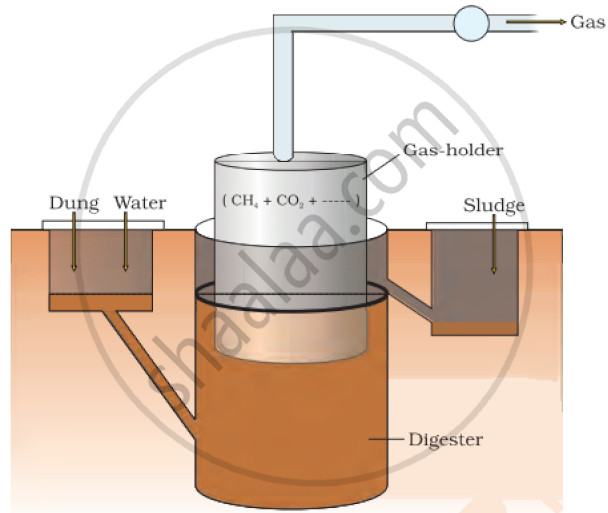
Biogas plant
Process of Biogas Production
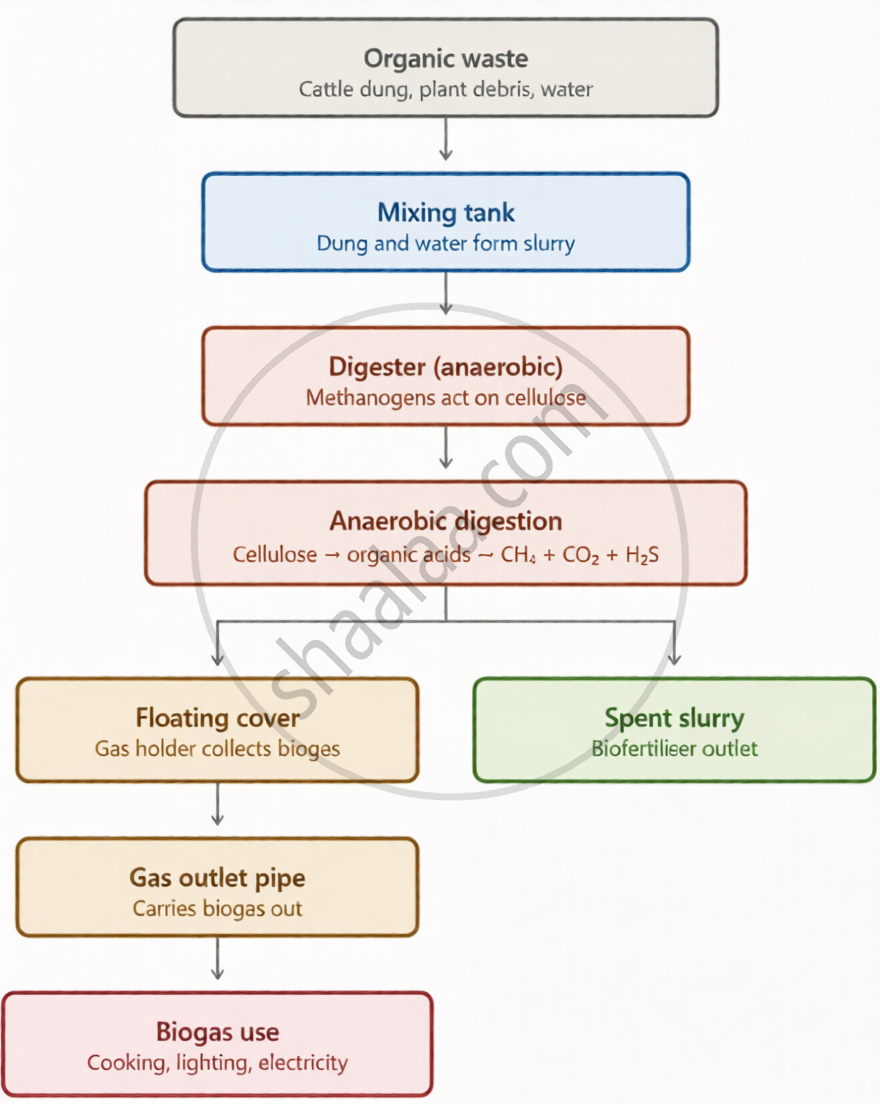
Role of IARI and KVIC
| Organisation | Full Form | Role |
|---|---|---|
| IARI | Indian Agricultural Research Institute | Developed biogas technology for India; designed plant models suited for rural use |
| KVIC | Khadi and Village Industries Commission | Promoted and implemented biogas plants at the village level across India |
Key Points: Microbes in Production of Biogas
- Biogas is predominantly methane (CH₄), produced by microbial activity, and used for cooking and lighting.
- Methanogens (e.g., Methanobacterium) grow anaerobically on cellulosic material, producing CH₄, CO₂, and H₂S.
- Methanogens are found in anaerobic sludge and the rumen of cattle, helping to digest cellulose.
- Cattle dung (gobar) is rich in methanogens and is used to generate biogas, called gobar gas.
- A biogas plant has 4 parts: a concrete tank (digester), a floating cover, two outlets, and a gas holder.
- One outlet supplies biogas for cooking/lighting; the other removes spent slurry, which is used as fertiliser.
- Biogas technology in India was developed by IARI and KVIC.
