Advertisements
Chapters
2: Compound Interest
3: Expansions
4: Factorisation
5: Simultaneous Linear Equations
6: Indices/Exponents
7: Logarithms
8: Triangles
9: Mid-point Theorem
10: Pythagoras Theorem
11: Rectilinear Figures
12: Constructions of Polygons
13: Theorems on Area
14: Circles
15: Statistics
▶ 16: Mensuration
17: Trigonometric Ratios
18: Trigonometric Ratios of Some Standard Angles and Complementary Angles
19: Co-ordinate Geometry: An Introduction
![Nootan solutions for Mathematics [English] Class 9 ICSE chapter 16 - Mensuration - Shaalaa.com](/images/mathematics-english-class-9-icse_6:f26eb985e8254aa987299226050d7c71.jpg "Nootan solutions for Mathematics [English] Class 9 ICSE chapter 16 - Mensuration")
Advertisements
Solutions for Chapter 16: Mensuration
Below listed, you can find solutions for Chapter 16 of CISCE Nootan for Mathematics [English] Class 9 ICSE.
Nootan solutions for Mathematics [English] Class 9 ICSE 16 Mensuration Exercise 16A [Pages 315 - 316]
Calculate the area of the triangle with the following sides:
42 cm, 34 cm and 20 cm
Calculate the area of the triangle with the following sides:
33 cm, 44 cm and 55 cm
Calculate the area of the triangle with the following sides:
39 m, 42 m and 45 m
Calculate the area of the triangle with the following sides:
29 cm, 20 cm and 21 cm
Find the area of a triangle whose base is 15 cm and height is 18 cm.
Find the area of an isosceles right triangle, the lengths of whose each side containing the right angle is 15 cm.
The sides of an equilateral triangle is 8 cm. Find its area and height.
ABC is a triangle in which AB = AC = 4 cm and ∠A = 90°. Calculate the area of ΔABC.
Find the area of a triangle whose sides are 20 cm, 34 cm and 42 cm. Hence find the height corresponding to the side 42 cm.
Find the area of an isosceles triangle in which base is 24 cm and each of equal sides is 13 cm.
Find the area of an isosceles triangle in which base is 12 cm and each of equal sides is 10 cm.
Find the area of an equilateral triangle whose height is 8 cm.
Find the perimeter of an equilateral triangle whose area is `36sqrt(3) "cm"^2`.
The sides of a triangular field are 975 m, 1050 m and 1125 m. If this field is sold at the rate of ₹ 100 per hectare, find its selling price. [Note : 1 hectare = 10000 m2]
The base of an isosceles triangle is 24 cm and its area is 192 sq. cm. Find its perimeter.
The base of a triangular field is `2 1/2` times its height. If the cost of turfing it at ₹ 48 per 100 sq. m is ₹ 960, find its base.
A plot of ground in the form of an isosceles triangle is turfed for ₹ 15 at 25 paise per sq. meter. Find the length of each of the equal sides if its base is 24 metres.
The base of an isosceles triangle is 6 cm and its area is 12 sq. cm. Find its perimeter.
Figure shows an equilateral triangle ABC whose each side is 10 cm and a right-angled triangle BDC whose side BD = 8 cm and ∠D = 90°. Find the area of the shaded portion.
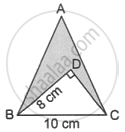
Each of the equal sides of an isosceles triangle is 4 cm greater than its height. If the base of the triangle is 24 cm; calculate the perimeter and the area of the triangle.
Calculate the area and the height of an equilateral triangle whose perimeter is 60 cm.
The perimeter of a triangular field is 540 m and its sides are in the ratio 25 : 17 : 12. Find the area of the triangle.
In the adjoining figure, ABC is an equilateral triangle in which BC = 10 cm and BCD is a right-angled triangle in which BD = CD. Find the area of the shaded region.
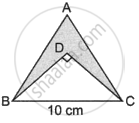
ΔABC and ΔADE are two equilateral triangles is which AB = 12 cm and AD = 6 cm. Find the area of the shaded region. `("Use" sqrt(3) = 1.73)`
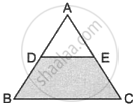
Find the side of an equilateral triangle whose area is equal to the area of that triangle whose sides are 12 cm, 15 cm and 21 cm.
Nootan solutions for Mathematics [English] Class 9 ICSE 16 Mensuration Exercise 16B [Pages 324 - 326]
Find the area of a quadrilateral, the length of one of its diagonals being 80 m and the lengths of the perpendiculars upon it from the opposite corners are 16 m and 24 m.
Find the area of a quadrilateral the length of whose diagonals are 120 m and 80 m respectively, and are at the right angles to each other.
Find the area of a quadrilateral plot of ground whose diagonals are 140 m and 130 m and intersect each other at right angles. Find also the cost of the land at ₹ 10 per m2.
Find the cost of cultivating a quadrilateral field at 50 paise per square meter whose one diagonal is 40 m and its offsets are 25 m and 20 m respectively.
Find the area of the parallelogram whose base is 25 cm and height is 16 cm.
The lengths of the adjacent sides of a plot of land in the form of a parallelogram are 15 m and 13 m. If a diagonal is 14 m, find its area.
The perimeter of a rectangle is 32 cm and its length is 6 cm. Find the area of the rectangle.
The area of a rectangle is 72 cm2 and length is 9 cm. Find its perimeter.
The area of a square is 576 cm2. Find its perimeter.
A field, in the form of a rhombus, has its diagonals as 40 m and 25 m long respectively. Find the cost of watering the field at 12 paise per m2.
The perimeter of a rhombus is 100 m and one of its diagonals is 40 m. Find its other diagonal and area.
Calculate the area of a trapezium, the sides of which, taken in order, are 50, 17, 25 and 12 cm, respectively and the first being parallel to the third.
A field, in the form of a trapezium, has its parallel sides 45.2 m and 22.8 m long and the distance between them is 12 m. Find the cost of turfing it at 20 paise per sq. m.
Find the area of the rhombus whose diagonals are 5 cm and 6 cm.
The area of a rhombus is 98 cm2. If one of its diagonals is 14 cm, what is the length of the other diagonal?
The sides of a rhombus are 5 cm each and one diagonal is 8 cm, calculate
- The length of the other diagonal,
- The area of the rhombus.
The perimeter of a rhombus is 20 cm. If one diagonal of the rhombus is 8 cm, find
- the length of the other diagonal,
- the area of the rhombus.
The area of a rhombus is 120 m2. If one of the diagonals is 24 m, find the perimeter of the rhombus.
Find the area of the following figure:
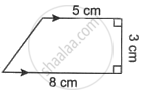
The area of a trapezium is 540 cm2. If the ratio of its parallel sides is 5 : 7 and the distance between the parallel sides 18 cm, find the length of the parallel sides.
In the following figure, two paths are shown in a rectangular field. Find the area of the path.
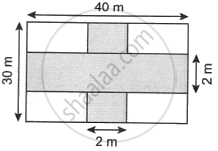
A footpath of uniform width of 2 m runs all around outside of a rectangular field 30 m long and 20 m wide. Find the area of the footpath.
A rectangular carpet has an area 60 m2. If the sum of its diagonal and longer side is equal to 5 times the shorter side, find the breadth of the carpet.
A rectangular plot 32 m long and 20 m wide is to be covered with grass leaving 1.5 m all around it. Find the area covered with grass.
A room is 16 m long and 12 m wide. Find the cost of carpeting the room with a carpet 75 cm wide at ₹ 22.50 per metre.
A floor is 20 m long and 8 m wide. How many tiles measuring 50 cm × 25 cm are required to cover the floor?
A rectangular hall 27 m long and 15 m wide, is to be covered with a carpet of width 60 cm. Find the cost of carpeting at ₹ 12 per metre.
A wire when bent in the form of a square encloses an area of 900 cm2. Find the largest area enclosed by the same wire when bent to form an equilateral triangle.
A wire when bent in the form of a square encloses an area of 225 cm2. Find the largest area enclosed by the same wire when bent to form a rectangle of breadth 12 cm.
The length and breadth of a rectangle are 6 cm and 4 cm respectively. Find the height of a triangle whose base is 8 cm and whose area is 2 times that of the rectangle.
A rectangle has twice the area of a square. The length of the rectangle is 12 cm greater and the width is 8 cm greater than a side of the square. Find the side of the square.
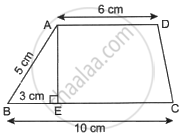
In the following figure, ABCD, it is given that BC || AD. BC = 10 cm, AD = 6 cm, AB = 5 cm and BE = 3 cm. Find the area of the figure ABCD.
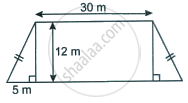
Find the area of the following trapezium:
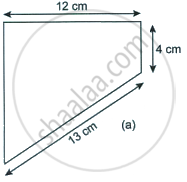
Find the perimeter of the following trapezium:
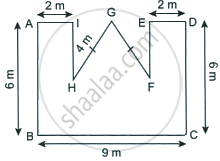
Find the area and perimeter of the given frame work, ABCDEFGHI. Given GH = GF.
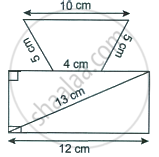
Find the area and perimeter of the following figure.
A rectangular garden is 276 m long and 180 m wide. It has an inside path of uniform width of 3 m all around it. Find the cost of
- repairing the path at 10 paise per sq. m and
- watering the remaining portion of the garden at ₹ 3 per 100 sq. meters.
A hall room 25 m long and 20 m wide is surrounded by a verandah 2.5 m wide. Find the cost of the flooring the verandah at ₹ 1.65 per sq. m.
A marginal walk all round the inside of a rectangular field 30 m long and 28 m wide costs ₹ 56.00 at 50 paise per m2 to construct it. Find the width of the walk.
A rectangular field 250 m by 250 m has two roads each 5 m wide in the middle of the field, one parallel to the length and the other parallel to the breadth. Find the area of the roads.
A carpet is spread in a square room leaving a margin of 5 dm all round the carpet. Find the cost of the carpet at ₹ 2.20 per sq. m, if the margin occupies an area of 13 m2.
There is a field whose each side is 40 m. A square flower bed is prepared in its centre leaving a gravel path all around the flower bed. The total cost of laying the flower bed and gravelling the path at ₹ 1.50 and 60 paise per square meter is ₹ 2126.40. Find the length of the gravel path.
A room is 5.5 m long, 2.5 m wide and 3.5 m high. Find the area of the four walls of the room.
A room is 6 m long, 4.5 m wide and 5 m high. Find the cost of papering its walls with paper 1 m wide which is available at 40 paise per meter.
A room is 5.2 m long and 3.8 m broad. Allowing an area of 14 sq. m for doors and windows, the cost of papering the walls with paper 75 cm wide at 45 paise per meter is ₹ 24. Find the height of the room.
Nootan solutions for Mathematics [English] Class 9 ICSE 16 Mensuration Exercise 16C [Pages 333 - 336]
Find the circumference and area of a circle whose radius is 6 cm. (Leave the answer in π).
Find the length of the circumference of a circle whose diameter is 7 cm.
Find the radius and the area of a circle if its circumference is 18 π cm.
Find the perimeter of semi-circular plate of radius 3.85 cm.
A garden roller has a circumference of 3 meters. How many revolutions does it makes in moving a distance of 21 meters?
A wire when bent in the form of a square, encloses an area of 121 cm2. The same wire is bent in the form of a circle. Find the area enclosed by the circle.
The wheel of a cart is making 5 revolutions per second. If the diameter of the wheel is 84 cm, find its speed in km/hr. Give your answer, correct to the nearest km.
Find the radius of a circular field if its area is 1386 cm2.
In the following figure the diameter of the inner circle is 3 m and that of outer circle is 11 m. Taking π to be `22/7`, find the area of the shaded region.
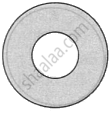
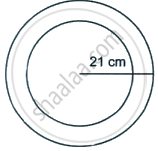
In the following figure, the area enclosed between the concentric circles is 770 cm2. Given that the radius of the outer circle is 21 cm, calculate the radius of the inner circle `(π = 22/7)`.
A road which is 7 m wide surrounds a circular park whose circumference is 352 m. Find the surface area of the road.
A road 3.5 m wide surrounds a circular plot whose circumference is 44 m. Find the cost of paving the road at 10 per m2.
The sum of the radii of two circles is 7 cm, and the difference of their circumferences is 8 cm. Find the circumference of the circles.
A lawn is in the shape of a semi-circle of diameter 35 dm. The lawn is surrounded by a flower bed of width 3.5 dm all round. Find the area of the flower bed in dm2.
A wire is in the form of a circle of radius 28 cm. Find the area of the square into which it can be bent.
A copper wire when bent in the form of a square encloses an area of 484 cm2. If the same wire is bent in the form of a circle, find the area enclosed by it.
How long will a man take to walk round once round a circular park of radius 84 m at the rate of 4.8 km per hour?
The length of a wire which is tied as a boundary of a semicircular park is 72 m. Find the radius of the semi-circular park and its area. [Hint: (πr + 2r) = 72]
In the following figure, A is the centre of the arc of the circle. Find the perimeter and the area of the shaded region, where length and breadth are 12 cm and 7 cm respectively.
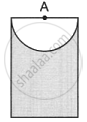
In the following figure, A is the centre of the arc of the circle. Find the perimeter and the area of the shaded region and the side of square is 10 cm.
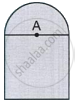
Find the area of the figure in square cm correct to one place of decimal `("take" π = 22/7)`.
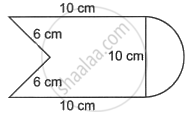
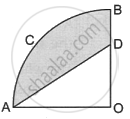
Figure represents a quadrant of a circle of radius 3.5 cm with centre O.
- Calculate the area of the quadrant OACB.
- Given OD = 2 cm, calculate the area of the shaded region `("Take" π = 22/7)`.
A student takes a rectangular piece of paper 30 cm long and 21 cm wide. Find the area of the biggest circle that can be cut out from the paper. Also find the area of the paper left after cutting out the circle `("Take" π = 22/7)`.
A boy is cycling such that the wheels of the cycle are making 140 revolutions per minute. If the diameter of each wheel is 60 cm. Calculate the speed which the boy is cycling.
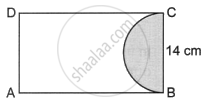
A paper is in the form of a rectangle ABCD in which AB = 20 cm and BC = 14 cm. A semi-circular portion with BC as diameter is cut off. Find the area of the remaining part.
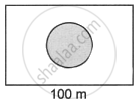
A park is in the form of a rectangle 100 m × 80 m. At the centre of the park there is a circular lawn. The area of the park excluding the lawn is 4150 m2. Find the radius of the circular lawn.
The short and long hands of a clock are 4 cm and 6 cm long respectively. Find the sum of distances travelled by their tips in 2 days. [Take π = 3.14.]
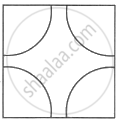
A square park has each side of 100 m. At each corner of the park, there is a flowerbed in the form of a quadrant of radius 14 m as shown in the figure. Find the area of the remaining part of the park.
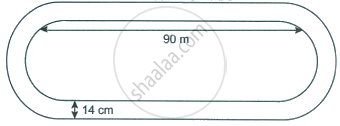
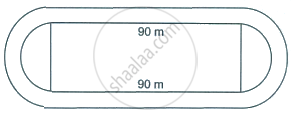
The inside perimeter of a running track (shown in the figure) is 400 m. The length of each of the straight portion is 90 m and the ends are semicircles. If the track is everywhere 14 m wide, find the area of the track. Also, find the length of the outer running track.
In the following figure, the inside perimeter of a practice running track with semi-circular ends and straight parallel sides is 312 m. The length of the straight portion of the track has a uniform width of 2 m through out, find its area.
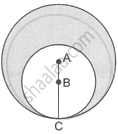
In the following figure, two circles with centres A and B touch each other at the point C. If AC = 8 cm and AB = 3 cm, find the area of the shaded region `("Take" π = 22/7)`.
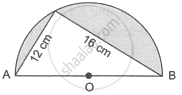
In the following figure, O is the centre of a circular arc, and AOB is a straight line. Find the perimeter and area of the shaded region correct to one decimal place (Take π = 3.14).
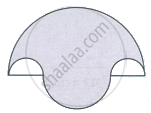
In the following figure, the boundary of the shaded region in the given diagram consists of four semi-circular arcs, the smallest two being equal. If the diameter of the largest is 14 cm and of the smallest is 3.5 cm, calculate:
- the length of the boundary,
- the area of the shaded region `("Take" π = 22/7)`.
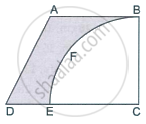
In the following figure, a piece of cardboard, in the shape of a trapezium ABCD, and AB || DC and ∠BCD = 90°, quarter circle BFEC is removed. Given AB = BC = 3.5 cm and DE = 2 cm. Calculate the area of the remaining piece of the cardboard `("Take" π = 22/7)`.
The boundary of the shaded region in figure consists of three semi-circular arcs, the smaller ones being equal. If the diameter of the larger arc is 10 cm, calculate:
- the length of the boundary,
- the area of the shaded region (Take π = 3.14).

A bed of roses is like the adjoining diagram (figure). In the centre is a square and on each side there is semi-circle. Side of the square is 21 m. If each rose-plant needs 6 m2 of space, find out the number of plants which can be planted in the whole figure.

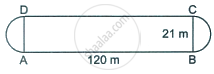
A rectangular playground has two semi-circles added to its outside with its smaller sides as diameters. If the sides of the rectangle are 120 m and 21 m, find the area of the playground `(π = 22/7)`.
In the given figure, AB is the diameter of a circle with center O and OA = 7 cm. Find the area of the shaded region.

In the equilateral ΔABC of side 14 cm, side BC is the diameter of a semicircle as shown in the figure below. Find the area of the shaded region. `("Take" π = 22/7 and sqrt(3) = 1.732)`.

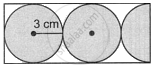
In the given figure, find the area of the unshaded portion within the rectangle (Take π = 3.14).
AC and BD are two perpendicular diameters of a circle with centre O. If AC = 16 cm, calculate the area and perimeter of the shaded part. (Take π = 3.14).

Nootan solutions for Mathematics [English] Class 9 ICSE 16 Mensuration Exercise 16D [Pages 344 - 345]
Find the surface area of the cube whose dimensions are (a) 7 cm, (b) 10 m.
The total surface area of a cube is 726 cm2. Find its volume.
The volume of a rectangular solid is 3600 cm3. If it is 20 cm long and 9 cm high, find the width.
The length and breadth of a rectangular solid are respectively 25 cm and 20 cm. If the volume is 7000 cm3, find its height.
The perimeter of one face of a cube is 20 cm. Find (i) the total area of the 6 faces, (ii) the volume of the cube.
The area of a playground is 4800 m2. Find the cost of covering it with gravel 1 cm deep, if the gravel costs ₹ 4.80 per cubic meter.
A rectangular water tank of base 7 m × 6 m contains water up to a depth of 5 m. How many cubic meters of water are there in the tank?
The internal measurements of a box are 20 cm long, 16 cm wide and 24 cm high. How many 4 cm cubes can be put into the box?
The length, breadth and height of a rectangular solid are in the ratio 5 : 4 : 2. If the total surface area is 1216 cm2, find the length, the breadth and the height of the solid.
There is a cubical room whose length is 5 m. How many students can it accommodate if each student requires 5 m3 of space.
Three cubes whose lengths are 2 cm, 3 cm and 4 cm respectively are melted to form a single cube. Find the edge of the new cube, supposing there is no waste in the process.
A rectangular water reservoir is 5 m by 4 m at the base. Water flows into it through a pipe whose cross-section is 5 cm × 3 cm at the rate of 2/3 m/sec. Find the height to which the water will rise in the reservoir in 25 minutes.
Find the length of the longest rod that can be placed in a room of 12 ft. long, 9 ft broad and 8 ft. high.
A field is 30 m long and 18 m broad. A pit 6 m long, 5 m wide and 3 m deep, is dug out from the middle of the field and the earth removed in evenly spread over the remaining area of the field. Find the rise in the level of the remaining part of the field in centimeters correct to one decimal place.
The rain water from a flat roof 5 m by 7 m drains into a tank which has dimensions 42 cm, 20 cm and 50 m. What depth of rainfall will fill the tank?
A rectangular container, whose base is a square of side 5 cm, stands on a horizontal table and holds water upto 1 cm from the top. When a cube is placed in the water and is completely submerged, the water rises to the top and 2 cm3 of water overflows. Calculate the volume of the cube and the length of its edge.
A certain quality of wood costs ₹ 250 per m3. A solid cubical block of such wood is bought for ₹ 182.25. Calculate the volume of the block and use the method of factors to find the length of one edge of the block.
A swimming pool is 50 meter long and 15 meters wide. Its shallow and deep ends are `1 1/2` meters and `4 1/2` meters deep respectively. If the bottom of the pool slopes uniformly, find the amount of water required to fill the pool.
When each side of a cube was increased by 2 cm the volume increased by 1016 cm3. Find the side of the cube. If each side is decreased by 2 cm, by how much will the volume decrease?
A cube of 11 cm edge is immersed completely in a rectangular vessel containing water. If the dimensions of base are 15 cm and 12 cm, find the rise in water level in the vessel.
Find the area of the cross-section, assuming it to be uniform, of a solid, given that its volume is 92.8 cm3 and length is 6.4 m.
Find the volume of a rail of uniform cross-section given area of cross-section 12.8 cm2 and length 1.26 cm.
The cross-section of a pipe is 42 cm2 and water is pouring out of it at the rate of 1.25 m per sec. If the pipe remains full, find the number of litres discharged per minute.
Figure shows a solid of uniform cross-section which is trapezium in shape. If length of the solid is 1 m, find its volume.
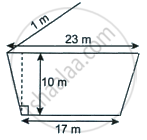
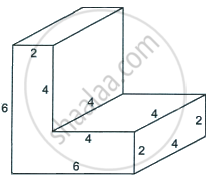
Figure shows a solid of uniform cross-section. Find its volume.
The area of cross-section of a pipe is 5.4 cm2 and water is pumped out of it at the rate of 27 km/hr. Find in litres the volume of water which flows out of the pipe in one minute.
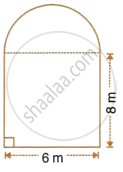
The cross-section of a railway tunnel is a rectangle 6 m broad and 8 m high surmounted by a semi-circle as shown in the figure. The tunnel is 35 m long. Find the cost of plastering the internal surface of the tunnel (excluding the floor) at the rate of Rs. 2.25 per m2.
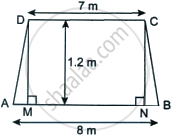
The cross-section of a tunnel perpendicular to its length is an isosceles trapezium as shown in the figure. If AB = 8 m, DC = 7 m, AD = BC and DM = 1.2 m and the tunnel is 100 m long, then calculate:
- the cost of painting the internal surface of the tunnel (excluding the floor) at the rate of ₹ 6 per m2.
- the cost of paving the floor at the rate of ₹ 20 per m2.
- the cubic content of the tunnel.
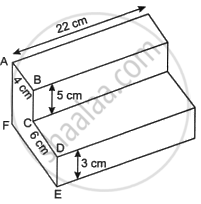
A solid copper piece has the shape shown in figure. (All measurements are in cm). The face ABCDEFA is the uniform cross-section. Assume that the angles at A, B, C, D, E and F are right angles.
- Calculate the area of the uniform cross-section.
- Calculate the volume of the above piece.
Nootan solutions for Mathematics [English] Class 9 ICSE 16 Mensuration Exercise 16E [Pages 346 - 347]
Multiple Choice Questions Choose the correct answer from the given four options in each of the following questions:
The area of an equilateral triangle is numerically equal to its perimeter. The side of triangle is ______.
`sqrt(3)` unit
`2sqrt(3)` unit
`3sqrt(3)` unit
`4sqrt(3)` unit
The area of an isosceles triangle whose equal sides are 5 cm each and base is 8 cm, is ______.
12 cm2
18 cm2
6 cm2
9 cm2
Each of the equal sides of an isosceles triangle is 2 cm more than its height. If the base of triangle is 12 cm, then the area of triangle is ______.
24 cm2
36 cm2
48 cm2
72 cm2
The sum of two sides of a right-angled triangle containing right angle is 17 cm and its hypotenuse is 13 cm. The area of triangle is ______.
24 cm2
30 cm2
36 cm2
40 cm2
If each side of a triangle is doubled, the percentage increase in the area of triangle is ______.
200%
300%
100%
400%
The sides of a triangle are in the ratio 25 : 17 : 12 and its perimeter is 540 cm. Its area is ______.
3600 cm2
4500 cm2
7200 cm2
9000 cm2
The diagonals of a rhombus are 20 cm and 12 cm. Its area is ______.
60 cm2
90 cm2
120 cm2
240 cm2
A wire when bent in the form of a square, encloses an area of 900 cm². When this wire is bent in the form of equilateral triangle, its area becomes:
`400sqrt(3)` cm2
`300sqrt(3)` cm2
`200sqrt(3)` cm2
`100sqrt(3)` cm2
The sides of a triangle are 26 cm, 28 cm and 30 cm. Its area is equal to the area of a parallelogram whose base is 28 cm. The height of parallelogram is ______.
8 cm
12 cm
15 cm
30 cm
A square is inscribed in a circle of radius 14 cm. The area of square is ______.
288 cm2
98 cm2
196 cm2
392 cm2
The diameter of a semi-circular protractor is 21 cm. Its perimeter is ______.
36 cm
54 cm
72 cm
108 cm
A solid piece of metal, cuboidal in shape, with dimensions 24 cm, 18 cm and 4 cm is recast into a cube. The side of cube is ______.
6 cm
8 cm
12 cm
16 cm
The length of longest pole that can be put in a room of dimensions 10 m × 6 m × 8 m is ______.
`10sqrt(2)` m
20 m
`20sqrt(2)` m
10 m
The length, breadth and height of a room are 10 m, 6 m and 4 m, respectively. If each child requires 2m2 area on floor, the number of children that can accommodate in the room are:
30
15
10
5
Valid Statements Questions
In the following questions, two statements (i) and (ii) are given. Choose the valid statement.
- Area of a parallelogram = base × corresponding height.
- Each of equal sides of an isosceles triangle is 5 cm and base is 8 cm. Its area will be 12 cm2.
Only (i)
Only (ii)
Both (i) and (ii)
Neither (i) nor (ii)
In the following questions, two statements (i) and (ii) are given. Choose the valid statement.
- The diagonals of a rhombus are 20 cm and 12 cm. Its area will be 240 cm2.
- Circumference of a circle of radius r is πr2.
Only (i)
Only (ii)
Both (i) and (ii)
Neither (i) nor (ii)
In the following questions, two statements (i) and (ii) are given. Choose the valid statement.
- The length of the longest pole that can be put in a room of dimensions 6 m × 8 m × 10 m is 12 m.
- Perimeter of a semi-circle of radius r is (π + 2)r.
Only (i)
Only (ii)
Both (i) and (ii)
Neither (i) nor (ii)
In the following questions, two statements (i) and (ii) are given. Choose the valid statement.
- Area of a trapezium = `1/2` × sum of parallel sides × distance between parallel sides.
- A square is inscribed in a circle of radius 14 cm. The area of square is 196 cm2.
Only (i)
Only (ii)
Both (i) and (ii)
Neither (i) nor (ii)
Solutions for 16: Mensuration
Nootan solutions for Mathematics [English] Class 9 ICSE chapter 16 - Mensuration
Shaalaa.com has the CISCE Mathematics Mathematics [English] Class 9 ICSE CISCE solutions in a manner that help students grasp basic concepts better and faster. The detailed, step-by-step solutions will help you understand the concepts better and clarify any confusion. Nootan solutions for Mathematics Mathematics [English] Class 9 ICSE CISCE 16 (Mensuration) include all questions with answers and detailed explanations. This will clear students' doubts about questions and improve their application skills while preparing for board exams.
Further, we at Shaalaa.com provide such solutions so students can prepare for written exams. Nootan textbook solutions can be a core help for self-study and provide excellent self-help guidance for students.
Concepts covered in Mathematics [English] Class 9 ICSE chapter 16 Mensuration are .
Using Nootan Mathematics [English] Class 9 ICSE solutions Mensuration exercise by students is an easy way to prepare for the exams, as they involve solutions arranged chapter-wise and also page-wise. The questions involved in Nootan Solutions are essential questions that can be asked in the final exam. Maximum CISCE Mathematics [English] Class 9 ICSE students prefer Nootan Textbook Solutions to score more in exams.
Get the free view of Chapter 16, Mensuration Mathematics [English] Class 9 ICSE additional questions for Mathematics Mathematics [English] Class 9 ICSE CISCE, and you can use Shaalaa.com to keep it handy for your exam preparation.
