Advertisements
Chapters
2: Compound Interest
3: Expansions
4: Factorisation
5: Simultaneous Linear Equations
6: Indices/Exponents
7: Logarithms
8: Triangles
9: Mid-point Theorem
10: Pythagoras Theorem
11: Rectilinear Figures
12: Constructions of Polygons
13: Theorems on Area
▶ 14: Circles
15: Statistics
16: Mensuration
17: Trigonometric Ratios
18: Trigonometric Ratios of Some Standard Angles and Complementary Angles
19: Co-ordinate Geometry: An Introduction
![Nootan solutions for Mathematics [English] Class 9 ICSE chapter 14 - Circles - Shaalaa.com](/images/mathematics-english-class-9-icse_6:f26eb985e8254aa987299226050d7c71.jpg "Nootan solutions for Mathematics [English] Class 9 ICSE chapter 14 - Circles")
Advertisements
Solutions for Chapter 14: Circles
Below listed, you can find solutions for Chapter 14 of CISCE Nootan for Mathematics [English] Class 9 ICSE.
Nootan solutions for Mathematics [English] Class 9 ICSE 14 Circles Exercise 14A [Pages 274 - 276]
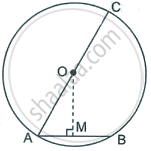
In the adjoining figure, ‘O’ is the centre of the circle. If AC = 10 cm and chord AB = 6 cm, find the distance of this chord from the centre of the circle.
A chord of length 10 cm, is at a distance of 12 cm from the centre of the circle. Find the radius of the circle.
A chord of length 10 cm is drawn in a circle of diameter 26 cm. Find its distance from the centre of the circle.
The radius of a circle is 17 cm and the length of perpendicular from centre to a chord is 8 cm. Find the length of the chord.
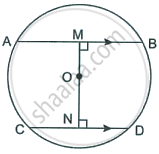
In the adjoining figure, AB and CD are two parallel chords and ‘O’ is the centre. If the radius of the circle is 15 cm, find the distance MN between the two chords of lengths 24 cm and 18 cm, respectively.
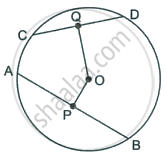
In the adjoining figure, O is the centre of the circle. AB and CD are two chords of the circle and OQ ⊥ CD, OP ⊥ AB. If AB = 24 cm, OQ = 12 cm, CD = 10 cm.
Find
- radius of the circle
- length of OP.
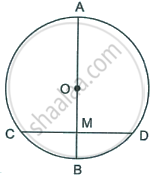
In the adjoining figure, a circle with centre O is shown in which AB is the diameter which bisects the chord CD at point M. If CD = 16 cm, BM = 4 cm, find the diameter of the circle.
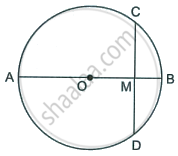
In the adjoining figure, O is the centre ofa circle with a diameter AB. If ∠OMC = 90°, CD = 6 cm, BM = 1 cm, find the radius of the circle.
In a circle of radius 13 cm, two parallel chords of lengths 24 cm and 10 cm are drawn. Find the distance between the chords, if both the chords are
- on the same side of the centre.
- on the opposite side of the centre.
Chords AB and CD of a circle are parallel to each other and lie on the opposite sides of the centre of the circle. If AB = 48 cm, CD = 36 cm and the distance between the chords is 42 cm, find the radius of the circle.
Two parallel chords are drawn in a circle of radius 15 cm. The length of one chord is 18 cm and the distance between the two chords is 21 cm. Find the length of another chord.
Prove that the line segments joining the mid-points of two parallel chords of a circle passes through the centre of the circle.
The radii of two intersecting circles are 17 cm and 25 cm. If the length of the common chord is 30 cm, find the distance between their centres.
Two equal chords AB and CD of a circle with centre O intersect each other at right angle at point P. If OM ⊥ AB and ON ⊥ CD, prove that OMPN is a square.
Two chords AB and CD of a circle with centre O intersect at point M such that ∠OMD = ∠OMA. Prove that AB = CD.
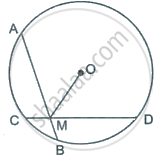
Two equal chords AB and CD of a circle with centre O intersect at point M inside the circle. Prove that AM = DM and BM = CM.
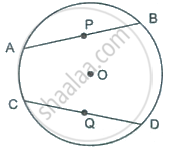
AB and CD are two equal chords of a circle with centre O. If P and Q are mid-points of AB and CD, respectively.
Prove that:
- ∠BPQ = ∠DQP
- ∠APQ = ∠CQP
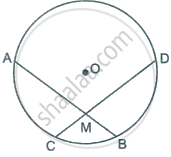
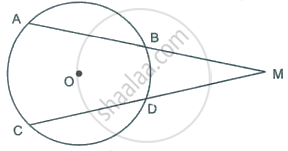
AB and CD are two equal chords of a circle with centre O, intersecting each other outside the circle at point M.
Prove that:
- AM = CМ
- BM = DM
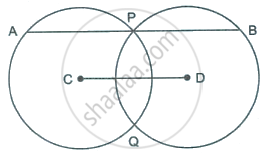
Two circles with centres C and D, intersect each other at points P and Q. If APB is parallel to CD, prove that AB = 2·CD
In an equilateral triangle, prove that the centroid and circumcentre of triangle coincide.
In ΔAВС, АВ = АC = 25 cm and BC = 14 cm. Find the radius of the circle circumscribing the triangle.
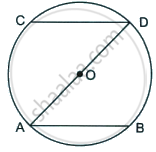
In the adjoining figure, AD is the diameter of the circle whose centre is O. If AB || CD, prove that AB = CD.
Nootan solutions for Mathematics [English] Class 9 ICSE 14 Circles Exercise 14B [Pages 278 - 279]
Two chords PQ and PR of a circle with centre O are equal. Prove that the centre of the circle lies on the bisector of ∠QPR.
Prove that the line of centres of two intersecting circles subtends equal angles at the two points of intersection.
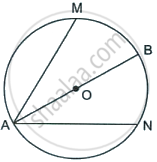
In the adjoining figure, AB is a diameter of a circle with centre O. If chord AM = chord AN, prove that arc BM = arc BN.
A and B are points on a circle with centre O. C is a point on the circle such that OC bisects ∠AOB. Prove that OC bisects the arc AB.
In the adjoining figure, two chords AB and CD of a circle intersect at M. If AB = CD, prove that arc AD = arc СВ.
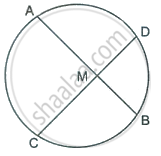
In a circle with centre O, chord SR = chord SM. The radius OS intersects the chord RM at P. Prove that PR = PM.
Prove that the angle subtended by an arc at the centre of a circle is bisected by the radius passing through the mid-point of the arc.
Nootan solutions for Mathematics [English] Class 9 ICSE 14 Circles Exercise 14C [Page 279]
The largest chord of a circle is called ______.
radius
diameter
circumference
arc
The line segment joining any two points lying on the circumference of a circle is called ______.
radius
arc
secant
chord
If P is any point in the interior of a circle with centre O and radius ‘r’, then ______.
OP = r
OP > r
OP < r
OP = 2r
Two arcs of a circle are congruent, the ratio of their corresponding chords is ______.
1 : 1
1 : 2
1 : 3
1 : 4
The radius of a circle is 5 cm. The length of its largest chord is ______.
2.5 cm
5 cm
7.5 cm
10 cm
A chord of length 6 cm is drawn in a circle of diameter 10 cm, its distance from the centre of the circle is ______.
6 cm
8 cm
4 cm
10 cm
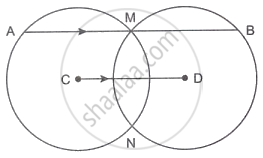
In the adjoining figure, C and D are the centres of two circles which intersect at points M and N. If AMB || CD, then AB is equal to:
4CD
CD
2CD
3CD
Solutions for 14: Circles
Nootan solutions for Mathematics [English] Class 9 ICSE chapter 14 - Circles
Shaalaa.com has the CISCE Mathematics Mathematics [English] Class 9 ICSE CISCE solutions in a manner that help students grasp basic concepts better and faster. The detailed, step-by-step solutions will help you understand the concepts better and clarify any confusion. Nootan solutions for Mathematics Mathematics [English] Class 9 ICSE CISCE 14 (Circles) include all questions with answers and detailed explanations. This will clear students' doubts about questions and improve their application skills while preparing for board exams.
Further, we at Shaalaa.com provide such solutions so students can prepare for written exams. Nootan textbook solutions can be a core help for self-study and provide excellent self-help guidance for students.
Concepts covered in Mathematics [English] Class 9 ICSE chapter 14 Circles are .
Using Nootan Mathematics [English] Class 9 ICSE solutions Circles exercise by students is an easy way to prepare for the exams, as they involve solutions arranged chapter-wise and also page-wise. The questions involved in Nootan Solutions are essential questions that can be asked in the final exam. Maximum CISCE Mathematics [English] Class 9 ICSE students prefer Nootan Textbook Solutions to score more in exams.
Get the free view of Chapter 14, Circles Mathematics [English] Class 9 ICSE additional questions for Mathematics Mathematics [English] Class 9 ICSE CISCE, and you can use Shaalaa.com to keep it handy for your exam preparation.
