Advertisements
Advertisements
Question
Prove that the line of centres of two intersecting circles subtends equal angles at the two points of intersection.
Advertisements
Solution
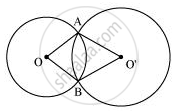
Let two circles having their centres as O and O’ intersect each other at point A and B respectively. Let us join OO’.
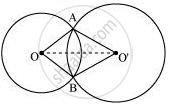
In ΔAOO’ and BOO’,
OA = OB ...(Radius of circle 1)
O’A = O’B ...(Radius of circle 2)
OO’ = OO’ ...(Common)
ΔAOO’ ≅ ΔBOO’ ...(By SSS congruence rule)
∠OAO’ = ∠OBO’ ...(By CPCT)
Therefore, line of centres of two intersecting circles subtends equal angles at the two points of intersection.
APPEARS IN
RELATED QUESTIONS
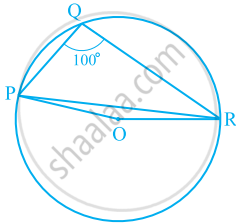
In the given figure, ∠PQR = 100°, where P, Q and R are points on a circle with centre O. Find ∠OPR.
If the non-parallel sides of a trapezium are equal, prove that it is cyclic.
ABC and ADC are two right triangles with common hypotenuse AC. Prove that ∠CAD = ∠CBD.
AC and BD are chords of a circle which bisect each other. Prove that (i) AC and BD are diameters; (ii) ABCD is a rectangle.
Two congruent circles intersect each other at points A and B. Through A any line segment PAQ is drawn so that P, Q lie on the two circles. Prove that BP = BQ.
In any triangle ABC, if the angle bisector of ∠A and perpendicular bisector of BC intersect, prove that they intersect on the circumcircle of the triangle ABC.
Bisectors of angles A, B and C of a triangle ABC intersect its circumcircle at D, E and F respectively. Prove that the angles of the triangle DEF are 90°-A, 90° − `1/2 A, 90° − 1/2 B, 90° − 1/2` C.
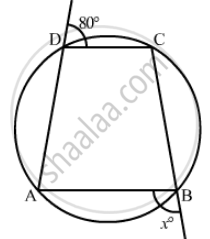
In the given figure, ABCD is a cyclic quadrilateral. Find the value of x.
Circles are described on the sides of a triangle as diameters. Prove that the circles on any two sides intersect each other on the third side (or third side produced).
ABCD is a parallelogram. A circle through A, B is so drawn that it intersects AD at P and BC at Q. Prove that P, Q, C and D are concyclic.
