Advertisements
Advertisements
Questions
Bisectors of angles A, B and C of a triangle ABC intersect its circumcircle at D, E and F respectively. Prove that the angles of the triangle DEF are 90°-A, 90° − `1/2 A, 90° − 1/2 B, 90° − 1/2` C.
Bisectors of angles A, B and C of a triangle ABC intersect its circumcircle at points D, E and F respectively. Prove that angles of ΔDEF are 90° − `1/2 ∠A, 90° − 1/2 ∠B, 90° − 1/2` ∠C.
Advertisements
Solution
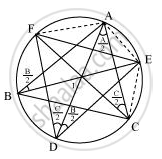
It is given that BE is the bisector of ∠B.
∴ ∠ABE = ∠B/2
However, ∠ADE = ∠ABE (Angles in the same segment for chord AE)
⇒ ∠ADE = ∠B/2
Similarly, ∠ACF = ∠ADF = ∠C/2 (Angle in the same segment for chord AF)
∠D = ∠ADE + ∠ADF
`= (angleB)/2 + (angleC)/2`
`= 1/2(angleB + angleC)`
`= 1/2(180^@ - angleA)`
`= 90^@ - 1/2angleA`
Similarly, it can be proved that
`angleE = 90^@ - 1/2angleB`
`angleF = 90^@ - 1/2angleC`
APPEARS IN
RELATED QUESTIONS
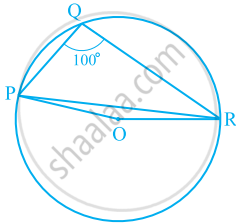
In the given figure, ∠PQR = 100°, where P, Q and R are points on a circle with centre O. Find ∠OPR.
ABCD is a cyclic quadrilateral whose diagonals intersect at a point E. If ∠DBC = 70°, ∠BAC is 30°, find ∠BCD. Further, if AB = BC, find ∠ECD.
If diagonals of a cyclic quadrilateral are diameters of the circle through the vertices of the quadrilateral, prove that it is a rectangle.
If circles are drawn taking two sides of a triangle as diameters, prove that the point of intersection of these circles lie on the third side.
Prove that the circle drawn with any side of a rhombus as diameter passes through the point of intersection of its diagonals.
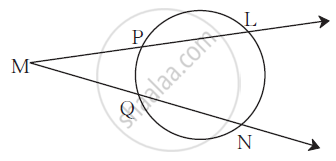
In the figure m(arc LN) = 110°,
m(arc PQ) = 50° then complete the following activity to find ∠LMN.
∠ LMN = `1/2` [m(arc LN) - _______]
∴ ∠ LMN = `1/2` [_________ - 50°]
∴ ∠ LMN = `1/2` × _________
∴ ∠ LMN = __________
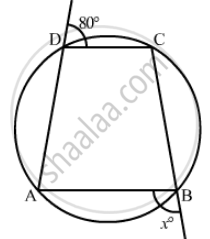
In the given figure, ABCD is a cyclic quadrilateral. Find the value of x.
ABCD is a cyclic trapezium with AD || BC. If ∠B = 70°, determine other three angles of the trapezium.
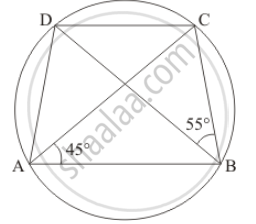
In the given figure, ABCD is a cyclic quadrilateral in which AC and BD are its diagonals. If ∠DBC = 55° and ∠BAC = 45°, find ∠BCD.
Prove that the perpendicular bisectors of the sides of a cyclic quadrilateral are concurrent.
ABCD is a cyclic quadrilateral in which BA and CD when produced meet in E and EA = ED. Prove that EB = EC.
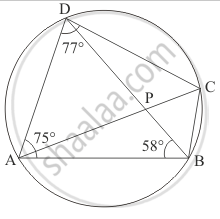
In the given figure, ABCD is a cyclic quadrilateral in which ∠BAD = 75°, ∠ABD = 58° and ∠ADC = 77°, AC and BD intersect at P. Then, find ∠DPC.
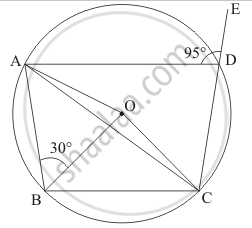
In the given figure, ABCD is a quadrilateral inscribed in a circle with centre O. CD is produced to E such that ∠AED = 95° and ∠OBA = 30°. Find ∠OAC.
PQRS is a cyclic quadrilateral such that PR is a diameter of the circle. If ∠QPR = 67° and ∠SPR = 72°, then ∠QRS =
ABCD is a cyclic quadrilateral such that ∠A = 90°, ∠B = 70°, ∠C = 95° and ∠D = 105°.
In the following figure, AOB is a diameter of the circle and C, D, E are any three points on the semi-circle. Find the value of ∠ACD + ∠BED.

ABCD is a parallelogram. A circle through A, B is so drawn that it intersects AD at P and BC at Q. Prove that P, Q, C and D are concyclic.
