Advertisements
Advertisements
Question
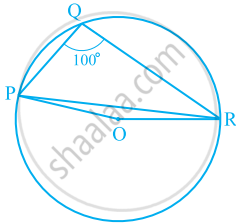
In the given figure, ∠PQR = 100°, where P, Q and R are points on a circle with centre O. Find ∠OPR.
Advertisements
Solution
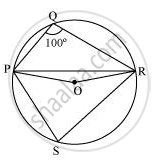
Consider PR as a chord of the circle.
Take any point S on the major arc of the circle.
PQRS is a cyclic quadrilateral.
∠PQR + ∠PSR = 180° ...(Opposite angles of a cyclic quadrilateral)
⇒ ∠PSR = 180° − 100° = 80°
We know that the angle subtended by an arc at the centre is double the angle subtended by it at any point on the remaining part of the circle.
∴ ∠POR = 2∠PSR = 2(80°) = 160°
In ΔPOR,
OP = OR ...(Radii of the same circle)
∴ ∠OPR = ∠ORP ...(Angles opposite to equal sides of a triangle)
∠OPR + ∠ORP + ∠POR = 180° ...(Angle sum property of a triangle)
2∠OPR + 160° = 180°
2∠OPR = 180° − 160° = 20°
∠OPR = 10°
APPEARS IN
RELATED QUESTIONS
Two circles intersect at two points B and C. Through B, two line segments ABD and PBQ are drawn to intersect the circles at A, D and P, Q respectively (see the given figure). Prove that ∠ACP = ∠QCD.
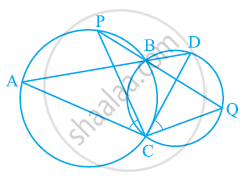
Prove that the line of centres of two intersecting circles subtends equal angles at the two points of intersection.
In any triangle ABC, if the angle bisector of ∠A and perpendicular bisector of BC intersect, prove that they intersect on the circumcircle of the triangle ABC.
Two chords AB and CD of lengths 5 cm 11cm respectively of a circle are parallel to each other and are on opposite sides of its centre. If the distance between AB and CD is 6 cm, find the radius of the circle.
In a cyclic quadrilateral ABCD, if ∠A − ∠C = 60°, prove that the smaller of two is 60°
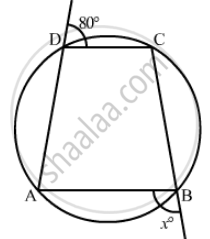
In the given figure, ABCD is a cyclic quadrilateral. Find the value of x.
ABCD is a cyclic quadrilateral in ∠BCD = 100° and ∠ABD = 70° find ∠ADB.
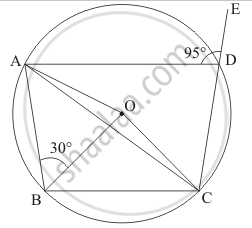
In the given figure, ABCD is a quadrilateral inscribed in a circle with centre O. CD is produced to E such that ∠AED = 95° and ∠OBA = 30°. Find ∠OAC.
ABCD is a cyclic quadrilateral such that ∠ADB = 30° and ∠DCA = 80°, then ∠DAB =
The three angles of a quadrilateral are 100°, 60°, 70°. Find the fourth angle.
