Advertisements
Advertisements
प्रश्न
In the given figure, ∠PQR = 100°, where P, Q and R are points on a circle with centre O. Find ∠OPR.
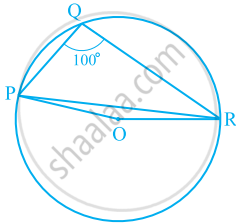
Advertisements
उत्तर
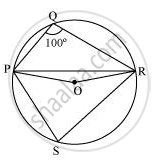
Consider PR as a chord of the circle.
Take any point S on the major arc of the circle.
PQRS is a cyclic quadrilateral.
∠PQR + ∠PSR = 180° ...(Opposite angles of a cyclic quadrilateral)
⇒ ∠PSR = 180° − 100° = 80°
We know that the angle subtended by an arc at the centre is double the angle subtended by it at any point on the remaining part of the circle.
∴ ∠POR = 2∠PSR = 2(80°) = 160°
In ΔPOR,
OP = OR ...(Radii of the same circle)
∴ ∠OPR = ∠ORP ...(Angles opposite to equal sides of a triangle)
∠OPR + ∠ORP + ∠POR = 180° ...(Angle sum property of a triangle)
2∠OPR + 160° = 180°
2∠OPR = 180° − 160° = 20°
∠OPR = 10°
APPEARS IN
संबंधित प्रश्न
Prove that a cyclic parallelogram is a rectangle.
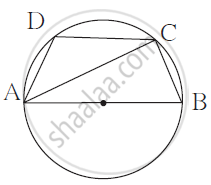
In the figure, `square`ABCD is a cyclic quadrilateral. Seg AB is a diameter. If ∠ ADC = 120˚, complete the following activity to find measure of ∠ BAC.
`square` ABCD is a cyclic quadrilateral.
∴ ∠ ADC + ∠ ABC = 180°
∴ 120˚ + ∠ ABC = 180°
∴ ∠ ABC = ______
But ∠ ACB = ______ .......(angle in semicircle)
In Δ ABC,
∠ BAC + ∠ ACB + ∠ ABC = 180°
∴ ∠BAC + ______ = 180°
∴ ∠ BAC = ______
Circles are described on the sides of a triangle as diameters. Prove that the circles on any two sides intersect each other on the third side (or third side produced).
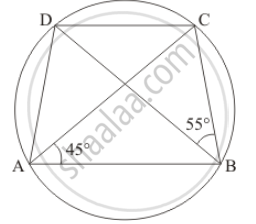
In the given figure, ABCD is a cyclic quadrilateral in which AC and BD are its diagonals. If ∠DBC = 55° and ∠BAC = 45°, find ∠BCD.
ABCD is a cyclic quadrilateral in which BA and CD when produced meet in E and EA = ED. Prove that AD || BC .
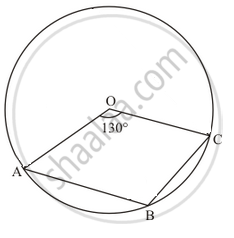
In the given figure, O is the centre of the circle such that ∠AOC = 130°, then ∠ABC =
ABCD is a cyclic quadrilateral such that AB is a diameter of the circle circumscribing it and ∠ADC = 140º, then ∠BAC is equal to ______.
If a pair of opposite sides of a cyclic quadrilateral are equal, prove that its diagonals are also equal.
In the following figure, AOB is a diameter of the circle and C, D, E are any three points on the semi-circle. Find the value of ∠ACD + ∠BED.

If P, Q and R are the mid-points of the sides BC, CA and AB of a triangle and AD is the perpendicular from A on BC, prove that P, Q, R and D are concyclic.
