Advertisements
Advertisements
प्रश्न
If a line is drawn parallel to the base of an isosceles triangle to intersect its equal sides, prove that the quadrilateral so formed is cyclic.
Advertisements
उत्तर
Given: ΔABC is an isosceles triangle such that AB = AC and also DE || BC.
To prove: Quadrilateral BCDE is a cyclic quadrilateral.
Construction: Draw a circle passes through the points B, C, D and E.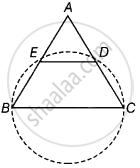
Proof: In ΔABC, AB = AC ...[Equal sides of an isosceles triangle]
⇒ ∠ACB = ∠ABC ...(i)
Since, DE || BC ...[Angles opposite to the equal sides are equal]
⇒ ∠ADE = ∠ACB [Corresponding angles] ...(ii)
On adding both sides by ∠EDC in equation (ii), we get
∠ADE + ∠EDC = ∠ACB + ∠EDC
⇒ 180° = ∠ACB + ∠EDC ...[∠ADE and ∠EDC from linear pair axiom]
⇒ ∠EDC + ∠ABC = 180° ...[From equation (i)]
Hence, BCDE is a cyclic quadrilateral, because sum of the opposite angles is 180°.
APPEARS IN
संबंधित प्रश्न
A chord of a circle is equal to the radius of the circle. Find the angle subtended by the chord at a point on the minor arc and also at a point on the major arc.
If the non-parallel sides of a trapezium are equal, prove that it is cyclic.
Let the vertex of an angle ABC be located outside a circle and let the sides of the angle intersect equal chords AD and CE with the circle. Prove that ∠ABC is equal to half the difference of the angles subtended by the chords AC and DE at the centre.
ABCD is a cyclic quadrilateral in BC || AD, ∠ADC = 110° and ∠BAC = 50°. Find ∠DAC.
ABCD is a cyclic quadrilateral in ∠BCD = 100° and ∠ABD = 70° find ∠ADB.
If the two sides of a pair of opposite sides of a cyclic quadrilateral are equal, prove that its diagonals are equal.
Prove that the perpendicular bisectors of the sides of a cyclic quadrilateral are concurrent.
Prove that the centre of the circle circumscribing the cyclic rectangle ABCD is the point of intersection of its diagonals.
ABCD is a cyclic quadrilateral in which BA and CD when produced meet in E and EA = ED. Prove that EB = EC.
If bisectors of opposite angles of a cyclic quadrilateral ABCD intersect the circle, circumscribing it at the points P and Q, prove that PQ is a diameter of the circle.
