Advertisements
Advertisements
प्रश्न
Prove that the centre of the circle circumscribing the cyclic rectangle ABCD is the point of intersection of its diagonals.
Advertisements
उत्तर
Here, ABCD is a cyclic rectangle; we have to prove that the centre of the corresponding circle is the intersection of its diagonals.
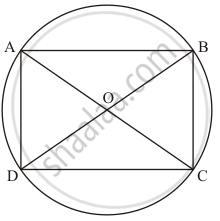
Let O be the centre of the circle.
We know that the angle formed in the semicircle is 90°.
Since, ABCD is a rectangle, So
`angleADC = angleDCB = angleABC = angleBAD = 90°`
Therefore, AC and BD are diameter of the circle.
We also know that the intersection of any two diameter is the centre of the circle.
Hence, the centre of the circle circumscribing the cyclic rectangle ABCD is the point of intersection of its diagonals.
APPEARS IN
संबंधित प्रश्न
ABCD is a cyclic quadrilateral whose diagonals intersect at a point E. If ∠DBC = 70°, ∠BAC is 30°, find ∠BCD. Further, if AB = BC, find ∠ECD.
If the non-parallel sides of a trapezium are equal, prove that it is cyclic.
The lengths of two parallel chords of a circle are 6 cm and 8 cm. If the smaller chord is at distance 4 cm from the centre, what is the distance of the other chord from the centre?
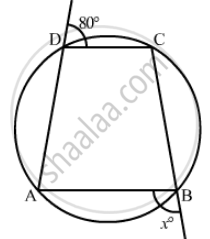
In the given figure, ABCD is a cyclic quadrilateral. Find the value of x.
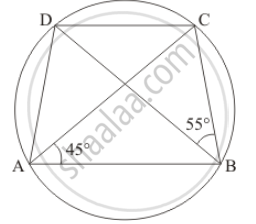
In the given figure, ABCD is a cyclic quadrilateral in which AC and BD are its diagonals. If ∠DBC = 55° and ∠BAC = 45°, find ∠BCD.
In a cyclic quadrilaterals ABCD, ∠A = 4x, ∠C = 2x the value of x is
ABCD is a cyclic quadrilateral such that AB is a diameter of the circle circumscribing it and ∠ADC = 140º, then ∠BAC is equal to ______.
If a line is drawn parallel to the base of an isosceles triangle to intersect its equal sides, prove that the quadrilateral so formed is cyclic.
If non-parallel sides of a trapezium are equal, prove that it is cyclic.
ABCD is a parallelogram. A circle through A, B is so drawn that it intersects AD at P and BC at Q. Prove that P, Q, C and D are concyclic.
