Advertisements
Advertisements
प्रश्न
ABCD is a cyclic quadrilateral in ∠BCD = 100° and ∠ABD = 70° find ∠ADB.
Advertisements
उत्तर
It is given that, ∠BCD = 100° and ∠ABD = 70°
As we know that sum of the opposite pair of angles of cyclic quadrilateral is 180°.
\[\angle ADC + \angle ABC = 180° \]
\[ \Rightarrow 180° - 80° + 180° - x = 180°\]
\[ \Rightarrow x = 100°\]
In ΔABD we have,
\[\angle DAB + \angle ABD + \angle BDA = 180° \]
\[ \Rightarrow \angle BDA = 180° - 150° = 30° \]
Hence, `angle ABD = 30°`
APPEARS IN
संबंधित प्रश्न
Prove that ‘Opposite angles of a cyclic quadrilateral are supplementary’.
If circles are drawn taking two sides of a triangle as diameters, prove that the point of intersection of these circles lie on the third side.
Prove that the line of centres of two intersecting circles subtends equal angles at the two points of intersection.
AC and BD are chords of a circle which bisect each other. Prove that (i) AC and BD are diameters; (ii) ABCD is a rectangle.
ABCD is a cyclic quadrilateral in ∠DBC = 80° and ∠BAC = 40°. Find ∠BCD.
Prove that the circles described on the four sides of a rhombus as diameters, pass through the point of intersection of its diagonals.
Circles are described on the sides of a triangle as diameters. Prove that the circles on any two sides intersect each other on the third side (or third side produced).
PQRS is a cyclic quadrilateral such that PR is a diameter of the circle. If ∠QPR = 67° and ∠SPR = 72°, then ∠QRS =
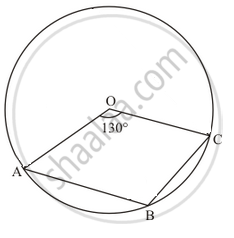
In the given figure, O is the centre of the circle such that ∠AOC = 130°, then ∠ABC =
In the following figure, AOB is a diameter of the circle and C, D, E are any three points on the semi-circle. Find the value of ∠ACD + ∠BED.

