Advertisements
Advertisements
प्रश्न
Prove that the circles described on the four sides of a rhombus as diameters, pass through the point of intersection of its diagonals.
Advertisements
उत्तर
Here, ABCD is a rhombus; we have to prove the four circles described on the four sides of any rhombusABCD pass through the point of intersection of its diagonals AC and BD.
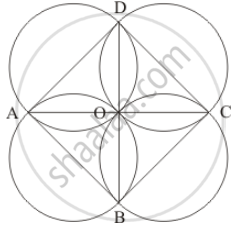
Let the diagonals AC and BD intersect at O.
We know that the diagonals of a rhombus intersect at right angle.
Therefore,
`angle AOB = `90°
`angleBOC = `90°
`angle COD ` = 90°
`angle AOD ` = 90°
Now, `angle AOB ` = 90 means that circle described on AB as diameter passes through O.
Similarly the remaining three circles with BC, CD and AD as their diameter will also pass through O.
Hence, all the circles with described on the four sides of any rhombus ABCD pass through the point of intersection of its diagonals AC and BD.
APPEARS IN
संबंधित प्रश्न
Prove that ‘Opposite angles of a cyclic quadrilateral are supplementary’.
Prove that the circle drawn with any side of a rhombus as diameter passes through the point of intersection of its diagonals.
Two congruent circles intersect each other at points A and B. Through A any line segment PAQ is drawn so that P, Q lie on the two circles. Prove that BP = BQ.
In a cyclic quadrilateral ABCD, if ∠A − ∠C = 60°, prove that the smaller of two is 60°
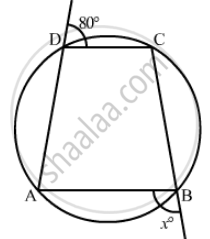
In the given figure, ABCD is a cyclic quadrilateral. Find the value of x.
ABCD is a cyclic quadrilateral in ∠DBC = 80° and ∠BAC = 40°. Find ∠BCD.
Circles are described on the sides of a triangle as diameters. Prove that the circles on any two sides intersect each other on the third side (or third side produced).
Prove that the perpendicular bisectors of the sides of a cyclic quadrilateral are concurrent.
ABCD is a cyclic quadrilateral such that AB is a diameter of the circle circumscribing it and ∠ADC = 140º, then ∠BAC is equal to ______.
If a line is drawn parallel to the base of an isosceles triangle to intersect its equal sides, prove that the quadrilateral so formed is cyclic.
