Advertisements
Advertisements
प्रश्न
ABCD is a cyclic quadrilateral in which BA and CD when produced meet in E and EA = ED. Prove that EB = EC.
Advertisements
उत्तर
EB = EC

Since, AD and BC are parallel to each other, so,
\[\angle ECB = \angle EDA \left( \text{ Corresponding angles } \right)\]
\[\angle EBC = \angle EAD \left( \text{ Corresponding angles} \right)\]
\[\text{ But } , \angle EDA = \angle EAD\]
\[\text{ Therefore } , \angle ECB = \angle EBC\]
\[ \Rightarrow EC = EB\]
\[ \text{ Therefore, } \bigtriangleup \text{ ECB is an isosceles triangle } .\]
APPEARS IN
संबंधित प्रश्न
If the non-parallel sides of a trapezium are equal, prove that it is cyclic.
Let the vertex of an angle ABC be located outside a circle and let the sides of the angle intersect equal chords AD and CE with the circle. Prove that ∠ABC is equal to half the difference of the angles subtended by the chords AC and DE at the centre.
In any triangle ABC, if the angle bisector of ∠A and perpendicular bisector of BC intersect, prove that they intersect on the circumcircle of the triangle ABC.
In a cyclic quadrilateral ABCD, if ∠A − ∠C = 60°, prove that the smaller of two is 60°
ABCD is a cyclic trapezium with AD || BC. If ∠B = 70°, determine other three angles of the trapezium.
Prove that the centre of the circle circumscribing the cyclic rectangle ABCD is the point of intersection of its diagonals.
ABCD is a cyclic quadrilateral such that ∠ADB = 30° and ∠DCA = 80°, then ∠DAB =
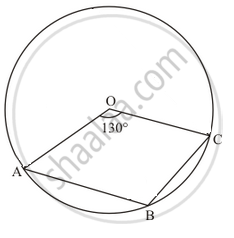
In the given figure, O is the centre of the circle such that ∠AOC = 130°, then ∠ABC =
In the following figure, AOB is a diameter of the circle and C, D, E are any three points on the semi-circle. Find the value of ∠ACD + ∠BED.

If bisectors of opposite angles of a cyclic quadrilateral ABCD intersect the circle, circumscribing it at the points P and Q, prove that PQ is a diameter of the circle.
