Advertisements
Advertisements
प्रश्न
If the non-parallel sides of a trapezium are equal, prove that it is cyclic.
Advertisements
उत्तर
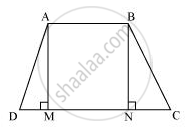
Consider a trapezium ABCD with AB | |CD and BC = AD.
Draw AM ⊥ CD and BN ⊥ CD.
In ΔAMD and ΔBNC,
AD = BC (Given)
∠AMD = ∠BNC (By construction, each is 90°)
AM = BN (Perpendicular distance between two parallel lines is same)
∴ ΔAMD ≅ ΔBNC (RHS congruence rule)
∴ ∠ADC = ∠BCD (CPCT) ... (1)
∠BAD and ∠ADC are on the same side of transversal AD.
∠BAD + ∠ADC = 180° ... (2)
∠BAD + ∠BCD = 180° [Using equation (1)]
This equation shows that the opposite angles are supplementary.
Therefore, ABCD is a cyclic quadrilateral.
संबंधित प्रश्न
A chord of a circle is equal to the radius of the circle. Find the angle subtended by the chord at a point on the minor arc and also at a point on the major arc.
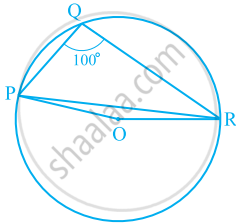
In the given figure, ∠PQR = 100°, where P, Q and R are points on a circle with centre O. Find ∠OPR.
ABCD is a cyclic quadrilateral whose diagonals intersect at a point E. If ∠DBC = 70°, ∠BAC is 30°, find ∠BCD. Further, if AB = BC, find ∠ECD.
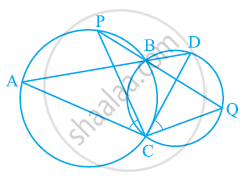
Two circles intersect at two points B and C. Through B, two line segments ABD and PBQ are drawn to intersect the circles at A, D and P, Q respectively (see the given figure). Prove that ∠ACP = ∠QCD.
AC and BD are chords of a circle which bisect each other. Prove that (i) AC and BD are diameters; (ii) ABCD is a rectangle.
ABCD is a cyclic quadrilateral in BC || AD, ∠ADC = 110° and ∠BAC = 50°. Find ∠DAC.
If the two sides of a pair of opposite sides of a cyclic quadrilateral are equal, prove that its diagonals are equal.
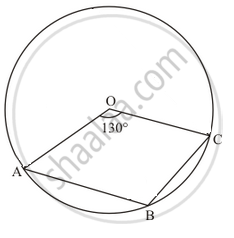
In the given figure, O is the centre of the circle such that ∠AOC = 130°, then ∠ABC =
Find all the angles of the given cyclic quadrilateral ABCD in the figure.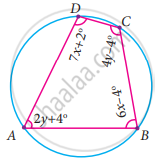
If P, Q and R are the mid-points of the sides BC, CA and AB of a triangle and AD is the perpendicular from A on BC, prove that P, Q, R and D are concyclic.
