Topics
Commercial Mathematics
Compound Interest
- Compound Interest as a Repeated Simple Interest Computation with a Growing Principal
- Use of Compound Interest in Computing Amount Over a Period of 2 Or 3-years
- Use of Formula
- Finding CI from the Relation CI = A – P
Goods and Services Tax (G.S.T.)
Algebra
Banking
Geometry
Shares and Dividends
Linear Inequations
Mensuration
Quadratic Equations
Trigonometry
Ratio and Proportion
Statistics
Probability
Factorisation of Polynomials
- Function and Polynomial
- Division Algorithm for Polynomials
- Remainder Theorem
- Factor Theorem
- Applications of Factor Theorem
Matrices
Arithmetic and Geometric Progression
Co-ordinate Geometry
- Foundation of Coordinate Geometry
- Advanced Concept of Reflection in Mathematics
- Invariant Points
- Combination of Reflections
- Using Graph Paper for Reflection
Similarity
Symmetry
Loci
- Locus
- Points Equidistant from Two Given Points
- Points Equidistant from Two Intersecting Lines
- Summary of Important Results on Locus
- Important Points on Concurrency in a Triangle
Circles
Tangent and Secant Properties
Constructions
Area and Volume of Solids (Cylinder, Cone and Sphere)
- Mensuration of Cylinder
- Hollow Cylinder
- Mensuration of Cones
- Mensuration of a Sphere
- Hemisphere
- Conversion of Solids
- Solid Figures
- Problems on Mensuration
Trigonometrical Identities
Heights and Distances
- Angles of Elevation and Depression
- Problems based on Elevation and Depression
Statistics : basic concepts, Mean, Median, Mode. Histograms and Ogive
Probability
Theorem: Opposite angles of a cyclic quadrilateral are supplementary
Statement:
The sum of the opposite angles of a cyclic quadrilateral is 180°.
Short Proof (Idea):
-
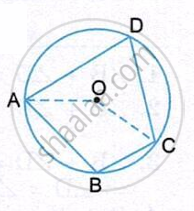
Let ABCD be a cyclic quadrilateral.
-
Arc ABC subtends an angle ∠ADC at the circle and ∠AOC at the centre.
-
The angle at the centre is double the angle at the circle.
∠ADC=`1/2`∠AOC
-
Similarly, the other arc subtends:
∠ABC = `1/2`(reflex ∠AOC)
-
The sum of angles around the centre is 360°.
-
Therefore,
∠ADC + ∠ABC = `1/2`(360°) = 180∘
Conclusion:
Hence, the opposite angles of a cyclic quadrilateral are supplementary.
Theorem: Converse of Cyclic Quadrilateral
Statement:
If the sum of a pair of opposite angles of a quadrilateral is 180°, then the quadrilateral is cyclic.
Short Proof (Idea):
-
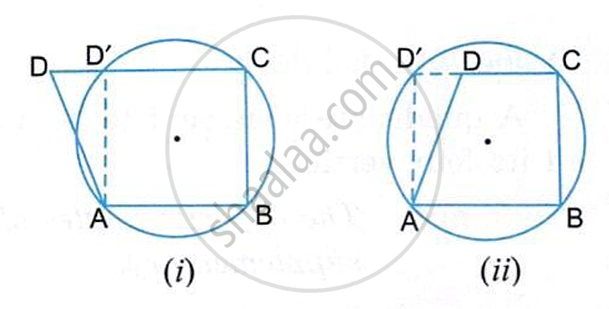
Given, ∠B + ∠D = 180°.
-
Draw a circle through three vertices of the quadrilateral.
-
If the fourth vertex does not lie on the circle, an exterior angle becomes equal to its interior opposite angle, which is not possible.
-
Hence, the fourth vertex must lie on the same circle.
Conclusion:
Therefore, ABCD is a cyclic quadrilateral.
Theorem: Exterior Angle of a Cyclic Quadrilateral
Statement:
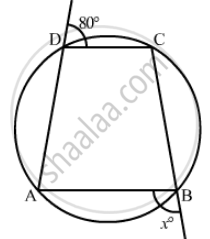
The exterior angle of a cyclic quadrilateral is equal to the interior opposite angle.
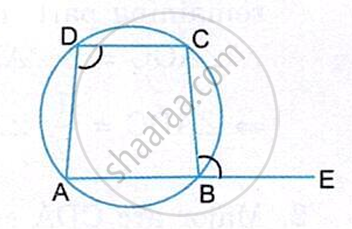
Short Proof (Idea):
-
In a cyclic quadrilateral, the sum of opposite angles is 180°.
-
The exterior angle and the adjacent interior angle form a straight line, so their sum is 180°.
-
Since both are supplementary to the same angle, they are equal.
Conclusion:
Therefore, the exterior angle of a cyclic quadrilateral is equal to the interior opposite angle.