Topics
Relations and Functions
Relations and Functions
Algebra
Inverse Trigonometric Functions
Calculus
Matrices
- Concept of Matrices
- Types of Matrices
- Equality of Matrices
- Operations on Matrices> Addition and Subtraction of Matrices
- Operations on Matrices>Scalar Multiplication
- Operations on Matrices> Matrix Multiplication
- Transpose of a Matrix
- Symmetric and Skew Symmetric Matrices
- Invertible Matrices
- Overview of Matrices
Determinants
Vectors and Three-dimensional Geometry
Continuity and Differentiability
- Continuous and Discontinuous Functions
- Algebra of Continuous Functions
- Concept of Differentiability
- Derivatives of Composite Functions
- Differentiation of Implicit Functions
- Derivative of Inverse Trigonometric Function
- Exponential and Logarithmic Functions
- Logarithmic Differentiation
- Derivatives of Functions in Parametric Forms
- Second Order Derivative
- Overview of Continuity and Differentiability
Linear Programming
Applications of Derivatives
Probability
Integrals
- Integration
- Integration as an Inverse Process of Differentiation
- Properties of Indefinite Integral
- Methods of Integration> Integration by Substitution
- Methods of Integration>Integration Using Trigonometric Identities
- Methods of Integration> Integration Using Partial Fraction
- Methods of Integration> Integration by Parts
- Integrals of Some Particular Functions
- Definite Integrals
- Fundamental Theorem of Integral Calculus
- Evaluation of Definite Integrals
- Properties of Definite Integrals
- Overview of Integrals
Sets
Applications of the Integrals
Differential Equations
- Basic Concepts of Differential Equations
- Order and Degree of a Differential Equation
- Solution of a Differential Equation
- Forms of Solving Differential Equations> Variable Separable
- Forms of Solving Differential Equations> Homogeneous Differential Equations
- Forms of Solving Differential Equations>Linear Differential Equations
- Overview of Differential Equations
Vectors
- Basic Concepts of Vector Algebra
- Direction Ratios, Direction Cosine & Direction Angles in Vector
- Types of Vectors in Algebra
- Algebra of Vectors > Addition & Subtraction of Two Vectors
- Algebra of Vectors > Scalar Multiplication
- Components of Vector in Algebra
- Vector Joining Two Points in Algebra
- Section Formula in Vector Algebra
- Product of Two Vectors > Scalar (Dot) Product
- Product of Two Vectors > Vector (Cross) Product
- Overview of Vectors
Three - Dimensional Geometry
Linear Programming
Probability
Introduction
A matrix is a rectangular arrangement of numbers written in rows and columns. It is used to organise information in a compact form and is widely applied in mathematics, science, economics, computer science, and data handling.
Matrices are especially useful when data has to be arranged systematically or when several quantities are handled together.
Definition: Matrix
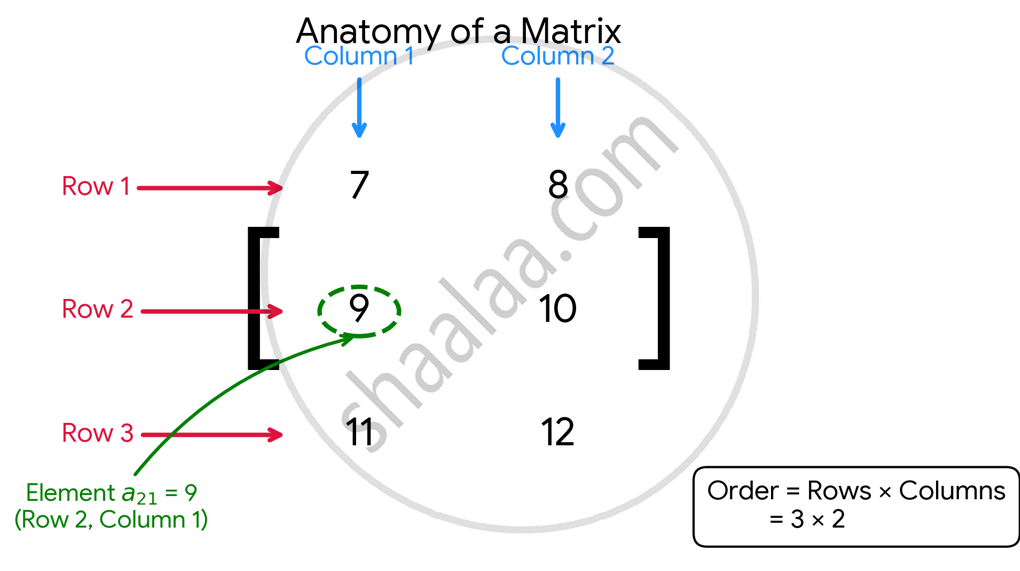
A matrix is a rectangular arrangement of numbers arranged in rows and columns, enclosed in brackets [ ] or parentheses ( ).
Elements (Entries) of a Matrix
- Each number in a matrix is called an element (or entry).
Rows and Columns
- Horizontal lines → rows
- Vertical lines → columns
Order of a Matrix
- Order = number of rows × number of columns
- Written as m × n and read as “m by n”
Example 1
Identify an Element
Let
- Order of matrix \[B = 3 \times 2\].
- The element in the 2nd row and 1st column is 9, so \[b_{21} = 9\].
- The element in the 3rd row and 2nd column is 12, so \[b_{32} = 12\].
Example 2
Construct a 3 × 2 matrix whose elements are given by \[a_{ij}=\frac{1}{2}|i-3j|\].
Solution: In general, a 3 × 2 matrix is given by \[\mathbf{A}= \begin{bmatrix} {a_{11}} & {a_{12}} \\ {a_{21}} & {a_{22}} \\ {a_{31}} & {a_{32}} \end{bmatrix}\]
Now
\[a_{ij}=\frac{1}{2}\mid i-3j\mid\], i = 1, 2, 3 and j = 1, 2.
Therefore
\[a_{11}=\frac{1}{2}\mid1-3\times1\mid=1\]
\[a_{12}=\frac{1}{2}\mid1-3\times2\mid=\frac{5}{2}\]
\[a_{21}=\frac{1}{2}|2-3\times1|=\frac{1}{2}\]
\[a_{22}=\frac{1}{2}\mid2-3\times2\mid=2\]
\[a_{31}=\frac{1}{2}\mid3-3\times1\mid=0\]
\[a_{32}=\frac{1}{2}\mid3-3\times2\mid=\frac{3}{2}\]
Hence, the required matrix is given by \[\mathrm{A}= \begin{bmatrix} 1 & \frac{5}{2} \\ \frac{1}{2} & 2 \\ 0 & \frac{3}{2} \end{bmatrix}\]
Key Points: Concept of Matrices
-
Matrix: A rectangular array of elements.
-
Element: An entry inside a matrix.
-
Order: Size of a matrix written as rows × columns.
-
Row: Horizontal set of elements.
-
Column: Vertical set of elements.
-
aij: Element in the i-th row and j-th column.
Test Yourself
Video Tutorials
Shaalaa.com | Matrices Example 1
Series:
00:04:05 undefined
00:04:43 undefined
00:07:56 undefined
00:04:18 undefined
00:04:46 undefined
00:04:24 undefined
00:04:56 undefined
00:08:16 undefined
00:05:51 undefined
00:05:28 undefined
00:06:21 undefined
00:07:55 undefined
00:04:02 undefined
00:03:57 undefined
