Topics
Relations and Functions
Relations and Functions
Algebra
Inverse Trigonometric Functions
Calculus
Matrices
- Concept of Matrices
- Types of Matrices
- Equality of Matrices
- Operations on Matrices> Addition and Subtraction of Matrices
- Operations on Matrices>Scalar Multiplication
- Operations on Matrices> Matrix Multiplication
- Transpose of a Matrix
- Symmetric and Skew Symmetric Matrices
- Invertible Matrices
- Overview of Matrices
Determinants
Vectors and Three-dimensional Geometry
Continuity and Differentiability
- Continuous and Discontinuous Functions
- Algebra of Continuous Functions
- Concept of Differentiability
- Derivatives of Composite Functions
- Differentiation of Implicit Functions
- Derivative of Inverse Trigonometric Function
- Exponential and Logarithmic Functions
- Logarithmic Differentiation
- Derivatives of Functions in Parametric Forms
- Second Order Derivative
- Overview of Continuity and Differentiability
Linear Programming
Applications of Derivatives
Probability
Integrals
- Integration
- Integration as an Inverse Process of Differentiation
- Properties of Indefinite Integral
- Methods of Integration> Integration by Substitution
- Methods of Integration>Integration Using Trigonometric Identities
- Methods of Integration> Integration Using Partial Fraction
- Methods of Integration> Integration by Parts
- Integrals of Some Particular Functions
- Definite Integrals
- Fundamental Theorem of Integral Calculus
- Evaluation of Definite Integrals
- Properties of Definite Integrals
- Overview of Integrals
Sets
Applications of the Integrals
Differential Equations
- Basic Concepts of Differential Equations
- Order and Degree of a Differential Equation
- Solution of a Differential Equation
- Forms of Solving Differential Equations> Variable Separable
- Forms of Solving Differential Equations> Homogeneous Differential Equations
- Forms of Solving Differential Equations>Linear Differential Equations
- Overview of Differential Equations
Vectors
- Basic Concepts of Vector Algebra
- Direction Ratios, Direction Cosine & Direction Angles in Vector
- Types of Vectors in Algebra
- Algebra of Vectors > Addition & Subtraction of Two Vectors
- Algebra of Vectors > Scalar Multiplication
- Components of Vector in Algebra
- Vector Joining Two Points in Algebra
- Section Formula in Vector Algebra
- Product of Two Vectors > Scalar (Dot) Product
- Product of Two Vectors > Vector (Cross) Product
- Overview of Vectors
Three - Dimensional Geometry
Linear Programming
Probability
Introduction
Conditional probability measures the probability of an event when another related event is already known to have occurred. This idea helps students understand restricted sample space, the multiplication rule, independent events, and later connections to Bayes’ theorem.
Maharashtra State Board: Class 12
Definition: Conditional Probability
If A and B are two events associated with the same sample space of a random experiment, the conditional probability of the event A given that B has occurred, i.e. P(A∣B), is given by
Formula
\[P(A | B) = \frac{P(A \cap B)}{P(B)}\], where \[P(B) \neq 0\].
\[P(B | A) = \frac{P(A \cap B)}{P(A)}\], where \[P(A) \neq 0\].
Multiplication rule: \[P(A \cap B) = P(B) \cdot P(A | B) = P(A) \cdot P(B | A)\].
Complement form: \[P(A' | B) = 1 - P(A | B)\], P(B) ≠ 0
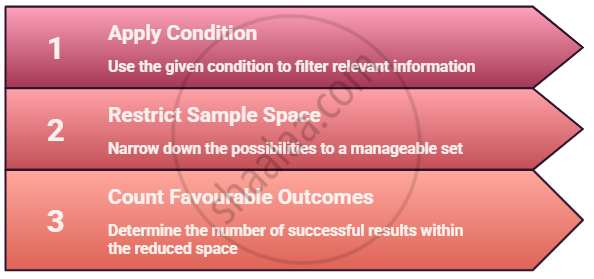
Steps
Example 1
A family has two children. What is the probability that both children are boys, given that at least one of them is a boy?
Let:
-
E = both children are boys
-
F = at least one child is a boy.
Step 1: Write the sample space
Using b for boy and g for girl:
These four outcomes are equally likely.
Step 2: Write the events
-
E = {(b,b)}
-
F = {(b,b),(g,b),(b,g)}
Step 3: Find the intersection
\[E \cap F = \{(b, b)\}\]
So,
\[P(E \cap F) = \frac{1}{4}, \quad P(F) = \frac{3}{4}\]
Step 4: Apply the formula
\[P(E | F) = \frac{P(E \cap F)}{P(F)} = \frac{1/4}{3/4} = \frac{1}{3}\]
Answer: \[\frac{1}{3}\]
Properties
- \[P(S|F) = P(F|F) = 1\]
-
If A and B are any two events of a sample space S and F is an event of S such that \[P(F) \neq 0\], then
\[P((A \cup B)|F) = P(A|F) + P(B|F) - P((A \cap B)|F)\] - \[P(E'|F) = 1 - P(E|F)\]
Key Points: Conditional Probability
-
Conditional probability means probability under a given condition.
-
The formula is \[P(A | B) = \frac{P(A \cap B)}{P(B)}\], where \[P(B) \neq 0\].
-
First restrict the sample space according to the given condition, then count the favourable outcomes.
-
The numerator represents outcomes common to both events.
-
Do not confuse P(A | B) with P(B | A).
-
For independent events, P(A | B) = P(A), provided P(B) ≠ 0.
