If f(x) = 4x² + 1 and \[g(x)=\frac{1}{x+2}\] find the following:
Topics
Relations and Functions
Relations and Functions
Algebra
Inverse Trigonometric Functions
Calculus
Matrices
- Concept of Matrices
- Types of Matrices
- Equality of Matrices
- Operations on Matrices> Addition and Subtraction of Matrices
- Operations on Matrices>Scalar Multiplication
- Operations on Matrices> Matrix Multiplication
- Transpose of a Matrix
- Symmetric and Skew Symmetric Matrices
- Invertible Matrices
- Overview of Matrices
Determinants
Vectors and Three-dimensional Geometry
Continuity and Differentiability
- Continuous and Discontinuous Functions
- Algebra of Continuous Functions
- Concept of Differentiability
- Derivatives of Composite Functions
- Differentiation of Implicit Functions
- Derivative of Inverse Trigonometric Function
- Exponential and Logarithmic Functions
- Logarithmic Differentiation
- Derivatives of Functions in Parametric Forms
- Second Order Derivative
- Overview of Continuity and Differentiability
Linear Programming
Applications of Derivatives
Probability
Integrals
- Integration
- Integration as an Inverse Process of Differentiation
- Properties of Indefinite Integral
- Methods of Integration> Integration by Substitution
- Methods of Integration>Integration Using Trigonometric Identities
- Methods of Integration> Integration Using Partial Fraction
- Methods of Integration> Integration by Parts
- Integrals of Some Particular Functions
- Definite Integrals
- Fundamental Theorem of Integral Calculus
- Evaluation of Definite Integrals
- Properties of Definite Integrals
- Overview of Integrals
Sets
Applications of the Integrals
Differential Equations
- Basic Concepts of Differential Equations
- Order and Degree of a Differential Equation
- Solution of a Differential Equation
- Forms of Solving Differential Equations> Variable Separable
- Forms of Solving Differential Equations> Homogeneous Differential Equations
- Forms of Solving Differential Equations>Linear Differential Equations
- Overview of Differential Equations
Vectors
- Basic Concepts of Vector Algebra
- Direction Ratios, Direction Cosine & Direction Angles in Vector
- Types of Vectors in Algebra
- Algebra of Vectors > Addition & Subtraction of Two Vectors
- Algebra of Vectors > Scalar Multiplication
- Components of Vector in Algebra
- Vector Joining Two Points in Algebra
- Section Formula in Vector Algebra
- Product of Two Vectors > Scalar (Dot) Product
- Product of Two Vectors > Vector (Cross) Product
- Overview of Vectors
Three - Dimensional Geometry
Linear Programming
Probability
Estimated time: 19 minutes
CBSE: Class 12
Introduction
A function connects each input to exactly one output. When one function is applied first and the result is then used as the input of another function, the new function formed is called the composition of functions.
This topic is important because it helps in understanding multistep mathematical processes, identity functions, inverse functions, and several board-level problem patterns.
CBSE: Class 12
Maharashtra State Board: Class 12
Maharashtra State Board: Class 12
Definition: Composition of Functions
Let f: A → B and g: B → C be any two functions. Then, the composition of f and g, denoted by gof, is defined as a function gof: A → C given by
gof(x) = g[f(x)], ∀ x ∈ A
- Domain (gof) = Domain (f)
- g∘f(x) = g(f(x)) → first apply f, then g
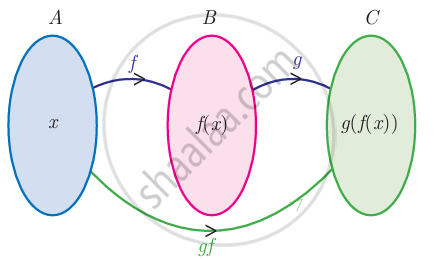
CBSE: Class 12
Conditions for Composition
| Condition | Meaning |
|---|---|
| First function | Takes input from set A |
| Second function | Must accept the output of the first function as input |
| Valid composition | Range of f should lie inside the domain of g |
| Result | A new function from A to C |
CBSE: Class 12
Properties
1. Order matters
In general,
\[g \circ f \neq f \circ g\]
So, composition is not commutative in general.
2. Associative property
If three functions are composable, then
\[h \circ (g \circ f) = (h \circ g) \circ f\]
Thus, composition is associative.
3. Identity function
If \[I_A\] is the identity function on set A, then
\[f \circ I_A = f \quad \text{and} \quad I_B \circ f = f\]
whenever the compositions are defined.
[Composition works only when: Range of inner function fits domain of outer function.]
CBSE: Class 12
Example 1
Let f : {2, 3, 4, 5} → {3, 4, 5, 9} and g : {3, 4, 5, 9} → {7, 11, 15} be functions defined as
f(2) = 3, f(3) = 4, f(4) = 5, f(5) = 5 and g(3) = 7, g(4) = 7, g(5) = 11, g(9) = 11 Find gof.
Solution
gof(2) = g(f(2)) = g(3) = 7
gof(3) = g(f(3)) = g(4) = 7
gof(4) = g(f(4)) = g(5) = 11
gof(5) = g(f(5)) = g(5) = 11
CBSE: Class 12
Example 2
CBSE: Class 12
Example 3
Let f, g and h be functions from R to R. Show that
(i) (f + g)oh = foh + goh
(ii) (f.g)oh = (foh) . (goh).
Solution:
(i) (f + g)oh = foh + goh
For all x ∈ R,
((f + g) ∘ h)(x) = (f + g)(h(x))
= f(h(x)) + g(h(x))
= (f ∘ h)(x) + (g ∘ h)(x)
∴ (f + g) ∘ h = f ∘ h + g ∘ h.
(ii) (f.g)oh = (foh) . (goh)
((f · g) ∘ h)(x) = (f · g)(h(x)) = f(h(x)) · g(h(x))
= (f ∘ h)(x) · (g ∘ h)(x)= {(f ∘ h) · (g ∘ h)}(x), ∀ x ∈ R.
Hence,
(f · g) ∘ h = (f ∘ h) · (g ∘ h).
CBSE: Class 12
Example 4
If f: R → R be the signum function defined as \[f(x)=
\begin{cases}
1, & x>0 \\
0, & x=0 \\
-1, & x<0 &
\end{cases}\] and g : R → R be the greatest integer function defined as g(x) = [x], then determine whether fog and gof coincide on (0, 1].
Solution:
Clearly gof: R → R and fog: R → R.
Consider x = 1/2, which lies in (0, 1].
Now
(gof)(1/2) = g(f(1/2)) = g(1) = [1] = 1
and (fog)(1/2) = f(g(1/2)) = f([1/2]) = f(0) = 0
⇒ (gof)(1/2) ≠ (fog)(1/2)
⇒ gof ≠ fog on (0, 1]
CBSE: Class 12
Example 5
If f(x) = \[\frac{x-1}{x+1}\], find (f ∘ f)(x).
Solution:
Step 1: Find the domain of f(x)
Given \[f(x)=\frac{x-1}{x+1}\] ⇒ Df = R − {−1}
Step 2: Domain of f∘f
Df∘f = { x : x ∈ Df , f(x) ∈ Df }
= { x : x ∈ R − {−1} , \[\frac{x-1}{x+1}\] ∈ Df } \[=\left\{x:x\neq-1,\frac{x-1}{x+1}\neq-1\right\}\]
\[=\{x:x\neq-1,x\neq0\}\]
⇒ Df∘f = R − {−1, 0}
∴ f ∘ f is defined with domain R − {−1, 0}
Step 3: Compute f(f(x))
(f ∘ f)(x) = f(f(x)) \[=f\left({\frac{x-1}{x+1}}\right)\] \[=\frac{\frac{x-1}{x+1}-1}{\frac{x-1}{x+1}+1}\]
\[=\frac{x-1-x-1}{x-1+x+1}=\frac{-2}{2x}=-\frac{1}{x}\]
CBSE: Class 12
Key Points: Composition of Functions
-
In \[g \circ f\], first apply f, then apply g.
-
\[(g \circ f)(x) = g(f(x))\].
-
Composition is defined only when the output of the first function is acceptable as input to the second function.
-
In general, \[g \circ f \neq f \circ g\].
-
Composition is associative whenever defined.
-
Identity function leaves a function unchanged under composition.
CBSE: Class 12
Common Misconceptions
-
Misconception 1: g∘f and f∘g are always equal.
Correction: They are usually different. -
Misconception 2: In g∘f, apply g first.
Correction: Always apply f first, then g. -
Misconception 3: Composition is always possible for any two functions.
Correction: It is possible only when the outputs of the first function fit into the domain of the second. -
Misconception 4: Composition and multiplication of functions are the same.
Correction: Composition means one rule after another; multiplication of functions is a different operation.
