Advertisements
Advertisements
प्रश्न
Multiple choice question :
Let f and g be two function given by f = {(0, 1), (2, 0), (3, – 4), (4, 2), (5, 7)} g = {(0, 2), (1, 0), (2, 4), (– 4, 2), (7, 0) then the range of fog is
विकल्प
{0, 2, 3, 4, 5}
{– 4, 1, 0, 2, 7}
{1, 2, 3, 4, 5}
{0, 1, 2}
Advertisements
उत्तर
{0, 1, 2}
Explanation;
f = {(0, 1) (2, 0) (3, – 4) (4, 2) (5, 7)}
g = {(0, 2) (1, 0) (2, 4) (– 4, 2) (7, 0)}
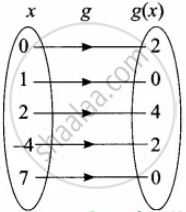
fog = f[g(x)]
f[g(0)] = f(2) = 0
f[g(1)] = f(0) = 1
f[g(2)] = f(4) = 2
f[g(– 4)] = f(2) = 0
f[g(7)] = f(0) = 1
Range of fog = {0, 1, 2}
APPEARS IN
संबंधित प्रश्न
Find the value of k, such that fog = gof
f(x) = 2x – k, g(x) = 4x + 5
Find k, if f(k) = 2k – 1 and fof(k) = 5
Let A, B, C ⊆ N and a function f: A → B be defined by f(x) = 2x + 1 and g: B → C be defined by g(x) = x2. Find the range of fog and gof.
If f(x)= x2, g(x) = 3x and h(x) = x – 2 Prove that (fog)oh = fo(goh)
Let \(f:A\to B\) and \(g:B\to C\) be functions. Which expression defines the composition of \(f\) and \(g\)?
For \(f:A\to B\) and \(g:B\to C\), what are the domain and codomain of \(g\circ f\)?
If three functions are composable, which associative property holds?
For \(f(x)=4x^2+1\) and \(g(x)=\frac{1}{x+2}\), what is \((g\circ f)(2)\)?
For functions \(f,g,h:\mathbb{R}\to\mathbb{R}\), which identity is established for multiplication?
Which statement correctly distinguishes composition of functions from multiplication of functions?
