Topics
Mathematical Logic
- Statements and Truth Values in Mathematical Logic
- Logical Connectives
- Tautology, Contradiction, and Contingency
- Quantifier, Quantified and Duality Statements in Logic
- Negations of Compound Statements
- Converse, Inverse, and Contrapositive
- Algebra of Statements
- Application of Logic to Switching Circuits
- Overview of Mathematical Logic
Matrices
- Elementry Transformations
- Adjoint and Inverse of a Matrix
- Application of Matrices
- Overview of Matrices
Trigonometric Functions
- Trigonometric Equations and Their Solutions
- Solutions of Triangle>Polar Co-Ordinates
- Solving a Triangle>Solving a Triangle
- Basics of Inverse Trigonometric Functions
- Graphs of Inverse Trigonometric Functions
- Domain, Range & Principal Value
- Properties of Inverse Trigonometric Functions > Self-adjusting Property
- Overview of Trigonometric Functions
- Properties of Inverse Trigonometric Functions > Reciprocal Property
- Properties of Inverse Trigonometric Functions > Complementary Property
- Properties of Inverse Trigonometric Functions > Addition & Subtraction Formula for Inverse Tangent
- Properties of Inverse Trigonometric Functions > Double-angle Property
- Properties of Inverse Trigonometric Functions > Triple-angle Property
- Properties of Inverse Trigonometric Functions > Addition–Subtraction Formula for Inverse Sine & Cosine
- Properties of Inverse Trigonometric Functions > Negative Argument Property
Pair of Straight Lines
Vectors
- Overview of Vectors
- Basic Concepts of Vector Algebra
- Types of Vectors in Algebra
- Algebra of Vectors > Scalar Multiplication
- Algebra of Vectors > Addition & Subtraction of Two Vectors
- Collinearity and Coplanarity of Vectors
- Vectors in Coordinate Geometry
- Components of Vector in Algebra
- Vector Joining Two Points in Algebra
- Section Formula in Vector Algebra
- Product of Two Vectors > Scalar (Dot) Product
- Product of Two Vectors > Vector (Cross) Product
- Direction Ratios, Direction Cosine & Direction Angles in Vector
- Scalar Triple Product
- Vector Triple Product
Line and Plane
Linear Programming
Differentiation
- Introduction & Derivatives of Some Standard Functions
- Derivatives of Composite Functions
- Geometrical Meaning of Derivative
- Derivative of Inverse Trigonometric Function
- Logarithmic Differentiation
- Differentiation of Implicit Functions
- Derivatives of Functions in Parametric Forms
- Higher Order Derivatives
- Overview of Differentiation
Applications of Derivatives
Indefinite Integration
Definite Integration
- Definite Integral as Limit of Sum
- Integral Calculus
- Methods of Evaluation and Properties of Definite Integral
- Overview of Definite Integration
Application of Definite Integration
- Application of Definite Integration
- Area Bounded by Two Curves
- Overview of Application of Definite Integration
Differential Equations
- Basic Concepts of Differential Equations
- Order and Degree of a Differential Equation
- Formation of Differential Equations
- Forms of Solving Differential Equations> Homogeneous Differential Equations
- Forms of Solving Differential Equations>Linear Differential Equations
- Applications of Differential Equation
- Solution of a Differential Equation
- Overview of Differential Equations
Probability Distributions
- Random Variables
- Probability Distribution of Discrete Random Variables
- Probability Distribution of a Continuous Random Variable
- Variance of a Random Variable
- Expected Value and Variance of a Random Variable
- Overview of Probability Distributions
Binomial Distribution
Introduction
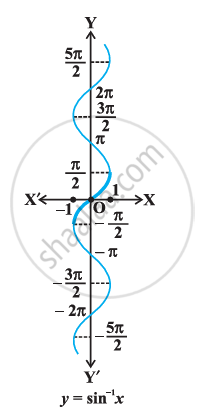
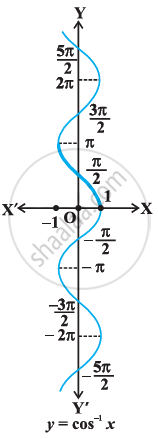
Inverse trigonometric functions are used to find an angle when the value of a trigonometric ratio is known. Since trigonometric functions are many-to-one over their full domains, each function is first restricted to a suitable interval so that its inverse becomes well-defined. The graphs of inverse trigonometric functions are obtained by reflecting the appropriate restricted branch of the original trigonometric graph in the line y = x.
Graphs of Inverse Trigonometric Functions
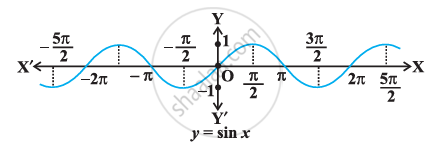
1. \[y = \sin^{-1}x\]
-
Behavior: The graph is strictly increasing.
-
Key points: Passes through \[(-1, -\frac{\pi}{2})\], \[(0, 0)\], and \[(1, \frac{\pi}{2})\].
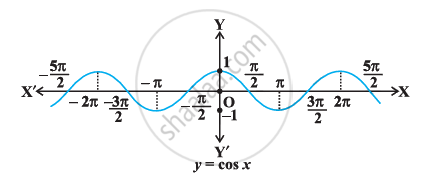
2. \[y = \cos^{-1}x\]
-
Behavior: The graph is strictly decreasing.
-
Key points: Passes through \[(-1, \pi)\], \[(0, \frac{\pi}{2})\], and \[(1, 0)\].
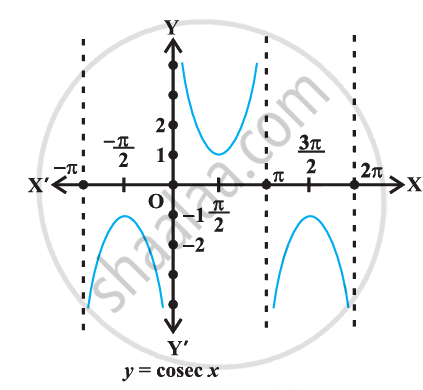
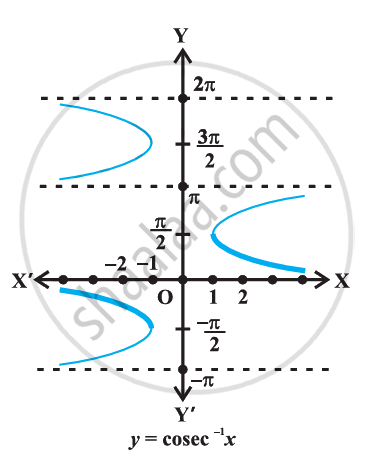
3. \[y = \text{cosec}^{-1}x\]
-
Asymptote: The x-axis (y = 0) is a horizontal asymptote as \[x \to \infty\] or \[x \to -\infty\].
-
Key points: The branches approach \[y = \frac{\pi}{2}\] as \[x \to \infty\] and \[y = -\frac{\pi}{2}\] as \[x \to -\infty\].
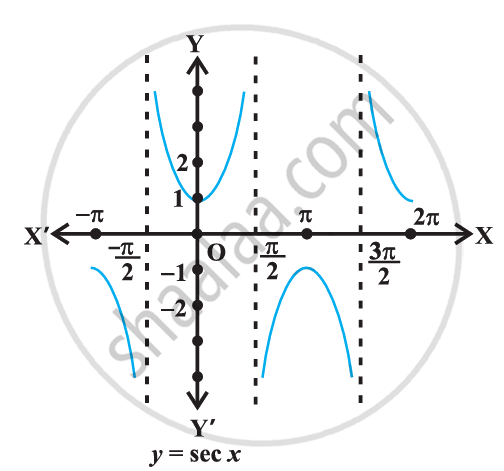
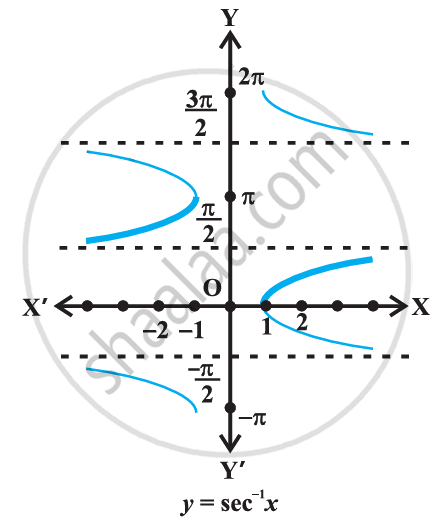
4. \[y = \sec^{-1}x\]
-
Behavior: The two branches are separated; one stays in the range \[[0, \frac{\pi}{2})\] and the other in \[(\frac{\pi}{2}, \pi]\].
-
Key points: Passes through \[(-1, \pi)\] and \[(1, 0).
5. \[y = \tan^{-1}x\]
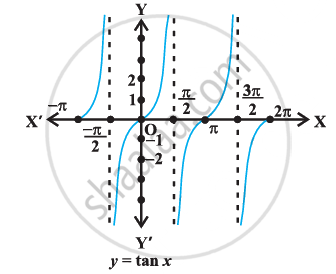
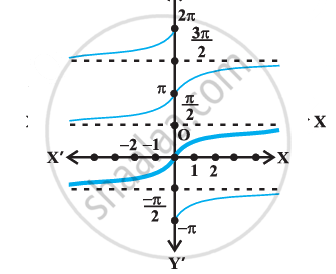
-
Behavior: Strictly increasing and passes through the origin (0, 0).
- Horizontal Asymptotes: \[y = -\frac{\pi}{2}\] and \[y = \frac{\pi}{2}\]
-
Symmetry: Symmetric about the origin (odd function).
6. \[y = \cot^{-1}x\]
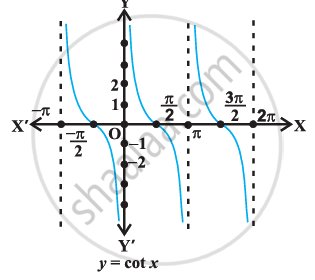
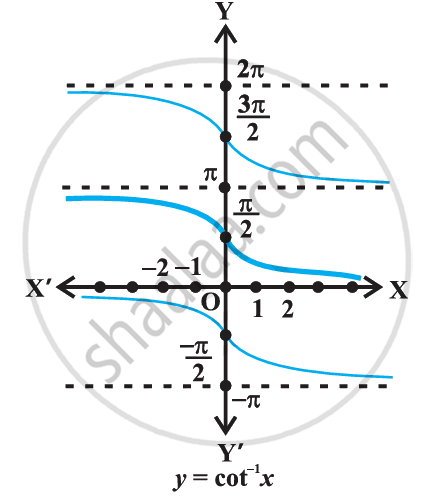
-
Behavior: Strictly decreasing over its entire domain.
- Horizontal Asymptotes: y = 0 and \[y = \pi\]
-
Key points: It crosses the y-axis at \[(0, \frac{\pi}{2})\].
Key Points: Graphs of Inverse Trigonometric Functions
| Function | Domain | Range / Principal value | Important note |
| \[y = \sin^{-1} x\] | [-1, 1] | \[[-\frac{\pi}{2}, \frac{\pi}{2}]\] | Increasing function |
| \[y = \cos^{-1} x\] | [-1, 1] | \[[0, \pi]\] | Decreasing function |
| \[y = \tan^{-1} x\] | \[\mathbb{R}\] | \[(-\frac{\pi}{2}, \frac{\pi}{2})\] | Increasing function |
| \[y = \cot^{-1} x\] | \[\mathbb{R}\] | \[(0, \pi)\] |
Decreasing function |
| \[y = \sec^{-1} x\] | \[(-\infty, -1] \cup [1, \infty)\] | \[[0, \pi] \setminus \{\frac{\pi}{2}\}\] | Increasing on each branch of its domain |
| \[y = \text{cosec}^{-1} x\] | \[(-\infty, -1] \cup [1, \infty)\] | \[\left[-\frac{\pi}{2},\frac{\pi}{2}\right]\setminus\{0\}\] | Decreasing on each branch of its domain |
