Topics
Mathematical Logic
- Statements and Truth Values in Mathematical Logic
- Logical Connectives
- Tautology, Contradiction, and Contingency
- Quantifier, Quantified and Duality Statements in Logic
- Negations of Compound Statements
- Converse, Inverse, and Contrapositive
- Algebra of Statements
- Application of Logic to Switching Circuits
- Overview of Mathematical Logic
Matrices
- Elementry Transformations
- Adjoint and Inverse of a Matrix
- Application of Matrices
- Overview of Matrices
Trigonometric Functions
- Trigonometric Equations and Their Solutions
- Solutions of Triangle>Polar Co-Ordinates
- Solving a Triangle>Solving a Triangle
- Basics of Inverse Trigonometric Functions
- Graphs of Inverse Trigonometric Functions
- Domain, Range & Principal Value
- Properties of Inverse Trigonometric Functions > Self-adjusting Property
- Overview of Trigonometric Functions
- Properties of Inverse Trigonometric Functions > Reciprocal Property
- Properties of Inverse Trigonometric Functions > Complementary Property
- Properties of Inverse Trigonometric Functions > Addition & Subtraction Formula for Inverse Tangent
- Properties of Inverse Trigonometric Functions > Double-angle Property
- Properties of Inverse Trigonometric Functions > Triple-angle Property
- Properties of Inverse Trigonometric Functions > Addition–Subtraction Formula for Inverse Sine & Cosine
- Properties of Inverse Trigonometric Functions > Negative Argument Property
Pair of Straight Lines
Vectors
- Overview of Vectors
- Basic Concepts of Vector Algebra
- Types of Vectors in Algebra
- Algebra of Vectors > Scalar Multiplication
- Algebra of Vectors > Addition & Subtraction of Two Vectors
- Collinearity and Coplanarity of Vectors
- Vectors in Coordinate Geometry
- Components of Vector in Algebra
- Vector Joining Two Points in Algebra
- Section Formula in Vector Algebra
- Product of Two Vectors > Scalar (Dot) Product
- Product of Two Vectors > Vector (Cross) Product
- Direction Ratios, Direction Cosine & Direction Angles in Vector
- Scalar Triple Product
- Vector Triple Product
Line and Plane
Linear Programming
Differentiation
- Introduction & Derivatives of Some Standard Functions
- Derivatives of Composite Functions
- Geometrical Meaning of Derivative
- Derivative of Inverse Trigonometric Function
- Logarithmic Differentiation
- Differentiation of Implicit Functions
- Derivatives of Functions in Parametric Forms
- Higher Order Derivatives
- Overview of Differentiation
Applications of Derivatives
Indefinite Integration
Definite Integration
- Definite Integral as Limit of Sum
- Integral Calculus
- Methods of Evaluation and Properties of Definite Integral
- Overview of Definite Integration
Application of Definite Integration
- Application of Definite Integration
- Area Bounded by Two Curves
- Overview of Application of Definite Integration
Differential Equations
- Basic Concepts of Differential Equations
- Order and Degree of a Differential Equation
- Formation of Differential Equations
- Forms of Solving Differential Equations> Homogeneous Differential Equations
- Forms of Solving Differential Equations>Linear Differential Equations
- Applications of Differential Equation
- Solution of a Differential Equation
- Overview of Differential Equations
Probability Distributions
- Random Variables
- Probability Distribution of Discrete Random Variables
- Probability Distribution of a Continuous Random Variable
- Variance of a Random Variable
- Expected Value and Variance of a Random Variable
- Overview of Probability Distributions
Binomial Distribution
Notes
Let R, S and T be three non collinear points on the plane with position vectors `vec a` , `vec b` and `vec c` respectively in following fig.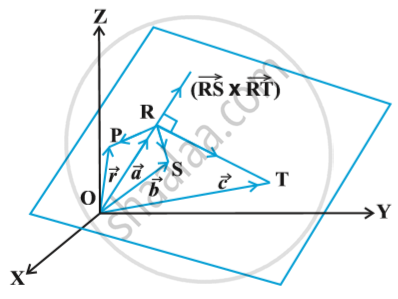
The vectors `vec (RS)` and `vec (RT)` are in the given plane. Therefore , the vector `vec (RS) xx vec (RT)` is perpendicular to the plane containing points R,S and T. Let `vec r`be the position vector of any point P in the plane. Therefore, the equation of the plane passing through R and perpendicular to the vector `vec (RS) xx vec (RT)` is
`(vec r - vec a) . (vec (RS) xx vec (RT)) = 0`
or `(vec r - vec a) . [(vec b - vec a) xx (vec c - vec a)] = 0` ...(1)
If the three points were on the same line, then there will be many planes that will contain them Fig.
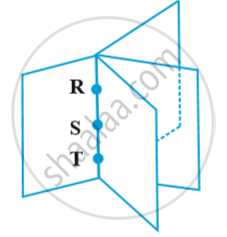
for example , These planes will resemble the pages of a book where the line containing the points R, S and T are members in the binding of the book.
Cartesian form:
Let `(x_1,y_1,z_1) , (x_2 , y_2 , z_2)` and `(x_3 , y_3 , z_3)` be the coordinates of the points R, S and T respectively. Let (x, y, z) be the coordinates of any point P on the plane with position vector `vec r`. Then
`vec (RP) = (x - x_1) hat i + ( y - y_1) hat j + (z - z_1) hat k`
`vec (RS) = (x_2 - x_1) hat i + ( y_2 - y_1) hat j + (z_2 - z_1) hat k`
`vec (RT) = (x_3 - x_1) hat i + ( y_3 - y_1) hat j + (z_3 - z_1) hat k`
Substituting these values in equation (1) of the vector form and expressing it in the form of a determinant, we have
`|(x - x_1 , y - y_1 , z - z_1),(x_2 - x_1 , y_2 - y_1, z_2 -z_1) ,(x_3 - x_1, y_3 - y_1, z_3 - z_1) | = 0`
which is the equation of the plane in Cartesian form passing through three non collinear points `(x_1, y_1, z_1), (x_2, y_2, z_2)` and `(x_3, y_3, z_3).`
Video link : https://youtu.be/PCyo3E5kOcw
Key Points: Equation of a Plane
| Case | Vector Form | Cartesian Form |
|---|---|---|
| 1. Normal form (given normal vector) | \[\overline{\mathbf{r}}.\hat{\mathbf{n}}=\mathbf{p}\] | ax + by + cz + d = 0 |
| 2. Through a point (x₁, y₁, z₁) | \[\begin{bmatrix} \mathbf{\overline{r}}-\mathbf{\overline{a}} \end{bmatrix}.\mathbf{\overline{n}}=\mathbf{0}\] | a(x−x₁) + b(y−y₁) + c(z−z₁) = 0 |
| 3. Through point + parallel to two vectors | \[\begin{bmatrix} \overline{\mathbf{r}}\overline{\mathbf{b}}\overline{\mathbf{c}} \end{bmatrix}= \begin{bmatrix} \overline{\mathbf{a}}\overline{\mathbf{b}}\overline{\mathbf{c}} \end{bmatrix}\] | \[\begin{vmatrix} x-x_1 & y-y_1 & z-z_1 \\ \mathbf{b}_1 & \mathbf{b}_2 & \mathbf{b}_3 \\ \mathbf{c}_1 & \mathbf{c}_2 & \mathbf{c}_3 \end{vmatrix}=0\] |
| 4. Through three non-collinear points | \[(\mathbf{r-a})\cdot[(\mathbf{b-a})\times(\mathbf{c-a})]=0\] | \[\begin{vmatrix} x-x_1 & y-y_1 & z-z_1 \\ x_2-x_1 & y_2-y_1 & z_2-z_1 \\ x_3-x_1 & y_3-y_1 & z_3-z_1 \end{vmatrix}=0\] |
| 5. Through the intersection of two planes | \[\left(\overline{\mathbf{r}}.\overline{\mathbf{n}}_1-\mathbf{d}_1\right)+\lambda\left(\overline{\mathbf{r}}.\overline{\mathbf{n}}_2-\mathbf{d}_2\right)=0\] | (a₁x + b₁y + c₁z + d₁) + λ(a₂x + b₂y + c₂z + d₂) = 0 |
Equation of a Plane in Intercept form:
\[\frac{x}{a}+\frac{y}{b}+\frac{z}{c}=1\]
Distance of the Plane from Origin is
\[d=\frac{1}{\sqrt{\frac{1}{a^{2}}+\frac{1}{b^{2}}+\frac{1}{c^{2}}}}\]
Notes
Consider a plane whose perpendicular distance from the origin is d (d ≠ 0). in following fig. 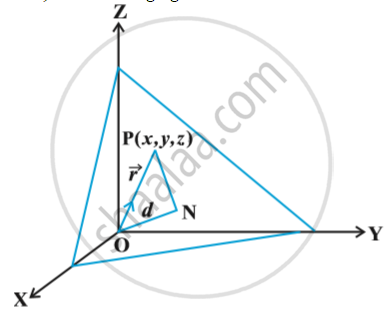
If `vec (ON)` is the normal from the origin to the plane, and `hat n ` is the unit normal vector along `vec (ON)`. Then `vec (ON)` = d . `hat n` . Let P be any point on the plane. Therefore , `vec (NP)` is perpendicular to `vec (ON)`.
Therefore, `vec (NP) . vec (ON) = 0` ...(1)
Let `vec r` be the position vector of the point P, then `vec (NP) = vec r - d . hat n` (as `vec (ON) + vec (NP) = vec (OP)`)
Therefore, (1) becomes
`(vec r - d . hat n) . d hat n = 0`
or `(vec r - d.hat n). hat n =0` (d ≠ 0)
or `vec r . hat n - d hat n . hat n = 0`
i.e., `vec r . hat n = d` (as `hat n . hat n = 1`) ...(2)
This is the vector form of the equation of the plane.
Cartesian form
Equation (2) gives the vector equation of a plane, where `hat n` is the unit vector normal to the plane. Let P(x, y, z) be any point on the plane. Then
`vec (OP) = vec r = x hat i + y hat j + z hat k`
Let l, m, n be the direction cosines of `hat n` . Then
`hat n = l hat i + m hat j + n hat k `
Therefore, (2) gives
`(x hat i + y hat j + z hat k) . (l hat i + m hat j + n hat k) = d`
i.e. lx + my + nz = d ... (3)
Notes
There can be many planes that are perpendicular to the given vector, but through a given point `P(x_1, y_1, z_1)`, only one such plane exists in following fig.
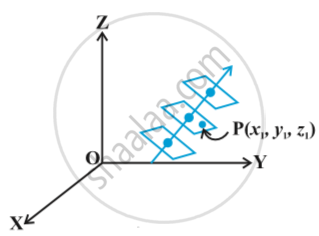
Let a plane pass through a point A with position vector `vec a` and perpendicular to the vector
`vec N `
Let `vec r` be the position vector of any point P(x,y,z) in the plane. Fig.
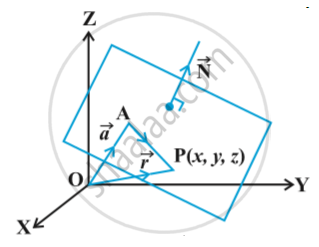
Then the point P lies in the plane if and only if `vec (AP)` is perpendicular to `vec N` . i.e., `vec (AP) . vec N = 0` . But `vec (AP) = vec r - vec a.` Therefore `(vec r - vec a) . vec N = 0` ...(1)
Cartesian form:
Let the given point A be `(x_1,y_1,z_1)` ,P be (x , y, z) and direction ratios of `vec N` are A ,B and C . Then,
`vec a = x_1 hat i + y_1 hat j + z_1 hat k , hat r = x hat i + y hat j +z hat k` and `vec N = A hat i + B hat j + C hat k`
Now `(vec r - vec a) . vec N = 0`
So `[(x - x_1) hat i + (y - y_1) hat j + (z - z_1) hat k] . (A hat i + B hat j +C hat k) = 0`
i.e. `A (x - x_1) + B (y - y_1) + C (z - z_1) = 0`
Video link : https://youtu.be/q6ASCg_D_gY
Notes
Let `π_1` and `π_2` be two planes with equations `vec r . hat n _1 = d_1` and `vec r . hat n _2 = d_2` respectively. The position vector of any point on the line of intersection must satisfy both the equations fig.
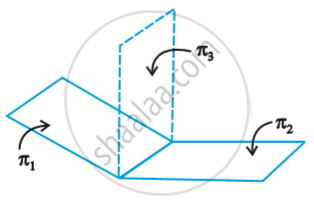
If `vec t ` is the position vector of a point on the line , then
`vec t . hat n_1 = d_1` and `vec t . hat n _2 = d_2`
Therefore , for all real values of λ, we have
`vec t . (hat n _1 + lambda hat n_2) = d_1 + lambda d_2`
Since `vec t` is arbitrary, it satisfies for any point on the line.
Hence , the equation `vec r . (vec n_1 + lambda vec n_2) = d_1 + lambda d_2` represents a plane `π_3` which is such that if any vector ` vec r` satisfies both the equations `π_1` and `π_2`, it also satisfies the equation `π_3` i.e., any plane passing through the intersection of the planes
`vec r . vec n_1 = d_1` and `vec r . vec n_2 = d_2`
has the equation `vec r . (vec n_1 + lambda vec n_2) = d_1 + lambda d_2` ...(1)
Cartesian form:
In Cartesian system, let `vec n_1 = A_1 hat i + B_2 hat j + C_1 hat k`
`vec n_2 = A_2 hat i + B_2 hat j + C _2 hat k`
and `vec r = x hat i + y hat j + z hat k`
Then (1) becomes
`x (A_1 + lambda A_2) + y(B_1 + lambda B_2) + z(C_1 +lambda C_2) = d_1 + lambda d_2`
or `(A_1x +B_1y + C_1z -d_1) + lambda (A_2x + B_2y + C_2z -d_2) = 0` ..(2)
which is the required Cartesian form of the equation of the plane passing through the intersection of the given planes for each value of λ.
