Topics
Mathematical Logic
- Statements and Truth Values in Mathematical Logic
- Logical Connectives
- Tautology, Contradiction, and Contingency
- Quantifier, Quantified and Duality Statements in Logic
- Negations of Compound Statements
- Converse, Inverse, and Contrapositive
- Algebra of Statements
- Application of Logic to Switching Circuits
- Overview of Mathematical Logic
Matrices
- Elementry Transformations
- Adjoint and Inverse of a Matrix
- Application of Matrices
- Overview of Matrices
Trigonometric Functions
- Trigonometric Equations and Their Solutions
- Solutions of Triangle>Polar Co-Ordinates
- Solving a Triangle>Solving a Triangle
- Basics of Inverse Trigonometric Functions
- Graphs of Inverse Trigonometric Functions
- Domain, Range & Principal Value
- Properties of Inverse Trigonometric Functions > Self-adjusting Property
- Overview of Trigonometric Functions
- Properties of Inverse Trigonometric Functions > Reciprocal Property
- Properties of Inverse Trigonometric Functions > Complementary Property
- Properties of Inverse Trigonometric Functions > Addition & Subtraction Formula for Inverse Tangent
- Properties of Inverse Trigonometric Functions > Double-angle Property
- Properties of Inverse Trigonometric Functions > Triple-angle Property
- Properties of Inverse Trigonometric Functions > Addition–Subtraction Formula for Inverse Sine & Cosine
- Properties of Inverse Trigonometric Functions > Negative Argument Property
Pair of Straight Lines
Vectors
- Overview of Vectors
- Basic Concepts of Vector Algebra
- Types of Vectors in Algebra
- Algebra of Vectors > Scalar Multiplication
- Algebra of Vectors > Addition & Subtraction of Two Vectors
- Collinearity and Coplanarity of Vectors
- Vectors in Coordinate Geometry
- Components of Vector in Algebra
- Vector Joining Two Points in Algebra
- Section Formula in Vector Algebra
- Product of Two Vectors > Scalar (Dot) Product
- Product of Two Vectors > Vector (Cross) Product
- Direction Ratios, Direction Cosine & Direction Angles in Vector
- Scalar Triple Product
- Vector Triple Product
Line and Plane
Linear Programming
Differentiation
- Introduction & Derivatives of Some Standard Functions
- Derivatives of Composite Functions
- Geometrical Meaning of Derivative
- Derivative of Inverse Trigonometric Function
- Logarithmic Differentiation
- Differentiation of Implicit Functions
- Derivatives of Functions in Parametric Forms
- Higher Order Derivatives
- Overview of Differentiation
Applications of Derivatives
Indefinite Integration
Definite Integration
- Definite Integral as Limit of Sum
- Integral Calculus
- Methods of Evaluation and Properties of Definite Integral
- Overview of Definite Integration
Application of Definite Integration
- Application of Definite Integration
- Area Bounded by Two Curves
- Overview of Application of Definite Integration
Differential Equations
- Basic Concepts of Differential Equations
- Order and Degree of a Differential Equation
- Formation of Differential Equations
- Forms of Solving Differential Equations> Homogeneous Differential Equations
- Forms of Solving Differential Equations>Linear Differential Equations
- Applications of Differential Equation
- Solution of a Differential Equation
- Overview of Differential Equations
Probability Distributions
- Random Variables
- Probability Distribution of Discrete Random Variables
- Probability Distribution of a Continuous Random Variable
- Variance of a Random Variable
- Expected Value and Variance of a Random Variable
- Overview of Probability Distributions
Binomial Distribution
Introduction
Maxima and minima are used to find the highest or lowest value of a quantity, such as greatest profit, shortest distance, maximum area, or minimum cost.
This topic forms an important part of Applications of Derivatives and connects graph interpretation, increasing-decreasing behavior, and optimization problems.
Definition: Maximum and Minimum Values
Let f be a function defined on an interval I.
Maximum value: f has a maximum value at c ∈ I if \[ \boxed{f(c) \geq f(x) \quad \text{for all } x \in I} \]
The value f(c) is called the maximum value and c is called a point of maximum.
Minimum value: f has a minimum value at c ∈ I if \[ \boxed{f(c) \leq f(x) \quad \text{for all } x \in I} \]
The value f(c) is called the minimum value and c is called a point of minimum.
Extreme value: A maximum or minimum value of f is called an extreme value.
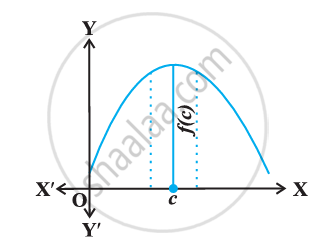
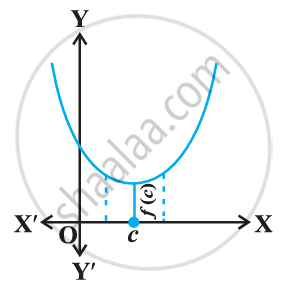
Maximum value Minimum value
Definition: Critical Point
A point in the domain of a function is called a critical point if either the derivative is zero there or the derivative does not exist there. Critical points are checked while locating possible maxima or minima.
Definition: Turning Point
The points where a function changes from decreasing to increasing or from increasing to decreasing are called turning points.
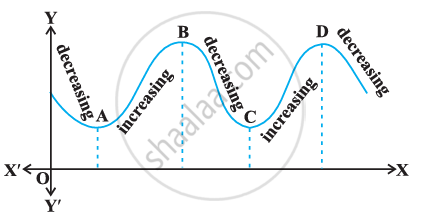
Types of Extrema
| Type | Meaning |
|---|---|
| Local maximum |
h > 0 such that \[ f(c) \geq f(x) \] for all \[ x \in (c - h, c + h). \] |
| Local minimum |
h > 0 such that \[ f(c) \leq f(x) \] for all \[ x \in (c - h, c + h). \] |
| Absolute maximum | Greatest value on the entire given interval |
| Absolute minimum | Smallest value on the entire given interval |
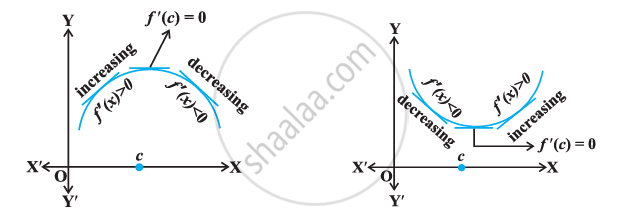
Local Maximum at x = c Local Minimum at x = c
Theorem: First Derivative Test
Let c be a critical point of a continuous function f:
-
Local Maximum: If f'(x) changes sign from positive to negative as x passes through c, then cc is a point of local maximum.
-
Local Minimum: If f'(x) changes sign from negative to positive then c is a point of local minimum.
-
Point of Inflection: f'(x) does not change sign as x passes through c (it is neither a maxima nor a minima).
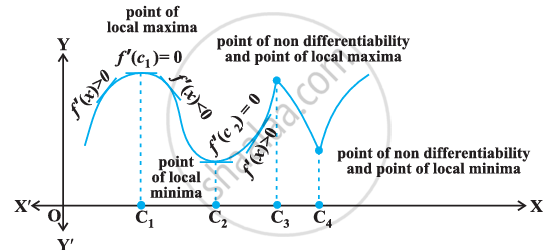
Theorem: Second Derivative Test
Assume f'(c) = 0 and the second derivative exists at c:
-
Local Maximum: f''(c) < 0
-
Local Minimum: f''(c) > 0
-
Test Fails: f''(c) = 0. If this happens, you must go back and use the First Derivative Test to check if it is a maxima, minima, or point of inflection.
Absolute Maxima and Minima
For a continuous function on a closed interval \([a,b]\), absolute maxima and minima are found by comparing function values at:
-
critical points inside the interval,
-
the left endpoint \(a\), and
-
the right endpoint \(b\).
This comparison is necessary because the largest or smallest value may occur at an endpoint.
Example 1
Find local maximum and local minimum values of the function f given by f (x) = 3x4 + 4x3 – 12x2 + 12
Solution:
First find the derivative: \[ f'(x) = 12x^3 + 12x^2 - 24x \]
\[ = 12x(x - 1)(x + 2) \]
For critical points, \[ f'(x) = 0 \]
So, \[ x = 0, \quad x = 1, \quad x = -2 \]
Now find the second derivative: \[ f''(x) = 36x^2 + 24x - 24 \]
At x = 0:
\[ f''(0) = -24 < 0 \]
Therefore, x = 0 is a point of local maximum.
\[ f(0) = 12 \]
Hence, \[ \boxed{\text{Local maximum value} = 12} \]
At x = 1:
\[ f''(1) = 36 > 0 \]
Therefore, x = 1 is a point of **local minimum**.
\[ f(1) = 3 + 4 - 12 + 12 = 7 \]
Hence, \[ \boxed{\text{Local minimum value} = 7} \]
At x = -2:
\[ f''(-2) = 72 > 0 \]
Therefore, x = -2 is also a point of **local minimum**.
\[ f(-2) = 48 - 32 - 48 + 12 = -20 \]
Hence, \[ \boxed{\text{Local minimum value} = -20} \]
Final Answer:
\[ \boxed{\text{Local maximum value} = 12 \text{ at } x = 0} \]
\[ \boxed{\text{Local minimum values} = 7 \text{ at } x = 1 \text{ and } -20 \text{ at } x = -2} \]
Maharashtra State Board: Class 12
Key Points: Maxima and Minima
-
Maxima and minima are extreme values of a function.
-
Critical points occur where \(f'(x)=0\) or \(f'(x)\) is not defined.
-
If \(f'(x)\) changes from positive to negative, the function has a local maximum.
-
If \(f'(x)\) changes from negative to positive, the function has a local minimum.
-
If \(f''(c) < 0\), there is a local maximum at \(x=c\).
-
If \(f''(c) > 0\), there is a local minimum at \(x=c\).
-
For absolute extrema on \([a,b]\), compare values at critical points and endpoints.
-
Not every critical point gives a maximum or minimum.
-
The second derivative test is quick, but the first derivative test is often more reliable in detailed reasoning.
