Advertisements
Advertisements
प्रश्न
Prove that the volume of the largest cone that can be inscribed in a sphere of radius R is `8/27` of the volume of the sphere.
Advertisements
उत्तर
Let VAB be the volume of the largest cone contained in the sphere.
Obviously, for maximum volume, the axis of the cone should be along the height of the sphere.
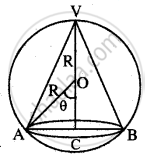
Let, ∠AOC = θ
∴ AC, the radius of the base of the cone = R sin θ, where R
is the radius of the sphere.
Height of the cone VC = VO + OC = R + R cos θ
Volume of a cone; V = `1/3 pi (AC)^2 xx (VC)`
`=> V = 1/3 piR^2 sin^2 θ (R + R cos theta)`
`=> V = 1/3 piR^3 sin^2 theta (1 + cos theta)`
On differentiating
`therefore dV/(d theta) = 1/3 piR^3 [sin^2 theta (- sin theta) + (1 cos theta) * 2 sin theta cos theta]`
`= 1/3 piR^3 [- sin^3 theta + 2 sin theta cos theta + 2 sin theta (1 - sin^2 theta)]`
`= 1/3 piR^3 [- sin^3 theta + 2 sin theta cos theta + 2 sin theta - 2sin^2 theta]`
`= 1/3 pi R^3 [- 3 sin^3 theta + 2 sin theta + 2 sin theta cos theta]`
For minimum and maximum, `(dV)/(d theta) = 0`
`=> 1/3 pi"R"^3 (- 3 sin^3 theta + 2 sin cos theta + 2 sin theta)` = 0
= - 3 sin3 θ + 2 sin θ cos θ + 2 sin θ = 0
= sin θ (- 3 sin2 θ + 2 cos θ + 2) = 0
= - 3 sin2 θ + 2 cos θ +2 = 0 ...[∵ sin θ ≠ 0]
= -3 (1 - cos2 θ) + 2 cos θ + 2 = 0
= - 3 + cos2 θ + 2 cos θ + 2 = 0
⇒ 3 cos2 θ + 2 cos θ - 1 = 0
⇒ (3 cos θ - 1)(cos θ + 1) = 0
⇒ cos θ = `1/3` cos θ = - 1
But cos θ ≠ 1 because cos θ = - 1 ⇒ θ = π which is not possible.
`therefore cos theta = 1/3`
When `cos theta = 1/3`, then `sin theta = sqrt(1 - cos^2 theta) = sqrt(1 - 1/9)`
`= sqrt(8/9)`
`= (2 sqrt2)/3`
Now `(dV)/(d theta) = 1/3 piR^3 sin theta [- 3 sin^2 theta + 2 + 2 cos theta]`
`= 1/3 piR^3 sin theta (3 cos theta - 1)(cos theta + 1)`
The sign of `cos theta = 1/3, (dV)/(d theta)` changes from +ve to -ve.
∴ V is highest at `theta = cos^-1 (1/3)`.
On decreasing θ, cos θ increases.
Now cos θ = `1/3` then V is maximum.
The height of the cone for this value of cos θ is
VC = R + R cos θ
`= R + R xx 1/3 = (4R)/3`
Radius of cone = AC = R sin θ = `R * (2sqrt2)/3 = (2 sqrt2)/3 R`
∴ Maximum volume of the cone is V
`= 1/3 pi (AC)^2 (VC)`
`= 1/3 pi ((2 sqrt(2R))/3)^2 ((4R')/3)`
`= 1/3 pi xx 8/9 R^2 xx (4R)/3`
`= 8/27 (4/3 piR^3)`
`= 8/27 xx` Volume of sphere
APPEARS IN
संबंधित प्रश्न
An open box is to be made out of a piece of a square card board of sides 18 cms by cutting off equal squares from the comers and turning up the sides. Find the maximum volume of the box.
A telephone company in a town has 5000 subscribers on its list and collects fixed rent charges of Rs.3,000 per year from each subscriber. The company proposes to increase annual rent and it is believed that for every increase of one rupee in the rent, one subscriber will be discontinued. Find what increased annual rent will bring the maximum annual income to the company.
Find the local maxima and local minima, if any, of the following function. Find also the local maximum and the local minimum values, as the case may be:
f(x) = x2
Find the local maxima and local minima, if any, of the following function. Find also the local maximum and the local minimum values, as the case may be:
`g(x) = x/2 + 2/x, x > 0`
Prove that the following function do not have maxima or minima:
g(x) = logx
Find the absolute maximum value and the absolute minimum value of the following function in the given interval:
f (x) = sin x + cos x , x ∈ [0, π]
Find two positive numbers x and y such that x + y = 60 and xy3 is maximum.
Of all the closed cylindrical cans (right circular), of a given volume of 100 cubic centimetres, find the dimensions of the can which has the minimum surface area?
The maximum value of `[x(x −1) +1]^(1/3)` , 0 ≤ x ≤ 1 is ______.
Find the maximum area of an isosceles triangle inscribed in the ellipse `x^2/ a^2 + y^2/b^2 = 1` with its vertex at one end of the major axis.
An open tank with a square base and vertical sides is to be constructed from a metal sheet so as to hold a given quantity of water. Show that the cost of material will be least when the depth of the tank is half of its width. If the cost is to be borne by nearby settled lower-income families, for whom water will be provided, what kind of value is hidden in this question?
Show that the cone of the greatest volume which can be inscribed in a given sphere has an altitude equal to \[ \frac{2}{3} \] of the diameter of the sphere.
Find the point on the straight line 2x+3y = 6, which is closest to the origin.
A wire of length 36 metres is bent in the form of a rectangle. Find its dimensions if the area of the rectangle is maximum.
Choose the correct option from the given alternatives :
If f(x) = `(x^2 - 1)/(x^2 + 1)`, for every real x, then the minimum value of f is ______.
Solve the following : Show that the height of a right circular cylinder of greatest volume that can be inscribed in a right circular cone is one-third of that of the cone.
Solve the following:
A wire of length l is cut into two parts. One part is bent into a circle and the other into a square. Show that the sum of the areas of the circle and the square is the least, if the radius of the circle is half of the side of the square.
The function f(x) = x log x is minimum at x = ______.
Divide the number 20 into two parts such that their product is maximum
The function `"f"("x") = "x" + 4/"x"` has ____________.
The function `f(x) = x^3 - 6x^2 + 9x + 25` has
The maximum value of the function f(x) = `logx/x` is ______.
A function f(x) is maximum at x = a when f'(a) > 0.
Let f: R → R be a function defined by f(x) = (x – 3)n1(x – 5)n2, n1, n2 ∈ N. Then, which of the following is NOT true?
A wire of length 36 m is cut into two pieces, one of the pieces is bent to form a square and the other is bent to form a circle. If the sum of the areas of the two figures is minimum, and the circumference of the circle is k (meter), then `(4/π + 1)`k is equal to ______.
The set of values of p for which the points of extremum of the function f(x) = x3 – 3px2 + 3(p2 – 1)x + 1 lie in the interval (–2, 4), is ______.
The greatest value of the function f(x) = `tan^-1x - 1/2logx` in `[1/sqrt(3), sqrt(3)]` is ______.
The sum of all the local minimum values of the twice differentiable function f : R `rightarrow` R defined by
f(x) = `x^3 - 3x^2 - (3f^('')(2))/2 x + f^('')(1)`
A rectangle with one side lying along the x-axis is to be inscribed in the closed region of the xy plane bounded by the lines y = 0, y = 3x and y = 30 – 2x. The largest area of such a rectangle is ______.
The maximum value of f(x) = `logx/x (x ≠ 0, x ≠ 1)` is ______.
If f(x) = `1/(4x^2 + 2x + 1); x ∈ R`, then find the maximum value of f(x).
Find the maximum and the minimum values of the function f(x) = x2ex.
A running track of 440 m is to be laid out enclosing a football field. The football field is in the shape of a rectangle with a semi-circle at each end. If the area of the rectangular portion is to be maximum,then find the length of its sides. Also calculate the area of the football field.
A right circular cylinder is to be made so that the sum of the radius and height is 6 metres. Find the maximum volume of the cylinder.
A box with a square base is to have an open top. The surface area of box is 147 sq. cm. What should be its dimensions in order that the volume is largest?
Mrs. Roy designs a window in her son’s study room so that the room gets maximum sunlight. She designs the window in the shape of a rectangle surmounted by an equilateral triangle. If the perimeter of the window is 12 m, find the dimensions of the window that will admit maximum sunlight into the room.

Let \[c\] be a critical point of a continuous function \[f\]. If \[f'(x)\] changes sign from negative to positive as \[x\] passes through \[c\], what is \[c\]?
