Advertisements
Advertisements
Question
Prove that the volume of the largest cone that can be inscribed in a sphere of radius R is `8/27` of the volume of the sphere.
Advertisements
Solution
Let VAB be the volume of the largest cone contained in the sphere.
Obviously, for maximum volume, the axis of the cone should be along the height of the sphere.
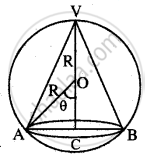
Let, ∠AOC = θ
∴ AC, the radius of the base of the cone = R sin θ, where R
is the radius of the sphere.
Height of the cone VC = VO + OC = R + R cos θ
Volume of a cone; V = `1/3 pi (AC)^2 xx (VC)`
`=> V = 1/3 piR^2 sin^2 θ (R + R cos theta)`
`=> V = 1/3 piR^3 sin^2 theta (1 + cos theta)`
On differentiating
`therefore dV/(d theta) = 1/3 piR^3 [sin^2 theta (- sin theta) + (1 cos theta) * 2 sin theta cos theta]`
`= 1/3 piR^3 [- sin^3 theta + 2 sin theta cos theta + 2 sin theta (1 - sin^2 theta)]`
`= 1/3 piR^3 [- sin^3 theta + 2 sin theta cos theta + 2 sin theta - 2sin^2 theta]`
`= 1/3 pi R^3 [- 3 sin^3 theta + 2 sin theta + 2 sin theta cos theta]`
For minimum and maximum, `(dV)/(d theta) = 0`
`=> 1/3 pi"R"^3 (- 3 sin^3 theta + 2 sin cos theta + 2 sin theta)` = 0
= - 3 sin3 θ + 2 sin θ cos θ + 2 sin θ = 0
= sin θ (- 3 sin2 θ + 2 cos θ + 2) = 0
= - 3 sin2 θ + 2 cos θ +2 = 0 ...[∵ sin θ ≠ 0]
= -3 (1 - cos2 θ) + 2 cos θ + 2 = 0
= - 3 + cos2 θ + 2 cos θ + 2 = 0
⇒ 3 cos2 θ + 2 cos θ - 1 = 0
⇒ (3 cos θ - 1)(cos θ + 1) = 0
⇒ cos θ = `1/3` cos θ = - 1
But cos θ ≠ 1 because cos θ = - 1 ⇒ θ = π which is not possible.
`therefore cos theta = 1/3`
When `cos theta = 1/3`, then `sin theta = sqrt(1 - cos^2 theta) = sqrt(1 - 1/9)`
`= sqrt(8/9)`
`= (2 sqrt2)/3`
Now `(dV)/(d theta) = 1/3 piR^3 sin theta [- 3 sin^2 theta + 2 + 2 cos theta]`
`= 1/3 piR^3 sin theta (3 cos theta - 1)(cos theta + 1)`
The sign of `cos theta = 1/3, (dV)/(d theta)` changes from +ve to -ve.
∴ V is highest at `theta = cos^-1 (1/3)`.
On decreasing θ, cos θ increases.
Now cos θ = `1/3` then V is maximum.
The height of the cone for this value of cos θ is
VC = R + R cos θ
`= R + R xx 1/3 = (4R)/3`
Radius of cone = AC = R sin θ = `R * (2sqrt2)/3 = (2 sqrt2)/3 R`
∴ Maximum volume of the cone is V
`= 1/3 pi (AC)^2 (VC)`
`= 1/3 pi ((2 sqrt(2R))/3)^2 ((4R')/3)`
`= 1/3 pi xx 8/9 R^2 xx (4R)/3`
`= 8/27 (4/3 piR^3)`
`= 8/27 xx` Volume of sphere
APPEARS IN
RELATED QUESTIONS
Examine the maxima and minima of the function f(x) = 2x3 - 21x2 + 36x - 20 . Also, find the maximum and minimum values of f(x).
Find the maximum and minimum value, if any, of the following function given by f(x) = 9x2 + 12x + 2
Find the maximum and minimum value, if any, of the function given by f(x) = |x + 2| − 1.
Prove that the following function do not have maxima or minima:
h(x) = x3 + x2 + x + 1
Find the maximum profit that a company can make, if the profit function is given by p(x) = 41 − 72x − 18x2.
At what points in the interval [0, 2π], does the function sin 2x attain its maximum value?
Find the maximum and minimum values of x + sin 2x on [0, 2π].
Find two positive numbers x and y such that their sum is 35 and the product x2y5 is a maximum.
Show that of all the rectangles inscribed in a given fixed circle, the square has the maximum area.
Of all the closed cylindrical cans (right circular), of a given volume of 100 cubic centimetres, find the dimensions of the can which has the minimum surface area?
Prove that the semi-vertical angle of the right circular cone of given volume and least curved surface is \[\cot^{- 1} \left( \sqrt{2} \right)\] .
Show that the height of a closed right circular cylinder of given volume and least surface area is equal to its diameter.
Determine the maximum and minimum value of the following function.
f(x) = x log x
The total cost of producing x units is ₹ (x2 + 60x + 50) and the price is ₹ (180 − x) per unit. For what units is the profit maximum?
The function f(x) = x log x is minimum at x = ______.
A metal wire of 36 cm long is bent to form a rectangle. By completing the following activity, find it’s dimensions when it’s area is maximum.
Solution: Let the dimensions of the rectangle be x cm and y cm.
∴ 2x + 2y = 36
Let f(x) be the area of rectangle in terms of x, then
f(x) = `square`
∴ f'(x) = `square`
∴ f''(x) = `square`
For extreme value, f'(x) = 0, we get
x = `square`
∴ f''`(square)` = – 2 < 0
∴ Area is maximum when x = `square`, y = `square`
∴ Dimensions of rectangle are `square`
If f(x) = px5 + qx4 + 5x3 - 10 has local maximum and minimum at x = 1 and x = 3 respectively then (p, q) = ______.
If z = ax + by; a, b > 0 subject to x ≤ 2, y ≤ 2, x + y ≥ 3, x ≥ 0, y ≥ 0 has minimum value at (2, 1) only, then ______.
If x is real, the minimum value of x2 – 8x + 17 is ______.
The maximum value of sin x . cos x is ______.
Maximum slope of the curve y = –x3 + 3x2 + 9x – 27 is ______.
The maximum value of `["x"("x" − 1) + 1]^(1/3)`, 0 ≤ x ≤ 1 is:
Find all the points of local maxima and local minima of the function f(x) = (x - 1)3 (x + 1)2
Find the points of local maxima and local minima respectively for the function f(x) = sin 2x - x, where `-pi/2 le "x" le pi/2`
If y `= "ax - b"/(("x" - 1)("x" - 4))` has a turning point P(2, -1), then find the value of a and b respectively.
Find the maximum profit that a company can make, if the profit function is given by P(x) = 41 + 24x – 18x2.
The distance of that point on y = x4 + 3x2 + 2x which is nearest to the line y = 2x - 1 is ____________.
Read the following passage and answer the questions given below.
|
In an elliptical sport field the authority wants to design a rectangular soccer field with the maximum possible area. The sport field is given by the graph of `x^2/a^2 + y^2/b^2` = 1. |
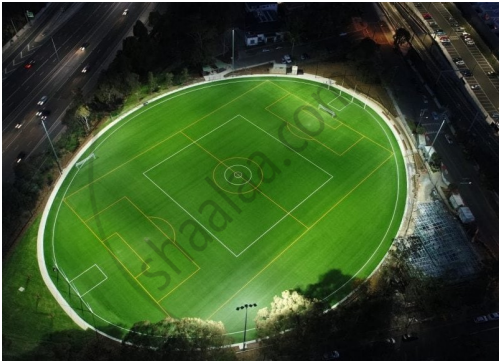
- If the length and the breadth of the rectangular field be 2x and 2y respectively, then find the area function in terms of x.
- Find the critical point of the function.
- Use First derivative Test to find the length 2x and width 2y of the soccer field (in terms of a and b) that maximize its area.
OR
Use Second Derivative Test to find the length 2x and width 2y of the soccer field (in terms of a and b) that maximize its area.
Let A = [aij] be a 3 × 3 matrix, where
aij = `{{:(1, "," if "i" = "j"),(-x, "," if |"i" - "j"| = 1),(2x + 1, "," "otherwise"):}`
Let a function f: R→R be defined as f(x) = det(A). Then the sum of maximum and minimum values of f on R is equal to ______.
If the function y = `(ax + b)/((x - 4)(x - 1))` has an extremum at P(2, –1), then the values of a and b are ______.
The function g(x) = `(f(x))/x`, x ≠ 0 has an extreme value when ______.
Let f(x) = |(x – 1)(x2 – 2x – 3)| + x – 3, x ∈ R. If m and M are respectively the number of points of local minimum and local maximum of f in the interval (0, 4), then m + M is equal to ______.
The sum of all the local minimum values of the twice differentiable function f : R `rightarrow` R defined by
f(x) = `x^3 - 3x^2 - (3f^('')(2))/2 x + f^('')(1)`
The point in the interval [0, 2π], where f(x) = ex sin x has maximum slope, is ______.
Find two numbers whose sum is 15 and when the square of one number multiplied by the cube of the other is maximum.
A box with a square base is to have an open top. The surface area of box is 147 sq. cm. What should be its dimensions in order that the volume is largest?
Assume \[f'(c)=0\] and the second derivative exists at \[c\]. Which condition gives a local maximum?
For a continuous function on a closed interval \[[a,b]\], which values must be compared to find absolute maxima and minima?
For \[f(x)=3x^4+4x^3-12x^2+12\], what conclusion follows at \[x=1\]?
For \[f(x)=3x^4+4x^3-12x^2+12\], what conclusion follows at \[x=-2\]?
