Advertisements
Advertisements
Question
If the sum of the lengths of the hypotenuse and a side of a right-angled triangle is given, show that the area of the triangle is maximum when the angle between them is `pi/3`
Advertisements
Solution
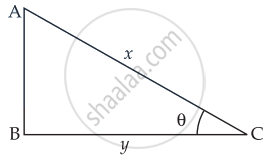
Let ΔABC be the right angled triangle in which ∠B = 90°
Let AC = x, BC = y
∴ AB = `sqrt(x^2 - y^2)`
∠ACB = θ
Let Z = x + y ....(Given)
Now area of ΔABC, A = `1/2 xx "AB" xx "BC"`
⇒ A = `1/2 y * sqrt(x^2 - y^2)`
⇒ A = `1/2 y * sqrt(("Z" - y)^2 - y^2)`
Squaring both sides, we get
⇒ A2 = `1/4 y^2 [("Z" - y)^2 - y^2]`
⇒ A2 = `1/4 y^2 ["Z"^2 + y^2 - 2"Z" y - y^2]`
⇒ P = `1/4 y^2 ["Z"^2 - 2"Z"y]`
⇒ P = `1/4 [y^2"Z"^2 - 2"Z"y^3]` ....[A2 = P]
Differentiating both sides w.r.t. y we get
`"dP"/"dy" = 1/4 [2y"Z"^2 - 6"Z"y^2]` .....(i)
For local maxima and local minima,
`"dP"/"dy"` = 0
∴ `1/4 (2y"Z"^2 - 6"Z"y^2)` = 0
⇒ `(2y"Z")/4 ("Z" - 3y)` = 0
⇒ yZ(Z – 3y) = 0
⇒ yZ ≠ 0 .....(∵ y ≠ 0 and Z ≠ 0)
⇒ Z – 3y = 0
⇒ y = `"Z"/3`
⇒ y = `(x + y)/3` .....(∵ Z = x + y)
⇒ 3y = x + y
⇒ 3y – y = x
⇒ 2y = x
⇒ `y/x = 1/2`
⇒ cos θ = `1/2`
∴ θ = `pi/3`
Differentiating eq. (i) w.r.t. y,
We have `("d"^2"P")/("dy"^2) = 1/4 [2"Z"^2 - 12"Z"y]`
`("d"^2"P")/("dy"^2)` at y = `"Z"/3 = 1/4 [2"Z"^2 - 12"Z" * "Z"/3]`
= `1/4 [2"Z"^2 - 4"Z"^2]`
= `(-"Z"^2)/2 < 0`
Hence, the area of the given triangle is maximum when the angle between its hypotenuse and a side is `pi/3`.
APPEARS IN
RELATED QUESTIONS
Find the maximum and minimum value, if any, of the function given by f(x) = |x + 2| − 1.
Find the maximum and minimum value, if any, of the following function given by h(x) = sin(2x) + 5.
Find the local maxima and local minima, if any, of the following function. Find also the local maximum and the local minimum values, as the case may be:
g(x) = x3 − 3x
Find the absolute maximum value and the absolute minimum value of the following function in the given interval:
f (x) = sin x + cos x , x ∈ [0, π]
Find both the maximum value and the minimum value of 3x4 − 8x3 + 12x2 − 48x + 25 on the interval [0, 3].
At what points in the interval [0, 2π], does the function sin 2x attain its maximum value?
What is the maximum value of the function sin x + cos x?
Show that the surface area of a closed cuboid with square base and given volume is minimum, when it is a cube.
An open tank with a square base and vertical sides is to be constructed from a metal sheet so as to hold a given quantity of water. Show that the cost of material will be least when the depth of the tank is half of its width. If the cost is to be borne by nearby settled lower-income families, for whom water will be provided, what kind of value is hidden in this question?
Prove that the semi-vertical angle of the right circular cone of given volume and least curved surface is \[\cot^{- 1} \left( \sqrt{2} \right)\] .
A rod of 108 meters long is bent to form a rectangle. Find its dimensions if the area is maximum. Let x be the length and y be the breadth of the rectangle.
Find the maximum and minimum of the following functions : f(x) = x log x
A ball is thrown in the air. Its height at any time t is given by h = 3 + 14t – 5t2. Find the maximum height it can reach.
Find the largest size of a rectangle that can be inscribed in a semicircle of radius 1 unit, so that two vertices lie on the diameter.
Solve the following : Show that of all rectangles inscribed in a given circle, the square has the maximum area.
A rectangular sheet of paper has it area 24 sq. Meters. The margin at the top and the bottom are 75 cm each and the sides 50 cm each. What are the dimensions of the paper if the area of the printed space is maximum?
A rod of 108 m long is bent to form a rectangle. Find it’s dimensions when it’s area is maximum.
By completing the following activity, examine the function f(x) = x3 – 9x2 + 24x for maxima and minima
Solution: f(x) = x3 – 9x2 + 24x
∴ f'(x) = `square`
∴ f''(x) = `square`
For extreme values, f'(x) = 0, we get
x = `square` or `square`
∴ f''`(square)` = – 6 < 0
∴ f(x) is maximum at x = 2.
∴ Maximum value = `square`
∴ f''`(square)` = 6 > 0
∴ f(x) is maximum at x = 4.
∴ Minimum value = `square`
The two parts of 120 for which the sum of double of first and square of second part is minimum, are ______.
An open box with square base is to be made of a given quantity of cardboard of area c2. Show that the maximum volume of the box is `"c"^3/(6sqrt(3))` cubic units
If y `= "ax - b"/(("x" - 1)("x" - 4))` has a turning point P(2, -1), then find the value of a and b respectively.
Find the maximum profit that a company can make, if the profit function is given by P(x) = 41 + 24x – 18x2.
If y = x3 + x2 + x + 1, then y ____________.
Find both the maximum and minimum values respectively of 3x4 - 8x3 + 12x2 - 48x + 1 on the interval [1, 4].
The area of a right-angled triangle of the given hypotenuse is maximum when the triangle is ____________.
The combined resistance R of two resistors R1 and R2 (R1, R2 > 0) is given by `1/"R" = 1/"R"_1 + 1/"R"_2`. If R1 + R2 = C (a constant), then maximum resistance R is obtained if ____________.
For all real values of `x`, the minimum value of `(1 - x + x^2)/(1 + x + x^2)`
Let A = [aij] be a 3 × 3 matrix, where
aij = `{{:(1, "," if "i" = "j"),(-x, "," if |"i" - "j"| = 1),(2x + 1, "," "otherwise"):}`
Let a function f: R→R be defined as f(x) = det(A). Then the sum of maximum and minimum values of f on R is equal to ______.
A wire of length 36 m is cut into two pieces, one of the pieces is bent to form a square and the other is bent to form a circle. If the sum of the areas of the two figures is minimum, and the circumference of the circle is k (meter), then `(4/π + 1)`k is equal to ______.
The sum of all the local minimum values of the twice differentiable function f : R `rightarrow` R defined by
f(x) = `x^3 - 3x^2 - (3f^('')(2))/2 x + f^('')(1)`
The maximum value of z = 6x + 8y subject to constraints 2x + y ≤ 30, x + 2y ≤ 24 and x ≥ 0, y ≥ 0 is ______.
The point in the interval [0, 2π], where f(x) = ex sin x has maximum slope, is ______.
Find two numbers whose sum is 15 and when the square of one number multiplied by the cube of the other is maximum.
If x + y = 8, then the maximum value of x2y is ______.
Find the point on the curve y2 = 4x, which is nearest to the point (2, 1).
Determine the minimum value of the function.
f(x) = 2x3 – 21x2 + 36x – 20
Sumit has bought a closed cylindrical dustbin. The radius of the dustbin is ‘r' cm and height is 'h’ cm. It has a volume of 20π cm3.
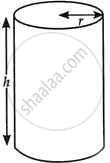
- Express ‘h’ in terms of ‘r’, using the given volume.
- Prove that the total surface area of the dustbin is `2πr^2 + (40π)/r`
- Sumit wants to paint the dustbin. The cost of painting the base and top of the dustbin is ₹ 2 per cm2 and the cost of painting the curved side is ₹ 25 per cm2. Find the total cost in terms of ‘r’, for painting the outer surface of the dustbin including the base and top.
- Calculate the minimum cost for painting the dustbin.
For a function defined on an interval \[I\], which condition means that \[f\] has a minimum value at \[c\in I\]?
A maximum or minimum value of \[f\] is called a(n) _____.
