Advertisements
Advertisements
Question
A window is in the form of a rectangle surmounted by a semicircular opening. The total perimeter of the window is 10 m. Find the dimensions of the window to admit maximum light through the whole opening
Advertisements
Solution
Let x and y be the length and breadth of the rectangle.
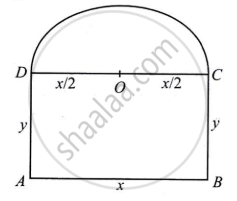
Radius of the semi - circle `= x/2`
Circumference of the semi - circle = `(pix)/2.`
Perimeter of the window
AB + BC + AD + DC
`x + 2y + (pix)/2= 10`
⇒ 2x + 4y + πx = 20
⇒ `y = (20 - (2 + pi)x)/4`
Area of the window = area of rectangle + area of a semicircle.
`A = xy + 1/2 pi (x/2)^2`
`= x ((20 - (2 + pi)x)/4) + (pix^2)/8.`
`A = (20x - (2 + pi) x^2)/4 + (pix^2)/8.`
∴ `(dA)/dx = (20 - (2 + pi) 2x)/4 + (2pix)/8`
For maxima / minima of A,
`(dA)/dx = 0`
⇒ `(20 - (2 + pi) 2x)/4 + (2pix)/8 = 0`
⇒ 20 - (2 + π) 2x + πx = 0
⇒ 20 + x (π - 4 - 2π) = 0
⇒ 20 - x (4 + π) = 0
⇒ `x = 20/ (4 + pi)`
`(d^2A)/dx^2 = (-(2 + pi)2)/4 + (2pi)/8`
`= (-4 -2pi + pi)/4`
` = (-4 -pi)/4`
⇒ `(d^2A)/dx^2 < 0`
Hence the window admit the maximum light when x = length = `20/ (4 + pi)`
and breadth `y = (20 - (2 + pi) 20/(4 + pi))/4`
`= (80 + 20pi - 40 - 20 pi)/(4 (4 + pi))`
`= 40/ (4(4 + pi))`
`= 10/ (4 + pi).`
RELATED QUESTIONS
Find the approximate value of cos (89°, 30'). [Given is: 1° = 0.0175°C]
If the sum of lengths of hypotenuse and a side of a right angled triangle is given, show that area of triangle is maximum, when the angle between them is π/3.
Find the maximum and minimum value, if any, of the following function given by g(x) = x3 + 1.
Find the local maxima and local minima, if any, of the following function. Find also the local maximum and the local minimum values, as the case may be:
f(x) = x3 − 6x2 + 9x + 15
Find the local maxima and local minima, if any, of the following function. Find also the local maximum and the local minimum values, as the case may be:
`g(x) = x/2 + 2/x, x > 0`
Prove that the following function do not have maxima or minima:
h(x) = x3 + x2 + x + 1
Find the absolute maximum value and the absolute minimum value of the following function in the given interval:
`f(x) =x^3, x in [-2,2]`
For all real values of x, the minimum value of `(1 - x + x^2)/(1+x+x^2)` is ______.
The maximum value of `[x(x −1) +1]^(1/3)` , 0 ≤ x ≤ 1 is ______.
Find the point on the straight line 2x+3y = 6, which is closest to the origin.
Find the maximum and minimum of the following functions : f(x) = 2x3 – 21x2 + 36x – 20
Find the maximum and minimum of the following functions : f(x) = x log x
Divide the number 20 into two parts such that sum of their squares is minimum.
Find the largest size of a rectangle that can be inscribed in a semicircle of radius 1 unit, so that two vertices lie on the diameter.
Determine the maximum and minimum value of the following function.
f(x) = x log x
Find the local maximum and local minimum value of f(x) = x3 − 3x2 − 24x + 5
If f(x) = `x + 1/x, x ne 0`, then local maximum and x minimum values of function f are respectively.
Twenty meters of wire is available for fencing off a flowerbed in the form of a circular sector. Then the maximum area (in sq. m) of the flower-bed, is ______
The maximum and minimum values for the function f(x) = 4x3 - 6x2 on [-1, 2] are ______
The minimum value of the function f(x) = 13 - 14x + 9x2 is ______
The two parts of 120 for which the sum of double of first and square of second part is minimum, are ______.
Show that the function f(x) = 4x3 – 18x2 + 27x – 7 has neither maxima nor minima.
The curves y = 4x2 + 2x – 8 and y = x3 – x + 13 touch each other at the point ______.
Find the points of local maxima and local minima respectively for the function f(x) = sin 2x - x, where `-pi/2 le "x" le pi/2`
If y `= "ax - b"/(("x" - 1)("x" - 4))` has a turning point P(2, -1), then find the value of a and b respectively.
The combined resistance R of two resistors R1 and R2 (R1, R2 > 0) is given by `1/"R" = 1/"R"_1 + 1/"R"_2`. If R1 + R2 = C (a constant), then maximum resistance R is obtained if ____________.
Let f: R → R be a function defined by f(x) = (x – 3)n1(x – 5)n2, n1, n2 ∈ N. Then, which of the following is NOT true?
A wire of length 36 m is cut into two pieces, one of the pieces is bent to form a square and the other is bent to form a circle. If the sum of the areas of the two figures is minimum, and the circumference of the circle is k (meter), then `(4/π + 1)`k is equal to ______.
Let x and y be real numbers satisfying the equation x2 – 4x + y2 + 3 = 0. If the maximum and minimum values of x2 + y2 are a and b respectively. Then the numerical value of a – b is ______.
The minimum value of 2sinx + 2cosx is ______.
The point in the interval [0, 2π], where f(x) = ex sin x has maximum slope, is ______.
A metal wire of 36 cm long is bent to form a rectangle. Find its dimensions when its area is maximum.
The rectangle has area of 50 cm2. Complete the following activity to find its dimensions for least perimeter.
Solution: Let x cm and y cm be the length and breadth of a rectangle.
Then its area is xy = 50
∴ `y =50/x`
Perimeter of rectangle `=2(x+y)=2(x+50/x)`
Let f(x) `=2(x+50/x)`
Then f'(x) = `square` and f''(x) = `square`
Now,f'(x) = 0, if x = `square`
But x is not negative.
∴ `x = root(5)(2) "and" f^('')(root(5)(2))=square>0`
∴ by the second derivative test f is minimum at x = `root(5)(2)`
When x = `root(5)(2),y=50/root(5)(2)=root(5)(2)`
∴ `x=root(5)(2) "cm" , y = root(5)(2) "cm"`
Hence, rectangle is a square of side `root(5)(2) "cm"`
Determine the minimum value of the function.
f(x) = 2x3 – 21x2 + 36x – 20
Sumit has bought a closed cylindrical dustbin. The radius of the dustbin is ‘r' cm and height is 'h’ cm. It has a volume of 20π cm3.
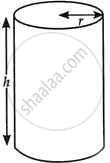
- Express ‘h’ in terms of ‘r’, using the given volume.
- Prove that the total surface area of the dustbin is `2πr^2 + (40π)/r`
- Sumit wants to paint the dustbin. The cost of painting the base and top of the dustbin is ₹ 2 per cm2 and the cost of painting the curved side is ₹ 25 per cm2. Find the total cost in terms of ‘r’, for painting the outer surface of the dustbin including the base and top.
- Calculate the minimum cost for painting the dustbin.
For a function defined on an interval \[I\], which condition means that \[f\] has a maximum value at \[c\in I\]?
For a function defined on an interval \[I\], which condition means that \[f\] has a minimum value at \[c\in I\]?
Let \[c\] be a critical point of a continuous function \[f\]. If \[f'(x)\] changes sign from positive to negative as \[x\] passes through \[c\], what is \[c\]?
Why must the left endpoint \[a\] and right endpoint \[b\] be checked for absolute extrema on \[[a,b]\]?
For \[f(x)=3x^4+4x^3-12x^2+12\], what conclusion follows at \[x=-2\]?
