Advertisements
Advertisements
Question
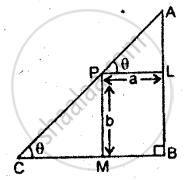
A point on the hypotenuse of a triangle is at distance a and b from the sides of the triangle.
Show that the minimum length of the hypotenuse is `(a^(2/3) + b^(2/3))^(3/2).`
Advertisements
Solution
Let P be a point on the hypotenuse of ∆ABC.
Draw perpendicular PL from P on AB and PM from P on BC.
Let ∠ACB = θ = ∠APL
AP = a sec θ, PC = b cosec θ
Let the length of the hypotenuse be l, then
l = AP + PC
= a sec θ + b cosec θ
On differentiating with respect to θ,
`therefore (dl)/(d theta) = a sec theta tan theta - b cosec theta cot theta`
For maximum and minimum, `(dl)/(d theta) = 0`
⇒ a sec θ tan θ - b cosec θ cot θ = 0
`=> a 1/(cos θ) * (sin θ)/(cos θ) - b 1/(sin θ) * (cos θ)/(sin θ) = 0`
`=> (a sin θ)/(cos^2 θ) - (b cos θ)/(sin^2 θ) = 0`
⇒ a sin3 θ - b cos3 θ = 0
⇒ a sin3 θ = b cos3 θ
`=> (sin^3 θ)/(cos^3 θ) = b/a`
`=> tan^3 θ = b/a`
`=> tan θ = (b/a)^(1//3)`
On differentiating again,
`(d^2l)/(d theta) = a (sec θ * sec^2 θ + tan θ * sec θ tan θ) - b [cosec θ (- cosec^2 θ) + cot θ (- cosec θ cot θ)]`
`= a sec θ (sec^2 θ + tan^2 θ) + b cosec θ xx (cosec^2 θ xx cot^2 θ)`
`because 0 < theta < pi/2` So all trigonometric ratios of θ are positive.
`therefore (d^2 l)/(d theta)^2` = + ve i.e. l is minimum.
a > 0 and b > 0
`therefore (d^2 l)/(d theta)^2` = + ve
When `tan theta = (b/a)^(1/3)` then l is minimum.
∴ Minimum value of l = a sec θ + b cosec θ
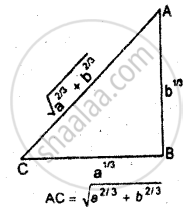
`= a sqrt (a^(2/3) + b^(2/3))/(a^(1/3)) + b sqrt (a^(2/3) + b^(2/3))/ b^(1/3)`
`= sqrt (a^(2/3) + b^(2/3)) (a^(2/3) + b^(2/3))`
`= (a^(2/3) + b^(2/3))^(3/2).`
APPEARS IN
RELATED QUESTIONS
If the sum of lengths of hypotenuse and a side of a right angled triangle is given, show that area of triangle is maximum, when the angle between them is π/3.
Find the local maxima and local minima, if any, of the following function. Find also the local maximum and the local minimum values, as the case may be:
f(x) = sinx − cos x, 0 < x < 2π
Prove that the following function do not have maxima or minima:
h(x) = x3 + x2 + x + 1
Find two positive numbers whose sum is 16 and the sum of whose cubes is minimum.
Show that of all the rectangles inscribed in a given fixed circle, the square has the maximum area.
Show that the semi-vertical angle of the cone of the maximum volume and of given slant height is `tan^(-1) sqrt(2)`
Find the absolute maximum and minimum values of the function f given by f (x) = cos2 x + sin x, x ∈ [0, π].
Show that the altitude of the right circular cone of maximum volume that can be inscribed in a sphere of radius r is `(4r)/3.`
Show that the surface area of a closed cuboid with square base and given volume is minimum, when it is a cube.
A given quantity of metal is to be cast into a half cylinder with a rectangular base and semicircular ends. Show that in order that the total surface area may be minimum the ratio of the length of the cylinder to the diameter of its semi-circular ends is \[\pi : (\pi + 2)\].
Show that the height of a cylinder, which is open at the top, having a given surface area and greatest volume, is equal to the radius of its base.
Find the maximum and minimum of the following functions : f(x) = 2x3 – 21x2 + 36x – 20
Find the maximum and minimum of the following functions : f(x) = `logx/x`
The perimeter of a triangle is 10 cm. If one of the side is 4 cm. What are the other two sides of the triangle for its maximum area?
The profit function P(x) of a firm, selling x items per day is given by P(x) = (150 – x)x – 1625 . Find the number of items the firm should manufacture to get maximum profit. Find the maximum profit.
Choose the correct option from the given alternatives :
If f(x) = `(x^2 - 1)/(x^2 + 1)`, for every real x, then the minimum value of f is ______.
State whether the following statement is True or False:
An absolute maximum must occur at a critical point or at an end point.
The maximum volume of a right circular cylinder if the sum of its radius and height is 6 m is ______.
Max value of z equals 3x + 2y subject to x + y ≤ 3, x ≤ 2, -2x + y ≤ 1, x ≥ 0, y ≥ 0 is ______
If f(x) = `x + 1/x, x ne 0`, then local maximum and x minimum values of function f are respectively.
If the sum of the lengths of the hypotenuse and a side of a right-angled triangle is given, show that the area of the triangle is maximum when the angle between them is `pi/3`
AB is a diameter of a circle and C is any point on the circle. Show that the area of ∆ABC is maximum, when it is isosceles.
If x is real, the minimum value of x2 – 8x + 17 is ______.
The maximum value of sin x . cos x is ______.
Maximum slope of the curve y = –x3 + 3x2 + 9x – 27 is ______.
The curves y = 4x2 + 2x – 8 and y = x3 – x + 13 touch each other at the point ______.
Find all the points of local maxima and local minima of the function f(x) = (x - 1)3 (x + 1)2
Find the points of local maxima and local minima respectively for the function f(x) = sin 2x - x, where `-pi/2 le "x" le pi/2`
If y = x3 + x2 + x + 1, then y ____________.
The distance of that point on y = x4 + 3x2 + 2x which is nearest to the line y = 2x - 1 is ____________.
The combined resistance R of two resistors R1 and R2 (R1, R2 > 0) is given by `1/"R" = 1/"R"_1 + 1/"R"_2`. If R1 + R2 = C (a constant), then maximum resistance R is obtained if ____________.
Read the following passage and answer the questions given below.
|
In an elliptical sport field the authority wants to design a rectangular soccer field with the maximum possible area. The sport field is given by the graph of `x^2/a^2 + y^2/b^2` = 1. |
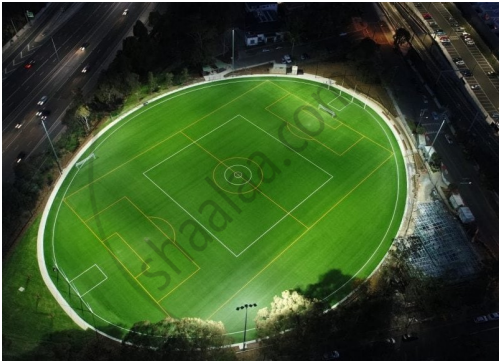
- If the length and the breadth of the rectangular field be 2x and 2y respectively, then find the area function in terms of x.
- Find the critical point of the function.
- Use First derivative Test to find the length 2x and width 2y of the soccer field (in terms of a and b) that maximize its area.
OR
Use Second Derivative Test to find the length 2x and width 2y of the soccer field (in terms of a and b) that maximize its area.
A rod AB of length 16 cm. rests between the wall AD and a smooth peg, 1 cm from the wall and makes an angle θ with the horizontal. The value of θ for which the height of G, the midpoint of the rod above the peg is minimum, is ______.
If x + y = 8, then the maximum value of x2y is ______.
Find the point on the curve y2 = 4x, which is nearest to the point (2, 1).
Determine the minimum value of the function.
f(x) = 2x3 – 21x2 + 36x – 20
If \[f\] has a maximum value at \[c\], what is \[c\] called?
What is an absolute maximum?
