Advertisements
Advertisements
Question
Show that the altitude of the right circular cone of maximum volume that can be inscribed in a sphere of radius r is `(4r)/3.`
Advertisements
Solution
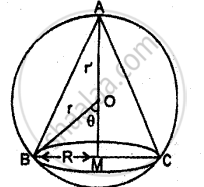
Let the radius of the sphere = r
Radius of cone = R
Height of the cone = AM
= OA + OM
= r + r cos θ
= r(1 + cosθ)
where ∠BOM = θ
BC = diameter of the base of the cone
∴ Radius of cone = r sin θ
Volume of cone V = `1/3 pi (r sin theta)^2 xx r (1 + cos theta)` ....`[because "volume of cone" = 1/3 pir^2 h]`
`= 1/3 pir^3 sin^2 theta (1 + cos theta)`
On differentiating,
`(dV)/(d theta) = 1/3 pir^3 [2 sin theta cos theta (1 + cos theta) + sin^2 theta (- sin theta)]`
`= 1/3 pir^3 [2 sin theta cos theta (1 + cos theta) - sin^3 theta]`
`= 1/3 pir^3 sin theta [2 cos theta (1 + cos theta) - sin^2 theta]`
`= 1/3 pir^3 sin theta [2 cos theta + 2 cos^2 theta - 1+ cos^2 theta]`
`= 1/3 pir^3 sin theta [3 cos^2 theta + 2 cos theta - 1]`
`= 1/3 pir^3 sin theta (cos theta + 1)(3 cos theta - 1)`
For maximum and minimum, `(dV)/(d theta) = 0`
⇒ cos θ ≠ - 1
⇒ θ ≠ π
∴ (3 cos θ - 1) = 0
⇒ `cos theta = 1/3`
In the interval `(0, pi/2)` cos θ is decreasing, cos θ increases as θ decreases and decreases as θ increases.
⇒ at cos θ = `1/3`
The sign of `(dV)/(d theta)` changes from positive to negative as θ passes through this point.
Hence V is highest at this point.
Height of the cone = `r (1 + cos theta) = r(1 + 1/3)`
`= r xx 4/3`
= `(4r)/3`
APPEARS IN
RELATED QUESTIONS
Find the local maxima and local minima, if any, of the following function. Find also the local maximum and the local minimum values, as the case may be:
f(x) = sinx − cos x, 0 < x < 2π
Find the local maxima and local minima, if any, of the following function. Find also the local maximum and the local minimum values, as the case may be:
`g(x) = x/2 + 2/x, x > 0`
Prove that the following function do not have maxima or minima:
h(x) = x3 + x2 + x + 1
What is the maximum value of the function sin x + cos x?
It is given that at x = 1, the function x4− 62x2 + ax + 9 attains its maximum value, on the interval [0, 2]. Find the value of a.
A wire of length 28 m is to be cut into two pieces. One of the pieces is to be made into a square and the other into a circle. What should be the length of the two pieces so that the combined area of the square and the circle is minimum?
Show that the semi-vertical angle of the cone of the maximum volume and of given slant height is `tan^(-1) sqrt(2)`
An open tank with a square base and vertical sides is to be constructed from a metal sheet so as to hold a given quantity of water. Show that the cost of material will be least when the depth of the tank is half of its width. If the cost is to be borne by nearby settled lower-income families, for whom water will be provided, what kind of value is hidden in this question?
Find the maximum and minimum of the following functions : f(x) = x3 – 9x2 + 24x
Find the maximum and minimum of the following functions : f(x) = `logx/x`
Divide the number 20 into two parts such that sum of their squares is minimum.
The perimeter of a triangle is 10 cm. If one of the side is 4 cm. What are the other two sides of the triangle for its maximum area?
Show that among rectangles of given area, the square has least perimeter.
Solve the following : A window is in the form of a rectangle surmounted by a semicircle. If the perimeter be 30 m, find the dimensions so that the greatest possible amount of light may be admitted.
Solve the following:
A rectangular sheet of paper of fixed perimeter with the sides having their lengths in the ratio 8 : 15 converted into an open rectangular box by folding after removing the squares of equal area from all corners. If the total area of the removed squares is 100, the resulting box has maximum volume. Find the lengths of the rectangular sheet of paper.
Divide the number 20 into two parts such that their product is maximum.
By completing the following activity, examine the function f(x) = x3 – 9x2 + 24x for maxima and minima
Solution: f(x) = x3 – 9x2 + 24x
∴ f'(x) = `square`
∴ f''(x) = `square`
For extreme values, f'(x) = 0, we get
x = `square` or `square`
∴ f''`(square)` = – 6 < 0
∴ f(x) is maximum at x = 2.
∴ Maximum value = `square`
∴ f''`(square)` = 6 > 0
∴ f(x) is maximum at x = 4.
∴ Minimum value = `square`
If f(x) = `x + 1/x, x ne 0`, then local maximum and x minimum values of function f are respectively.
If the sum of the lengths of the hypotenuse and a side of a right-angled triangle is given, show that the area of the triangle is maximum when the angle between them is `pi/3`
The maximum value of sin x . cos x is ______.
Find the local minimum value of the function f(x) `= "sin"^4" x + cos"^4 "x", 0 < "x" < pi/2`
Find both the maximum and minimum values respectively of 3x4 - 8x3 + 12x2 - 48x + 1 on the interval [1, 4].
The area of a right-angled triangle of the given hypotenuse is maximum when the triangle is ____________.
Find the area of the largest isosceles triangle having a perimeter of 18 meters.
For all real values of `x`, the minimum value of `(1 - x + x^2)/(1 + x + x^2)`
Let f: R → R be a function defined by f(x) = (x – 3)n1(x – 5)n2, n1, n2 ∈ N. Then, which of the following is NOT true?
If p(x) be a polynomial of degree three that has a local maximum value 8 at x = 1 and a local minimum value 4 at x = 2; then p(0) is equal to ______.
If the function y = `(ax + b)/((x - 4)(x - 1))` has an extremum at P(2, –1), then the values of a and b are ______.
If the point (1, 3) serves as the point of inflection of the curve y = ax3 + bx2 then the value of 'a ' and 'b' are ______.
The sum of all the local minimum values of the twice differentiable function f : R `rightarrow` R defined by
f(x) = `x^3 - 3x^2 - (3f^('')(2))/2 x + f^('')(1)`
A rectangle with one side lying along the x-axis is to be inscribed in the closed region of the xy plane bounded by the lines y = 0, y = 3x and y = 30 – 2x. The largest area of such a rectangle is ______.
A straight line is drawn through the point P(3, 4) meeting the positive direction of coordinate axes at the points A and B. If O is the origin, then minimum area of ΔOAB is equal to ______.
A box with a square base is to have an open top. The surface area of box is 147 sq. cm. What should be its dimensions in order that the volume is largest?
Find the local maxima and local minima, if any, of the following function. Find also the local maximum and the local minimum values, as the case may be:
f(x) `= x sqrt(1 - x), 0 < x < 1`
For a function defined on an interval \[I\], which condition means that \[f\] has a maximum value at \[c\in I\]?
When is a point in the domain of a function called a critical point?
Assume \[f'(c)=0\] and the second derivative exists at \[c\]. Which condition gives a local maximum?
For \[f(x)=3x^4+4x^3-12x^2+12\], what is \[f''(x)\]?
