Advertisements
Advertisements
Question
If the sum of the surface areas of cube and a sphere is constant, what is the ratio of an edge of the cube to the diameter of the sphere, when the sum of their volumes is minimum?
Advertisements
Solution
Let x be the edge of the cube and r be the radius of the sphere.
Surface area of cube = 6x2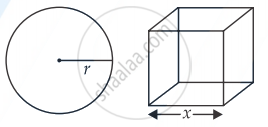
And surface area of the sphere = 4πr2
∴ 6x2 + 4πr2 = K ......(constant)
⇒ r = `sqrt(("K" - 6x^2)/(4pi)` .....(i)
Volume of the cube = x3 and the volume of sphere = `3/4 pi"r"^3`
∴ Sum of their volumes (V) = Volume of cube + Volume of sphere
⇒ V = `x^3 + 4/3 pi"r"^3`
⇒ V = `x^3 + 4/3 pi xx (("K" - 6x^2)/(4pi))^(3/2)`
Differentiating both sides w.r.t. x, we get
`"dV"/"dx" = 3x^2 + (4pi)/3 xx 3/2("K" - 6x^2)^(1/2) (- 12x) xx 1/((4pi)^(3/2)`
= `3x^2 + (2pi)/((4pi)^(3/2)) xx (-12x) ("K" - 6x^2)^(1/2)`
= `3x^2 + 1/(4pi^(1/2)) xx (-12x) ("K" - 6x^2)^(1/2)`
∴ `"dV"/"dx" = 3x^2 - (3x)/sqrt(pi) ("K" - 6x^2)^(1/2)` ....(ii)
For local maxima and local minima, `"dV"/"dx"` = 0
∴ `3x^2 - (3x)/sqrt(pi) ("K" - 6x^2)^(1/2)` = 0
⇒ `3x[x - ("k" - 6x^2)^(1/2)/sqrt(pi)]` = 0
x ≠ 0
∴ `x - ("K" - 6x^2)^(1/2)/sqrt(pi)` = 0
⇒ x = `("K" - 6x^2)^(1/2)/sqrt(pi)`
Squaring both sides, we get
x2 = `("K" - 6x^2)/pi`
⇒ `pix^2 = "K" - 6x^2`
⇒ `pix^2 + 6x^2` = K
⇒ `x^2(pi + 6)` = K
⇒ x2 = `"K"/(pi + 6)`
∴ x = `sqrt("K"/(pi + 6)`
Now putting the value of K in equation (i), we get
`6x^2 + 4pir^2 = x^2(pi + 6)`
⇒ `6x^2 + 4pi"r"^2 = pix^2 + 6x^2`
⇒ `4pi"r"^2 = pi"r"^2`
⇒ 4r2 = x2
∴ 2r = x
∴ x:2r = 1:1
Now differentiating equation (ii) w.r.t x, we have
`("d"^2"V")/("dx"^2) = 6x - 3/sqrt(pi) "d"/"dx" [x("K" - 6x^2)^(1/2)]`
= `6x - 3/sqrt(pi)[x * 1/(2sqrt("K" - 6x^2)) xx (-12x) + ("K" - 6x^2)^(1/2) * 1]`
= `6x - 3/sqrt(pi) [(-6x^2)/sqrt("K" - 6x^2) + sqrt("K" - 6x^2)]`
= `6x - 3/sqrt(pi) [(-6x^2 + "K" - 6x^2)/sqrt("K" - 6x^2)]`
= `6x + 3/sqrt(pi) [(12x^2 - "K")/sqrt("K" - 6x^2)]`
Put x = `sqrt("K"/(pi + 6)`
= `6sqrt("K"/(pi + 6)) + 3/sqrt(pi)[((12"K")/(pi + 6) - "K")/sqrt("K" - (6"K")/(pi + 6))]`
= `6sqrt("K"/(pi + 6)) + 3/sqrt(pi) [(12"K" - pi"K" - 6"K")/sqrt((pi"K" + 6"K" - 6"K")/(pi + 6))]`
= `6sqrt("K"/(pi + 6)) + 3/sqrt(pi) [(6"K" - pi"K")/sqrt((pi"K")/(pi + 6))]`
= `6sqrt("K"/(pi + 6)) + 3/(pisqrt("K"))[(6"K" - pi"K") sqrt(pi + 6)] > 0`
So it is minima.
Hence, the required ratio is 1 : 1 when the combined volume is minimum.
APPEARS IN
RELATED QUESTIONS
If the sum of lengths of hypotenuse and a side of a right angled triangle is given, show that area of triangle is maximum, when the angle between them is π/3.
Find the maximum and minimum value, if any, of the following function given by g(x) = − |x + 1| + 3.
Find the absolute maximum value and the absolute minimum value of the following function in the given interval:
`f(x) =x^3, x in [-2,2]`
At what points in the interval [0, 2π], does the function sin 2x attain its maximum value?
Find the maximum and minimum values of x + sin 2x on [0, 2π].
Show that of all the rectangles inscribed in a given fixed circle, the square has the maximum area.
Show that the altitude of the right circular cone of maximum volume that can be inscribed in a sphere of radius r is `(4r)/3.`
A metal box with a square base and vertical sides is to contain 1024 cm3. The material for the top and bottom costs Rs 5 per cm2 and the material for the sides costs Rs 2.50 per cm2. Find the least cost of the box
An open tank with a square base and vertical sides is to be constructed from a metal sheet so as to hold a given quantity of water. Show that the cost of material will be least when the depth of the tank is half of its width. If the cost is to be borne by nearby settled lower-income families, for whom water will be provided, what kind of value is hidden in this question?
Show that the cone of the greatest volume which can be inscribed in a given sphere has an altitude equal to \[ \frac{2}{3} \] of the diameter of the sphere.
Find the maximum and minimum of the following functions : f(x) = `x^2 + (16)/x^2`
An open cylindrical tank whose base is a circle is to be constructed of metal sheet so as to contain a volume of `pia^3`cu cm of water. Find the dimensions so that the quantity of the metal sheet required is minimum.
Show that the height of a closed right circular cylinder of given volume and least surface area is equal to its diameter.
Solve the following:
A rectangular sheet of paper of fixed perimeter with the sides having their lengths in the ratio 8 : 15 converted into an open rectangular box by folding after removing the squares of equal area from all corners. If the total area of the removed squares is 100, the resulting box has maximum volume. Find the lengths of the rectangular sheet of paper.
Solve the following : Show that the altitude of the right circular cone of maximum volume that can be inscribed in a sphere of radius r is `(4r)/(3)`.
Examine the function for maxima and minima f(x) = x3 - 9x2 + 24x
A wire of length 120 cm is bent in the form of a rectangle. Find its dimensions if the area of the rectangle is maximum
By completing the following activity, examine the function f(x) = x3 – 9x2 + 24x for maxima and minima
Solution: f(x) = x3 – 9x2 + 24x
∴ f'(x) = `square`
∴ f''(x) = `square`
For extreme values, f'(x) = 0, we get
x = `square` or `square`
∴ f''`(square)` = – 6 < 0
∴ f(x) is maximum at x = 2.
∴ Maximum value = `square`
∴ f''`(square)` = 6 > 0
∴ f(x) is maximum at x = 4.
∴ Minimum value = `square`
Max value of z equals 3x + 2y subject to x + y ≤ 3, x ≤ 2, -2x + y ≤ 1, x ≥ 0, y ≥ 0 is ______
The maximum value of function x3 - 15x2 + 72x + 19 in the interval [1, 10] is ______.
A metal box with a square base and vertical sides is to contain 1024 cm3. The material for the top and bottom costs Rs 5/cm2 and the material for the sides costs Rs 2.50/cm2. Find the least cost of the box.
The sum of the surface areas of a rectangular parallelopiped with sides x, 2x and `x/3` and a sphere is given to be constant. Prove that the sum of their volumes is minimum, if x is equal to three times the radius of the sphere. Also find the minimum value of the sum of their volumes.
Maximum slope of the curve y = –x3 + 3x2 + 9x – 27 is ______.
If y `= "ax - b"/(("x" - 1)("x" - 4))` has a turning point P(2, -1), then find the value of a and b respectively.
The function f(x) = x5 - 5x4 + 5x3 - 1 has ____________.
A ball is thrown upward at a speed of 28 meter per second. What is the speed of ball one second before reaching maximum height? (Given that g= 10 meter per second2)
The minimum value of α for which the equation `4/sinx + 1/(1 - sinx)` = α has at least one solution in `(0, π/2)` is ______.
If S1 and S2 are respectively the sets of local minimum and local maximum points of the function. f(x) = 9x4 + 12x3 – 36x2 + 25, x ∈ R, then ______.
The set of values of p for which the points of extremum of the function f(x) = x3 – 3px2 + 3(p2 – 1)x + 1 lie in the interval (–2, 4), is ______.
Let f(x) = |(x – 1)(x2 – 2x – 3)| + x – 3, x ∈ R. If m and M are respectively the number of points of local minimum and local maximum of f in the interval (0, 4), then m + M is equal to ______.
The minimum value of 2sinx + 2cosx is ______.
A rectangle with one side lying along the x-axis is to be inscribed in the closed region of the xy plane bounded by the lines y = 0, y = 3x and y = 30 – 2x. The largest area of such a rectangle is ______.
The minimum value of the function f(x) = xlogx is ______.
Read the following passage:
Engine displacement is the measure of the cylinder volume swept by all the pistons of a piston engine. The piston moves inside the cylinder bore.
|


Based on the above information, answer the following questions:
- If the radius of cylinder is r cm and height is h cm, then write the volume V of cylinder in terms of radius r. (1)
- Find `(dV)/(dr)`. (1)
- (a) Find the radius of cylinder when its volume is maximum. (2)
OR
(b) For maximum volume, h > r. State true or false and justify. (2)
The rectangle has area of 50 cm2. Complete the following activity to find its dimensions for least perimeter.
Solution: Let x cm and y cm be the length and breadth of a rectangle.
Then its area is xy = 50
∴ `y =50/x`
Perimeter of rectangle `=2(x+y)=2(x+50/x)`
Let f(x) `=2(x+50/x)`
Then f'(x) = `square` and f''(x) = `square`
Now,f'(x) = 0, if x = `square`
But x is not negative.
∴ `x = root(5)(2) "and" f^('')(root(5)(2))=square>0`
∴ by the second derivative test f is minimum at x = `root(5)(2)`
When x = `root(5)(2),y=50/root(5)(2)=root(5)(2)`
∴ `x=root(5)(2) "cm" , y = root(5)(2) "cm"`
Hence, rectangle is a square of side `root(5)(2) "cm"`
Sumit has bought a closed cylindrical dustbin. The radius of the dustbin is ‘r' cm and height is 'h’ cm. It has a volume of 20π cm3.
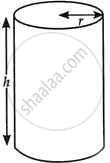
- Express ‘h’ in terms of ‘r’, using the given volume.
- Prove that the total surface area of the dustbin is `2πr^2 + (40π)/r`
- Sumit wants to paint the dustbin. The cost of painting the base and top of the dustbin is ₹ 2 per cm2 and the cost of painting the curved side is ₹ 25 per cm2. Find the total cost in terms of ‘r’, for painting the outer surface of the dustbin including the base and top.
- Calculate the minimum cost for painting the dustbin.
For a function defined on an interval \[I\], which condition means that \[f\] has a minimum value at \[c\in I\]?
