Advertisements
Advertisements
Questions
Show that the altitude of the right circular cone of maximum volume that can be inscribed in a sphere of radius r is `(4r)/3`. Also find maximum volume in terms of volume of the sphere
Show that the altitude of a right circular cone of maximum volume that can be inscribed in a sphere of radius r is `(4r)/3` . Also, show that the maximum volume of the cone is `8/27` of the volume of the sphere.
Advertisements
Solution 1
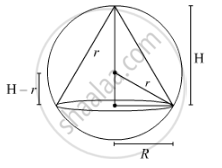
`V=1/3piR^2H`
It is clear from the figure that
`R^2+(H−r)^2=r^2`
`⇒R^2+H^2+r^2−2Hr=r^2`
`⇒R^2=2Hr−H^2`
Substituting the value of R2 in the formula for the volume of the cone, we get
`V=1/3pi(2Hr-H^2)H`
` V=2/3πrH^2−π/3H^3`
Differentiating with respect to H both sides, we get:
`(dV)/(dH)=4/3πrH−πH^2`
At critical point,`(dV)/(dH)` is 0.
`⇒4/3πrH−πH^2=0`
`⇒H=4/3r`
Differentiating V w.r.t H again, we get:
`(d^2V)/(dH^2)=4/3πr−2πH`
`|(d^2V)/(dH^2)|_(H=4/3r)=−4/3πr <0`
Hence maxima.
Volume of cone =`1/3πR^2H`
` V=2/3πrH^2−π/3H^3`
Substituting the value of H, we get:
`V=2/3πr(4/3r)^2−π/3(4/3r)^3`
`=>V=8/27(4πr^3−8/3πr^3)`
`=>V=8/27(4/3πr^3)`
`=>V=8/27(volume of sphere)`
Solution 2
A sphere of fixed radius (r) is given.
Let R and h be the radius and the height of the cone, respectively.
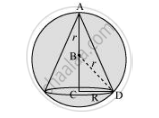
The volume (V) of the cone is given by,
`V=1/3piR^2h`
Now, from the right triangle BCD, we have:
`BC=sqrt(r^2-R^2)`
`:.h=r+sqrt(r^2-R^2)`
`V=1/3piR^2(r+sqrt(r^2-R^2))=1/3piR^2r+1/3piR^2sqrt(r^2-R^2)`
`(dV)/(dR)=2/3piRr+2/3piRsqrt(r^2-R^2)+(piR^2)/3 (-2R)/(2sqrt(r^2-R^2))`
`=2/3piRr+2/3piRsqrt(r^2-R^2)-(piR^3)/(3sqrt(r^2-R^2))`
`=2/3piRr+(2piR(r^2-R^2)-piR^3)/(3sqrt(r^2-R^2))`
`2/3piRr+(2piRr^2-3piR^3)/(3sqrt(r^2-R^2))`
Now
`(dV)/(dR^2)=0`
`=>(2pirR)/3=(3piR^3-2piRr^2)/(3sqrt(r^2-R^2))`
`=>2rsqrt(r^2-R^2)=3R^2-2r^2`
`=>4r^2(r^2-R^2)=(3R^2-2r^2)^2`
`=>4r^4-4r^2R^2=9R^4+4r^4-12R^2r^2`
`=>9R^4-8r^2R^2=0`
`=>9R^2=8r^2`
`=>R^2=(8r^2)/9`
Now,
`(d^2V)/(dR^2)=(2pir)/3+(3sqrt(r^2-R^2)(2pir^2-9piR^2)-(2piRr^2-3piR^3)(-6R)1/(2sqrtr^2-R^2))/(9(r^2-R^2))`
`=(2pir)/3+(3sqrt(r^2-R^2) (2pir^2-9piR^2)+(2piRr^2-3piR^3)(3R)1/(2sqrt(r^2-R^2)))/(9(r^2-R^2))`
Now when `R^2=(8r^2)/9`it can be shown that `(d^2V)/(dR^2)<0`
∴ The volume is the maximum when `R^2=(8r^2)/9`
When `R^2=(8r^2)/9`height of cone= `r+sqrt(r^2-(8r^2)/9)=r+sqrt(r^2/9)=r+r/3=(4r)/3`
Hence, it can be seen that the altitude of a right circular cone of maximum volume that can be inscribed in a sphere of radius r is `(4r)/3`
Let volume of the sphere be `V_s=4/3pir^3`
`r=3sqrt((3V_s)/(4pi))`
∴ Volume of cone, V = `1/3piR^2h`
⇒R = `(2sqrt2)/3r`
V = `1/3pi((2sqrt2)/3r)xx(4r)/3`
⇒V = `1/3pi(8r^2)/9xx(4r)/3`
`V=(32pir^3)/81=32/81pi[(3V_s)/(4pi)]`
∴ Volume of cone in terms of sphere
APPEARS IN
RELATED QUESTIONS
If the sum of lengths of hypotenuse and a side of a right angled triangle is given, show that area of triangle is maximum, when the angle between them is π/3.
Find the maximum and minimum value, if any, of the function given by f(x) = |x + 2| − 1.
Prove that the following function do not have maxima or minima:
f(x) = ex
A wire of length 28 m is to be cut into two pieces. One of the pieces is to be made into a square and the other into a circle. What should be the length of the two pieces so that the combined area of the square and the circle is minimum?
Show that the semi-vertical angle of the cone of the maximum volume and of given slant height is `tan^(-1) sqrt(2)`
The maximum value of `[x(x −1) +1]^(1/3)` , 0 ≤ x ≤ 1 is ______.
A rod of 108 meters long is bent to form a rectangle. Find its dimensions if the area is maximum. Let x be the length and y be the breadth of the rectangle.
The volume of a closed rectangular metal box with a square base is 4096 cm3. The cost of polishing the outer surface of the box is Rs. 4 per cm2. Find the dimensions of the box for the minimum cost of polishing it.
Divide the number 20 into two parts such that sum of their squares is minimum.
Choose the correct option from the given alternatives :
If f(x) = `(x^2 - 1)/(x^2 + 1)`, for every real x, then the minimum value of f is ______.
Solve the following:
A wire of length l is cut into two parts. One part is bent into a circle and the other into a square. Show that the sum of the areas of the circle and the square is the least, if the radius of the circle is half of the side of the square.
Solve the following : Show that the height of the cylinder of maximum volume that can be inscribed in a sphere of radius R is `(2"R")/sqrt(3)`. Also, find the maximum volume.
A rectangular sheet of paper has it area 24 sq. Meters. The margin at the top and the bottom are 75 cm each and the sides 50 cm each. What are the dimensions of the paper if the area of the printed space is maximum?
Max value of z equals 3x + 2y subject to x + y ≤ 3, x ≤ 2, -2x + y ≤ 1, x ≥ 0, y ≥ 0 is ______
Show that the function f(x) = 4x3 – 18x2 + 27x – 7 has neither maxima nor minima.
The maximum value of sin x . cos x is ______.
The curves y = 4x2 + 2x – 8 and y = x3 – x + 13 touch each other at the point ______.
Find the points of local maxima and local minima respectively for the function f(x) = sin 2x - x, where `-pi/2 le "x" le pi/2`
Divide 20 into two ports, so that their product is maximum.
A wire of length 36 m is cut into two pieces, one of the pieces is bent to form a square and the other is bent to form a circle. If the sum of the areas of the two figures is minimum, and the circumference of the circle is k (meter), then `(4/π + 1)`k is equal to ______.
The set of values of p for which the points of extremum of the function f(x) = x3 – 3px2 + 3(p2 – 1)x + 1 lie in the interval (–2, 4), is ______.
A cone of maximum volume is inscribed in a given sphere. Then the ratio of the height of the cone to the diameter of the sphere is ______.
Let f(x) = |(x – 1)(x2 – 2x – 3)| + x – 3, x ∈ R. If m and M are respectively the number of points of local minimum and local maximum of f in the interval (0, 4), then m + M is equal to ______.
The maximum value of z = 6x + 8y subject to constraints 2x + y ≤ 30, x + 2y ≤ 24 and x ≥ 0, y ≥ 0 is ______.
The minimum value of the function f(x) = xlogx is ______.
Sum of two numbers is 5. If the sum of the cubes of these numbers is least, then find the sum of the squares of these numbers.
Divide the number 100 into two parts so that the sum of their squares is minimum.
Find the point on the curve y2 = 4x, which is nearest to the point (2, 1).
Let \[c\] be a critical point of a continuous function \[f\]. If \[f'(x)\] changes sign from positive to negative as \[x\] passes through \[c\], what is \[c\]?
For \[f(x)=3x^4+4x^3-12x^2+12\], what is \[f'(x)\]?
