Advertisements
Advertisements
Question
Divide the number 20 into two parts such that sum of their squares is minimum.
Advertisements
Solution
Let the first part of 20 be x.
Then the second part is 20 – x.
∴ Sum of their squares = x2 + (20 – x)2 = f(x) ...(Say)
∴ f'(x) = `d/dx[x^2 + (20 - x)^2]`
= `2x + 2(20 - x) * d/dx(20 - x)`
= 2x + 2(20 – x) × (0 – 1)
= 2x – 40 + 2x
= 4x – 40
and f"(x) = `d/dx(4x - 40)`
= 4 × 1 – 0
= 4
The root of the equation f'(x) = 0, i.e., 4x – 40 = 0 is x = 10 and f"(10) = 4 > 0.
∴ By the second derivative test, f is minimum at x = 10.
Hence, the required parts of 20 are 10 and 10.
RELATED QUESTIONS
Examine the maxima and minima of the function f(x) = 2x3 - 21x2 + 36x - 20 . Also, find the maximum and minimum values of f(x).
Find the approximate value of cos (89°, 30'). [Given is: 1° = 0.0175°C]
Show that the height of the cylinder of maximum volume, that can be inscribed in a sphere of radius R is `(2R)/sqrt3.` Also, find the maximum volume.
If the sum of lengths of hypotenuse and a side of a right angled triangle is given, show that area of triangle is maximum, when the angle between them is π/3.
Find the maximum and minimum value, if any, of the following function given by g(x) = x3 + 1.
Prove that the following function do not have maxima or minima:
f(x) = ex
Prove that the following function do not have maxima or minima:
g(x) = logx
At what points in the interval [0, 2π], does the function sin 2x attain its maximum value?
A square piece of tin of side 18 cm is to made into a box without a top by cutting a square from each corner and folding up the flaps to form the box. What should be the side of the square to be cut off so that the volume of the box is the maximum possible?
Show that the right circular cylinder of given surface and maximum volume is such that is heights is equal to the diameter of the base.
The maximum value of `[x(x −1) +1]^(1/3)` , 0 ≤ x ≤ 1 is ______.
Find the maximum area of an isosceles triangle inscribed in the ellipse `x^2/ a^2 + y^2/b^2 = 1` with its vertex at one end of the major axis.
Find the point on the straight line 2x+3y = 6, which is closest to the origin.
Find the maximum and minimum of the following functions : y = 5x3 + 2x2 – 3x.
Show that among rectangles of given area, the square has least perimeter.
Determine the maximum and minimum value of the following function.
f(x) = 2x3 – 21x2 + 36x – 20
Divide the number 20 into two parts such that their product is maximum.
Find all the points of local maxima and local minima of the function f(x) = `- 3/4 x^4 - 8x^3 - 45/2 x^2 + 105`
Let f have second derivative at c such that f′(c) = 0 and f"(c) > 0, then c is a point of ______.
Find the dimensions of the rectangle of perimeter 36 cm which will sweep out a volume as large as possible, when revolved about one of its sides. Also, find the maximum volume.
AB is a diameter of a circle and C is any point on the circle. Show that the area of ∆ABC is maximum, when it is isosceles.
The maximum value of sin x . cos x is ______.
Maximum slope of the curve y = –x3 + 3x2 + 9x – 27 is ______.
The curves y = 4x2 + 2x – 8 and y = x3 – x + 13 touch each other at the point ______.
Find all the points of local maxima and local minima of the function f(x) = (x - 1)3 (x + 1)2
If y = x3 + x2 + x + 1, then y ____________.
A ball is thrown upward at a speed of 28 meter per second. What is the speed of ball one second before reaching maximum height? (Given that g= 10 meter per second2)
Range of projectile will be maximum when angle of projectile is
The maximum value of `[x(x - 1) + 1]^(2/3), 0 ≤ x ≤ 1` is
The maximum value of the function f(x) = `logx/x` is ______.
Read the following passage and answer the questions given below.
|
In an elliptical sport field the authority wants to design a rectangular soccer field with the maximum possible area. The sport field is given by the graph of `x^2/a^2 + y^2/b^2` = 1. |
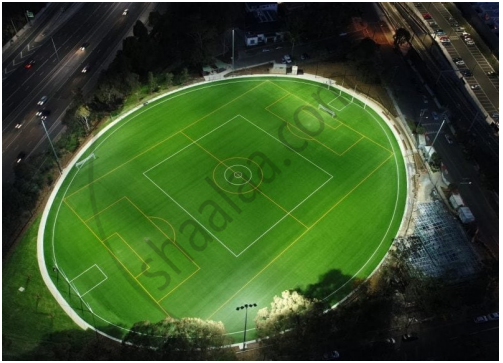
- If the length and the breadth of the rectangular field be 2x and 2y respectively, then find the area function in terms of x.
- Find the critical point of the function.
- Use First derivative Test to find the length 2x and width 2y of the soccer field (in terms of a and b) that maximize its area.
OR
Use Second Derivative Test to find the length 2x and width 2y of the soccer field (in terms of a and b) that maximize its area.
A function f(x) is maximum at x = a when f'(a) > 0.
The set of values of p for which the points of extremum of the function f(x) = x3 – 3px2 + 3(p2 – 1)x + 1 lie in the interval (–2, 4), is ______.
Let f(x) = |(x – 1)(x2 – 2x – 3)| + x – 3, x ∈ R. If m and M are respectively the number of points of local minimum and local maximum of f in the interval (0, 4), then m + M is equal to ______.
A rectangle with one side lying along the x-axis is to be inscribed in the closed region of the xy plane bounded by the lines y = 0, y = 3x and y = 30 – 2x. The largest area of such a rectangle is ______.
If f(x) = `1/(4x^2 + 2x + 1); x ∈ R`, then find the maximum value of f(x).
Complete the following activity to divide 84 into two parts such that the product of one part and square of the other is maximum.
Solution: Let one part be x. Then the other part is 84 - x
Letf (x) = x2 (84 - x) = 84x2 - x3
∴ f'(x) = `square`
and f''(x) = `square`
For extreme values, f'(x) = 0
∴ x = `square "or" square`
f(x) attains maximum at x = `square`
Hence, the two parts of 84 are 56 and 28.
If Mr. Rane order x chairs at the price p = (2x2 - 12x - 192) per chair. How many chairs should he order so that the cost of deal is minimum?
Solution: Let Mr. Rane order x chairs.
Then the total price of x chairs = p·x = (2x2 - 12x- 192)x
= 2x3 - 12x2 - 192x
Let f(x) = 2x3 - 12x2 - 192x
∴ f'(x) = `square` and f''(x) = `square`
f'(x ) = 0 gives x = `square` and f''(8) = `square` > 0
∴ f is minimum when x = 8
Hence, Mr. Rane should order 8 chairs for minimum cost of deal.
Find the local maxima and local minima, if any, of the following function. Find also the local maximum and the local minimum values, as the case may be:
f(x) `= x sqrt(1 - x), 0 < x < 1`
If \[f\] has a maximum value at \[c\], what is \[c\] called?
Let \[c\] be a critical point of a continuous function \[f\]. If \[f'(x)\] changes sign from positive to negative as \[x\] passes through \[c\], what is \[c\]?
Let \[c\] be a critical point of a continuous function \[f\]. If \[f'(x)\] changes sign from negative to positive as \[x\] passes through \[c\], what is \[c\]?
Assume \[f'(c)=0\] and the second derivative exists at \[c\]. Which condition gives a local minimum?
Why must the left endpoint \[a\] and right endpoint \[b\] be checked for absolute extrema on \[[a,b]\]?
What are the critical points obtained from \[12x(x-1)(x+2)=0\]?
For \[f(x)=3x^4+4x^3-12x^2+12\], what conclusion follows at \[x=-2\]?
