Advertisements
Advertisements
Question
Prove that the semi-vertical angle of the right circular cone of given volume and least curved surface is \[\cot^{- 1} \left( \sqrt{2} \right)\] .
Advertisements
Solution 1

Let:
Radius of the base = r,
Height = h,
Slant height = l,
Volume = V,
Curved surface area = C
\[\text { As, Volume }, V = \frac{1}{3}\pi r^2 h\]
\[ \Rightarrow h = \frac{3V}{\pi r^2}\]
\[\text { Also, the slant height, l } = \sqrt{h^2 + r^2}\]
\[ = \sqrt{\left( \frac{3V}{\pi r^2} \right)^2 + r^2}\]
\[ = \sqrt{\frac{9 V^2}{\pi^2 r^4} + r^2}\]
\[ = \sqrt{\frac{9 V^2 + \pi^2 r^6}{\pi^2 r^4}}\]
\[ \Rightarrow l = \frac{\sqrt{9 V^2 + \pi^2 r^6}}{\pi r^2}\]
\[\text { Now, }\]
\[\text { CSA, C } = \pi rl\]
\[ \Rightarrow C\left( r \right) = \pi r\frac{\sqrt{9 V^2 + \pi^2 r^6}}{\pi r^2}\]
\[ \Rightarrow C\left( r \right) = \frac{\sqrt{9 V^2 + \pi^2 r^6}}{r}\]
\[ \Rightarrow C'\left( r \right) = \frac{r \times \frac{6 \pi^2 r^5}{2\sqrt{9 V^2 + \pi^2 r^6}} - \sqrt{9 V^2 + \pi^2 r^6}}{r^2}\]
\[ = \frac{\left[ \frac{3 \pi^2 r^6 - \left( 9 V^2 + \pi^2 r^6 \right)}{\sqrt{9 V^2 + \pi^2 r^6}} \right]}{r^2}\]
\[ = \frac{3 \pi^2 r^6 - 9 V^2 - \pi^2 r^6}{r^2 \sqrt{9 V^2 + \pi^2 r^6}}\]
\[ = \frac{2 \pi^2 r^6 - 9 V^2}{r^2 \sqrt{9 V^2 + \pi^2 r^6}}\]
\[\text { For maxima or minima, C }'\left( r \right) = 0\]
\[ \Rightarrow \frac{2 \pi^2 r^6 - 9 V^2}{r^2 \sqrt{9 V^2 + \pi^2 r^6}} = 0\]
\[ \Rightarrow 2 \pi^2 r^6 - 9 V^2 = 0\]
\[ \Rightarrow 2 \pi^2 r^6 = 9 V^2 \]
\[ \Rightarrow V^2 = \frac{2 \pi^2 r^6}{9}\]
\[ \Rightarrow V = \sqrt{\frac{2 \pi^2 r^6}{9}}\]
\[ \Rightarrow V = \frac{\pi r^3 \sqrt{2}}{3} or \ r = \left( \frac{3V}{\pi\sqrt{2}} \right)^\frac{1}{3} \]
\[\text { So,} h = \frac{3}{\pi r^2} \times \frac{\pi r^3 \sqrt{2}}{3}\]
\[ \Rightarrow h = r\sqrt{2}\]
\[ \Rightarrow \frac{h}{r} = \sqrt{2}\]
\[ \Rightarrow \cot\theta = \sqrt{2}\]
\[ \therefore \theta = \cot^{- 1} \left( \sqrt{2} \right)\]
\[\text { Also }, \]
\[\text { Since, for } r < \left( \frac{3V}{\pi\sqrt{2}} \right)^\frac{1}{3} , C'\left( r \right) < 0 \text { and for } r > \left( \frac{3V}{\pi\sqrt{2}} \right)^\frac{1}{3} , C'\left( r \right) > 0\]
\[\text { So, the curved surface for r }= \left( \frac{3V}{\pi\sqrt{2}} \right)^\frac{1}{3} or V = \frac{\pi r^3 \sqrt{2}}{3}\text { is the least } .\]
Solution 2
Volume V = `1/3πr^2h` ...(1)
Also l2 = h2 + r2 ...(2)
∵ Volume V is given, so V is constant.
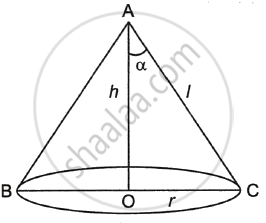
Curved area of cone
c = πrl = `πrsqrt(h^2 + r^2)` ...[By (2)]
c2 = π2r2(h2 + r2)
c2 = `π^2r^2 {(9V^2)/(π^2r^2) + r^2}` ...`{By (1), h = (3V)/(πr^2)}`
c2 = `(9V^2)/r^2 + π^2r^4`
Differentiate w.r. to ‘r’
`d/(dr) (c^2) = (-18V^2)/r^3 + 4π^2r^3` ...(3)
and `(d^2(c^2))/(dr^2) = (54V^2)/r^2 + 12π^2r^2` ...(4)
For least curved area `(d(c^2))/(dr)` = 0
`\implies (-18V^2)/r^3 + 4π^2r^3` = 0
`\implies` 9V2 = 2π2r6
`\implies` `9 xx 1/9 π^2r^4h^2` = 2π2r6
`\implies` h2 = 2r2
h = `sqrt(2)r`
Also by (4) `(d^2(c^2))/(dr^2) > 0`
∴ c2 is minimum
`\implies` c is also minimum.
Hence c is least when h = `sqrt(2)r`
`\implies h/r = sqrt(2)`
`\implies` cot α = `sqrt(2)`
α = `cot^-1 (sqrt(2))`
RELATED QUESTIONS
If `f'(x)=k(cosx-sinx), f'(0)=3 " and " f(pi/2)=15`, find f(x).
Find the approximate value of cos (89°, 30'). [Given is: 1° = 0.0175°C]
Find the maximum and minimum value, if any, of the following function given by f(x) = (2x − 1)2 + 3.
Find the maximum and minimum value, if any, of the following function given by g(x) = − |x + 1| + 3.
Find the local maxima and local minima, if any, of the following function. Find also the local maximum and the local minimum values, as the case may be:
`g(x) = x/2 + 2/x, x > 0`
Prove that the following function do not have maxima or minima:
f(x) = ex
Find the absolute maximum value and the absolute minimum value of the following function in the given interval:
f (x) = sin x + cos x , x ∈ [0, π]
Find the absolute maximum value and the absolute minimum value of the following function in the given interval:
`f(x) = 4x - 1/x x^2, x in [-2 ,9/2]`
Find the maximum value of 2x3 − 24x + 107 in the interval [1, 3]. Find the maximum value of the same function in [−3, −1].
Show that the semi-vertical angle of the cone of the maximum volume and of given slant height is `tan^(-1) sqrt(2)`
Show that semi-vertical angle of right circular cone of given surface area and maximum volume is `Sin^(-1) (1/3).`
A rectangle is inscribed in a semicircle of radius r with one of its sides on the diameter of the semicircle. Find the dimensions of the rectangle to get the maximum area. Also, find the maximum area.
A box with a square base is to have an open top. The surface area of the box is 192 sq cm. What should be its dimensions in order that the volume is largest?
Find the volume of the largest cylinder that can be inscribed in a sphere of radius ‘r’ cm.
Solve the following : An open box with a square base is to be made out of given quantity of sheet of area a2. Show that the maximum volume of the box is `a^3/(6sqrt(3)`.
Solve the following : Show that of all rectangles inscribed in a given circle, the square has the maximum area.
Divide the number 20 into two parts such that their product is maximum.
The total cost of producing x units is ₹ (x2 + 60x + 50) and the price is ₹ (180 − x) per unit. For what units is the profit maximum?
A rectangular sheet of paper has it area 24 sq. Meters. The margin at the top and the bottom are 75 cm each and the sides 50 cm each. What are the dimensions of the paper if the area of the printed space is maximum?
The maximum volume of a right circular cylinder if the sum of its radius and height is 6 m is ______.
If z = ax + by; a, b > 0 subject to x ≤ 2, y ≤ 2, x + y ≥ 3, x ≥ 0, y ≥ 0 has minimum value at (2, 1) only, then ______.
Twenty meters of wire is available for fencing off a flowerbed in the form of a circular sector. Then the maximum area (in sq. m) of the flower-bed, is ______
The maximum and minimum values for the function f(x) = 4x3 - 6x2 on [-1, 2] are ______
A telephone company in a town has 500 subscribers on its list and collects fixed charges of Rs 300/- per subscriber per year. The company proposes to increase the annual subscription and it is believed that for every increase of Re 1/- one subscriber will discontinue the service. Find what increase will bring maximum profit?
The maximum value of `["x"("x" − 1) + 1]^(1/3)`, 0 ≤ x ≤ 1 is:
Find the height of the cylinder of maximum volume that can be inscribed in a sphere of radius a.
The combined resistance R of two resistors R1 and R2 (R1, R2 > 0) is given by `1/"R" = 1/"R"_1 + 1/"R"_2`. If R1 + R2 = C (a constant), then maximum resistance R is obtained if ____________.
The maximum value of `[x(x - 1) + 1]^(2/3), 0 ≤ x ≤ 1` is
The greatest value of the function f(x) = `tan^-1x - 1/2logx` in `[1/sqrt(3), sqrt(3)]` is ______.
The sum of all the local minimum values of the twice differentiable function f : R `rightarrow` R defined by
f(x) = `x^3 - 3x^2 - (3f^('')(2))/2 x + f^('')(1)`
The minimum value of the function f(x) = xlogx is ______.
The maximum value of f(x) = `logx/x (x ≠ 0, x ≠ 1)` is ______.
If f(x) = `1/(4x^2 + 2x + 1); x ∈ R`, then find the maximum value of f(x).
Find the maximum and the minimum values of the function f(x) = x2ex.
A running track of 440 m is to be laid out enclosing a football field. The football field is in the shape of a rectangle with a semi-circle at each end. If the area of the rectangular portion is to be maximum,then find the length of its sides. Also calculate the area of the football field.
The shortest distance between the line y - x = 1and the curve x = y2 is
If \[\mathrm{A}+\mathrm{B}=\frac{\pi}{2}\] then the maximum value of cosA.cosB is
Let \[c\] be a critical point of a continuous function \[f\]. If \[f'(x)\] changes sign from negative to positive as \[x\] passes through \[c\], what is \[c\]?
For \[f(x)=3x^4+4x^3-12x^2+12\], what conclusion follows at \[x=-2\]?
