Advertisements
Advertisements
Question
An isosceles triangle of vertical angle 2 \[\theta\] is inscribed in a circle of radius a. Show that the area of the triangle is maximum when \[\theta\] = \[\frac{\pi}{6}\] .
Advertisements
Solution
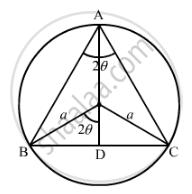
Let ABC be an isosceles triangle inscribed in the circle with radius a such that AB = AC.
\[AD = AO + OD = a + a\cos2\theta = a\left( 1 + \cos2\theta \right)and\]
\[BC = 2BD = 2a\sin2\theta\]
\[\text { As, area of the triangle } AC, A = \frac{1}{2}BC \times AD\]
\[ \Rightarrow A\left( \theta \right) = \frac{1}{2} \times 2a\sin2\theta \times a\left( 1 + \cos2\theta \right)\]
\[ = a^2 \sin2\theta\left( 1 + \cos2\theta \right)\]
\[ = a^2 \sin2\theta + a^2 \sin2\theta\cos2\theta\]
\[ \Rightarrow A\left( \theta \right) = a^2 \sin2\theta + \frac{a^2 \sin4\theta}{2}\]
\[ \Rightarrow A'\left( \theta \right) = 2 a^2 \cos2\theta + \frac{4 a^2 \cos4\theta}{2}\]
\[ \Rightarrow A'\left( \theta \right) = 2 a^2 \cos2\theta + 2 a^2 \cos4\theta\]
\[ \Rightarrow A'\left( \theta \right) = 2 a^2 \left( \cos2\theta + \cos4\theta \right)\]
\[\text { For maxima or minima }, A'\left( \theta \right) = 0\]
\[ \Rightarrow 2 a^2 \left( \cos2\theta + \cos4\theta \right) = 0\]
\[ \Rightarrow \cos2\theta + \cos4\theta = 0\]
\[ \Rightarrow \cos2\theta = - \cos4\theta\]
\[ \Rightarrow \cos2\theta = \cos\left( \pi - 4\theta \right)\]
\[ \Rightarrow 2\theta = \pi - 4\theta\]
\[ \Rightarrow 6\theta = \pi\]
\[ \Rightarrow \theta = \frac{\pi}{6}\]
\[\text { Also,} A''\left( \theta \right) = 2 a^2 \left( - \sin2\theta - \sin4\theta \right) = - 2 a^2 \left( \sin2\theta + \sin4\theta \right) < 0 \text { at }\theta = \frac{\pi}{6} . \]
\[\text { So, the area of the triangle is maximum at } \theta = \frac{\pi}{6} .\]
RELATED QUESTIONS
f(x) = 4x2 + 4 on R .
f(x) = | sin 4x+3 | on R ?
f(x) = x3 (x \[-\] 1)2 .
f(x) = (x \[-\] 1) (x+2)2.
f(x) = sin x \[-\] cos x, 0 < x < 2\[\pi\] .
Find the point of local maximum or local minimum, if any, of the following function, using the first derivative test. Also, find the local maximum or local minimum value, as the case may be:
f(x) = x3(2x \[-\] 1)3.
`f(x) = x/2+2/x, x>0 `.
f(x) = \[x + \sqrt{1 - x}, x \leq 1\] .
Show that \[\frac{\log x}{x}\] has a maximum value at x = e ?
Find the maximum and minimum values of y = tan \[x - 2x\] .
If f(x) = x3 + ax2 + bx + c has a maximum at x = \[-\] 1 and minimum at x = 3. Determine a, b and c ?
f(x) = 4x \[-\] \[\frac{x^2}{2}\] in [ \[-\] 2,4,5] .
f(x) = (x \[-\] 1)2 + 3 in [ \[-\] 3,1] ?
f(x) = (x \[-\] 2) \[\sqrt{x - 1} \text { in }[1, 9]\] .
Determine two positive numbers whose sum is 15 and the sum of whose squares is maximum.
Divide 15 into two parts such that the square of one multiplied with the cube of the other is minimum.
Find the largest possible area of a right angled triangle whose hypotenuse is 5 cm long.
A rectangular sheet of tin 45 cm by 24 cm is to be made into a box without top, in cutting off squares from each corners and folding up the flaps. What should be the side of the square to be cut off so that the volume of the box is maximum possible?
A large window has the shape of a rectangle surmounted by an equilateral triangle. If the perimeter of the window is 12 metres find the dimensions of the rectangle will produce the largest area of the window.
Prove that a conical tent of given capacity will require the least amount of canavas when the height is \[\sqrt{2}\] times the radius of the base.
Find the dimensions of the rectangle of perimeter 36 cm which will sweep out a volume as large as possible when revolved about one of its sides ?
Show that among all positive numbers x and y with x2 + y2 =r2, the sum x+y is largest when x=y=r \[\sqrt{2}\] .
Find the point on the curve x2 = 8y which is nearest to the point (2, 4) ?
Find the point on the curvey y2 = 2x which is at a minimum distance from the point (1, 4).
Find the maximum slope of the curve y = \[- x^3 + 3 x^2 + 2x - 27 .\]
A straight line is drawn through a given point P(1,4). Determine the least value of the sum of the intercepts on the coordinate axes ?
Write the point where f(x) = x log, x attains minimum value.
Write the maximum value of f(x) = x1/x.
Let f(x) = (x \[-\] a)2 + (x \[-\] b)2 + (x \[-\] c)2. Then, f(x) has a minimum at x = _____________ .
The sum of two non-zero numbers is 8, the minimum value of the sum of the reciprocals is ______________ .
The function f(x) = \[\sum^5_{r = 1}\] (x \[-\] r)2 assumes minimum value at x = ______________ .
If x lies in the interval [0,1], then the least value of x2 + x + 1 is _______________ .
The maximum value of f(x) = \[\frac{x}{4 - x + x^2}\] on [ \[-\] 1, 1] is _______________ .
The point on the curve y2 = 4x which is nearest to, the point (2,1) is _______________ .
If x+y=8, then the maximum value of xy is ____________ .
Let x, y be two variables and x>0, xy=1, then minimum value of x+y is _______________ .
The function f(x) = \[2 x^3 - 15 x^2 + 36x + 4\] is maximum at x = ________________ .
The maximum value of f(x) = \[\frac{x}{4 + x + x^2}\] on [ \[-\] 1,1] is ___________________ .
