Advertisements
Advertisements
Question
Read the following passage and answer the questions given below.
|
In an elliptical sport field the authority wants to design a rectangular soccer field with the maximum possible area. The sport field is given by the graph of `x^2/a^2 + y^2/b^2` = 1. |
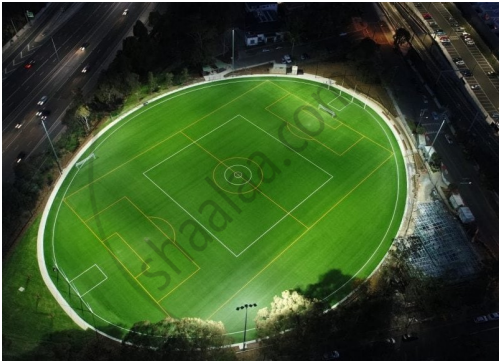
- If the length and the breadth of the rectangular field be 2x and 2y respectively, then find the area function in terms of x.
- Find the critical point of the function.
- Use First derivative Test to find the length 2x and width 2y of the soccer field (in terms of a and b) that maximize its area.
OR
Use Second Derivative Test to find the length 2x and width 2y of the soccer field (in terms of a and b) that maximize its area.
Advertisements
Solution
i.
Let (x, y) = `(x, b/a sqrt(a^2 - x^2))` be the upper right vertex of the rectangle.
The area function A = `2x xx 2 b/a sqrt(a^2 - x^2)`
= `(4b)/a x sqrt(a^2 - x^2), x ∈ (0, a)`.
ii. `(dA)/(dx) = (4b)/a [x xx (-x)/sqrt(a^2 - x^2) + sqrt(a^2 - x^2)]`
= `(4b)/a xx (a^2 - 2x^2)/sqrt(a^2 - x^2)`
= `-(4b)/a xx (2(x + a/sqrt(2)) (x - a/sqrt(2)))/sqrt(a^2 - x^2)`
`(dA)/(dx)` = 0
⇒ x = `a/sqrt(2)`
x = `a/sqrt(2)` is the critical point.
iii. For the values of x less than `a/sqrt(2)` and close to `a/sqrt(2), (dA)/(dx) > 0` and for the values of x greater than `a/sqrt(2)` and close to `a/sqrt(2), (dA)/(dx) < 0`.
Hence, by the first derivative test, there is a local maximum at the critical point x = `a/sqrt(2)`. Since there is only one critical point, therefore, the area of the soccer field is maximum at this critical point x = `a/sqrt(12)`
Thus, for maximum area of the soccer field, its length should be `asqrt(2)` and its width should be `bsqrt(2)`.
OR
A = `2x xx 2 b/a sqrt(a^2 - x^2), x ∈ (0, a)`
Squaring both sides, we get
Z = A2 = `(16b^2)/a^2 x^2(a^2 - x^2)`
= `(16b^2)/a^2 (x^2a^2 - 4x^4),x ∈ (0, a)`
A is maximum when Z is maximum.
`(dZ)/(dx) = (16b^2)/a^2 (2xa^2 - 4x^3)`
= `(32b^2)/a^2 x(a + sqrt(2)x)(a - sqrt(2)x)`
`(dZ)/(dx)` = 0
⇒ x = `a/sqrt(2)`
`(d^2Z)/(dx^2) = (32b^2)/a^2 (a^2 - 6x^2)`
`((d^2Z)/(dx^2))_(x = a/sqrt(2)) = (32b^2)/a^2 (a^2 - 3a^2)`
= –64b2 < 0
Hence, by the second derivative test, there is a local maximum value of Z at the critical point x = `a/sqrt(2)`. Since there is only one critical point, therefore, Z is maximum at x = `a/sqrt(2)`, hence, A is maximum at x = `a/sqrt(2)`.
Thus, for the maximum area of the soccer field, its length should be `asqrt(2)` and its width should be `bsqrt(2)`.
APPEARS IN
RELATED QUESTIONS
If the sum of lengths of hypotenuse and a side of a right angled triangle is given, show that area of triangle is maximum, when the angle between them is π/3.
Find the local maxima and local minima, if any, of the following function. Find also the local maximum and the local minimum values, as the case may be:
f(x) = sinx − cos x, 0 < x < 2π
Find the local maxima and local minima, if any, of the following function. Find also the local maximum and the local minimum values, as the case may be:
f(x) = x3 − 6x2 + 9x + 15
Prove that the following function do not have maxima or minima:
g(x) = logx
Show that semi-vertical angle of right circular cone of given surface area and maximum volume is `Sin^(-1) (1/3).`
A given quantity of metal is to be cast into a half cylinder with a rectangular base and semicircular ends. Show that in order that the total surface area may be minimum the ratio of the length of the cylinder to the diameter of its semi-circular ends is \[\pi : (\pi + 2)\].
Show that a cylinder of a given volume, which is open at the top, has minimum total surface area when its height is equal to the radius of its base.
The perimeter of a triangle is 10 cm. If one of the side is 4 cm. What are the other two sides of the triangle for its maximum area?
Solve the following:
A rectangular sheet of paper of fixed perimeter with the sides having their lengths in the ratio 8 : 15 converted into an open rectangular box by folding after removing the squares of equal area from all corners. If the total area of the removed squares is 100, the resulting box has maximum volume. Find the lengths of the rectangular sheet of paper.
A rectangular sheet of paper has it area 24 sq. Meters. The margin at the top and the bottom are 75 cm each and the sides 50 cm each. What are the dimensions of the paper if the area of the printed space is maximum?
The function y = 1 + sin x is maximum, when x = ______
Show that the function f(x) = 4x3 – 18x2 + 27x – 7 has neither maxima nor minima.
Let f have second derivative at c such that f′(c) = 0 and f"(c) > 0, then c is a point of ______.
Find the points of local maxima, local minima and the points of inflection of the function f(x) = x5 – 5x4 + 5x3 – 1. Also find the corresponding local maximum and local minimum values.
An open box with square base is to be made of a given quantity of cardboard of area c2. Show that the maximum volume of the box is `"c"^3/(6sqrt(3))` cubic units
The distance of that point on y = x4 + 3x2 + 2x which is nearest to the line y = 2x - 1 is ____________.
Let f(x) = 1 + 2x2 + 22x4 + …… + 210x20. Then f (x) has ____________.
A ball is thrown upward at a speed of 28 meter per second. What is the speed of ball one second before reaching maximum height? (Given that g= 10 meter per second2)
Read the following passage and answer the questions given below.
|
|

- Is the function differentiable in the interval (0, 12)? Justify your answer.
- If 6 is the critical point of the function, then find the value of the constant m.
- Find the intervals in which the function is strictly increasing/strictly decreasing.
OR
Find the points of local maximum/local minimum, if any, in the interval (0, 12) as well as the points of absolute maximum/absolute minimum in the interval [0, 12]. Also, find the corresponding local maximum/local minimum and the absolute ‘maximum/absolute minimum values of the function.
The function g(x) = `(f(x))/x`, x ≠ 0 has an extreme value when ______.
Let f(x) = (x – a)ng(x) , where g(n)(a) ≠ 0; n = 0, 1, 2, 3.... then ______.
The set of values of p for which the points of extremum of the function f(x) = x3 – 3px2 + 3(p2 – 1)x + 1 lie in the interval (–2, 4), is ______.
Let f(x) = |(x – 1)(x2 – 2x – 3)| + x – 3, x ∈ R. If m and M are respectively the number of points of local minimum and local maximum of f in the interval (0, 4), then m + M is equal to ______.
Find two numbers whose sum is 15 and when the square of one number multiplied by the cube of the other is maximum.
Sum of two numbers is 5. If the sum of the cubes of these numbers is least, then find the sum of the squares of these numbers.
Check whether the function f : R `rightarrow` R defined by f(x) = x3 + x, has any critical point/s or not ? If yes, then find the point/s.
A metal wire of 36 cm long is bent to form a rectangle. Find its dimensions when its area is maximum.
Complete the following activity to divide 84 into two parts such that the product of one part and square of the other is maximum.
Solution: Let one part be x. Then the other part is 84 - x
Letf (x) = x2 (84 - x) = 84x2 - x3
∴ f'(x) = `square`
and f''(x) = `square`
For extreme values, f'(x) = 0
∴ x = `square "or" square`
f(x) attains maximum at x = `square`
Hence, the two parts of 84 are 56 and 28.
What are the critical points obtained from \[12x(x-1)(x+2)=0\]?
For \[f(x)=3x^4+4x^3-12x^2+12\], what conclusion follows at \[x=1\]?
